TSA Digital ID: 21 States, 17 Wallets, No Guarantee
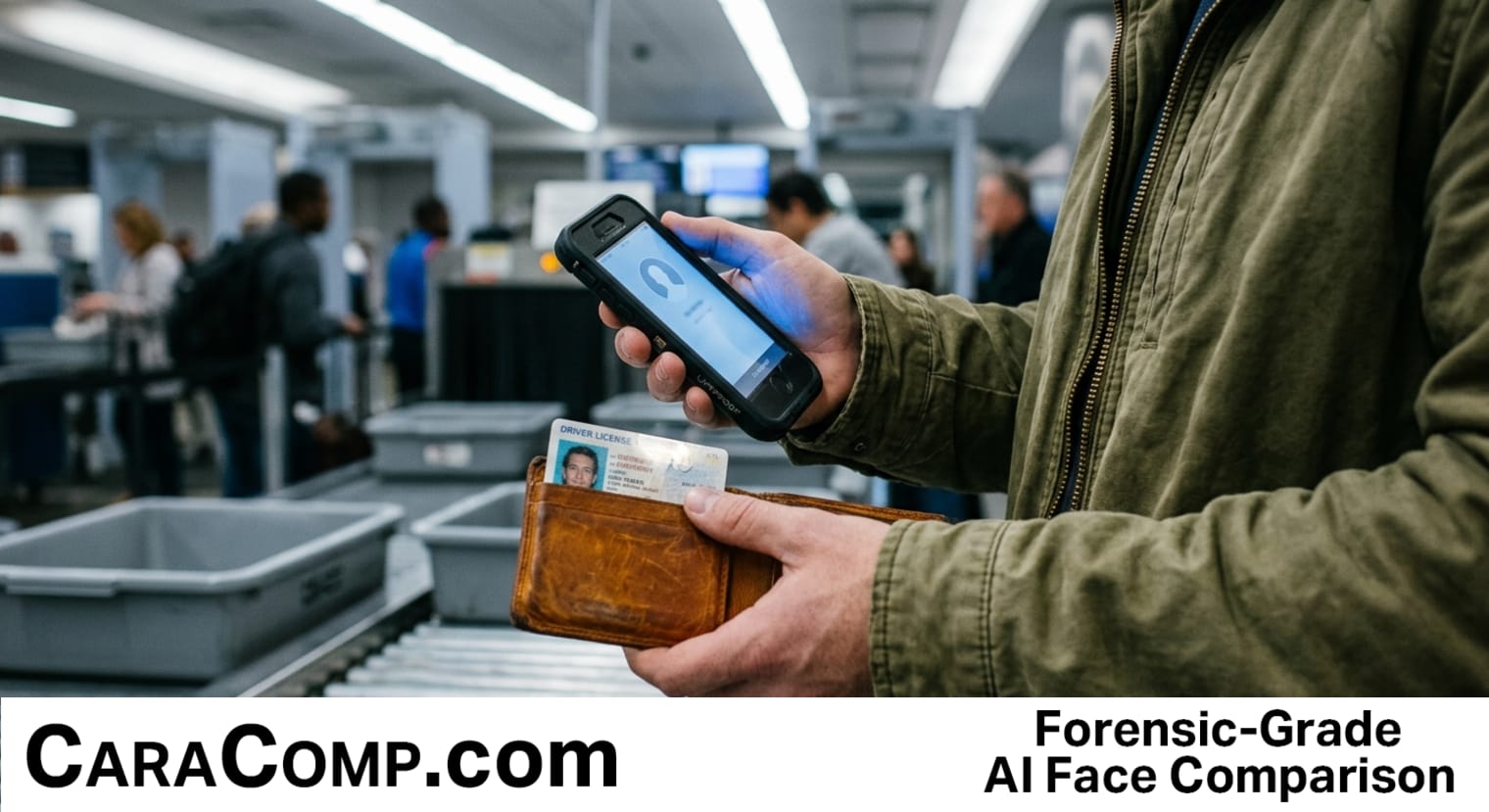
Forty-one percent of Americans can now legally load a digital driver’s license onto their smartphones, yet a staggering 93% refuse to activate it. The Transportation Security Administration’s accelerated push toward mobile credentials has exposed a chaotic reality: 21 states are currently relying on 17 mismatched digital wallet frameworks, creating an identity verification bottleneck where federal modernization ambitions clash directly with fragmented technical execution.
While travelers scramble between incompatible apps and terminal scanners, this rollout highlights an essential principle that professional investigators understand implicitly: reliable identity verification requires rigorous, standardized facial comparison methodology, not an unwieldy patchwork of disparate systems. The federal checkpoint infrastructure depends entirely on 1-to-1 facial comparison—measuring live subjects against verified reference credentials. When standardized benchmarks fail, verification collapses.
For private investigators, fraud analysts, and OSINT professionals examining identity workflows, the TSA's digital rollout delivers vital takeaways:
- Standardized 1-to-1 comparison outperforms fragmented networks: Checkpoint efficiency relies on direct facial comparison between a verified source file and the subject. Precise Euclidean distance analysis remains the gold standard for confirming identity across digital environments without relying on unreliable, unverified databases.
- Architectural fragmentation introduces critical case friction: When 21 jurisdictions deploy 17 separate credential formats, evidentiary consistency dissolves. High-stakes case analysis demands uniform, court-ready comparison methodologies rather than fragmented consumer tools.
- Facial comparison technology is becoming foundational investigative protocol: Mobile credential validation proves that biometric verification is no longer reserved for government agencies with massive budgets. Private practitioners cannot afford to waste hours manually examining photos when automated comparison software delivers definitive mathematical verification in seconds.
As state agencies struggle to build unified credential ecosystems, the private sector has already demonstrated that closing the identity verification gap requires accessible, objective, and mathematically sound tooling.
Read the full article on CaraComp: TSA Digital ID: 21 States, 17 Wallets, No Guarantee


Comments
Post a Comment