Lab Scores vs. Street Reality: What Facial Recognition Accuracy Really Means
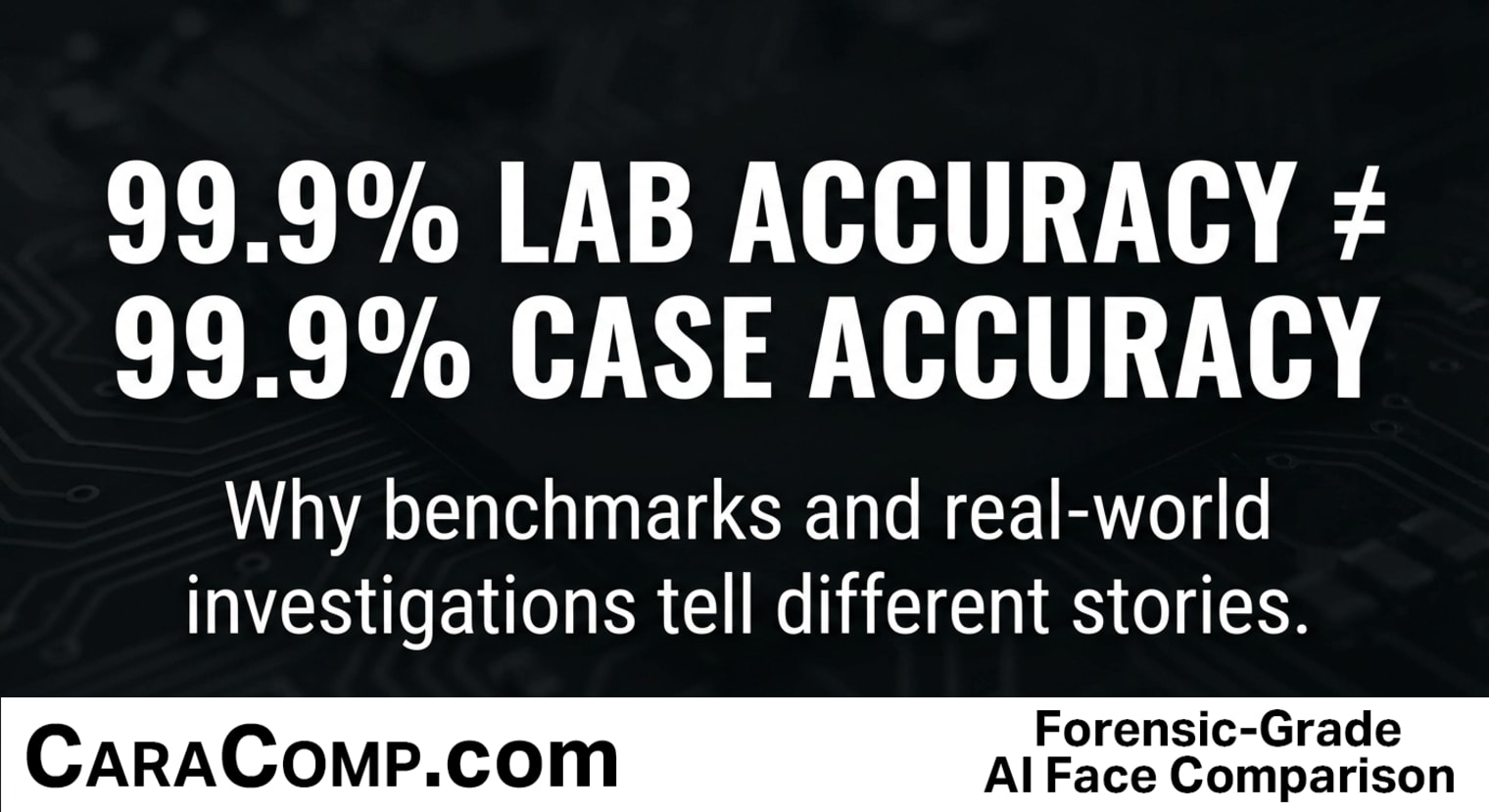
An algorithm can boast a near-perfect 99.9% accuracy rating in a controlled laboratory and still fail to identify a subject on standard 12fps CCTV footage because the mathematical "ceiling" of the software collapses when met with real-world variables. For the solo investigator, relying on these high-flying benchmark percentages without context is a recipe for missed matches or professional embarrassment. The reality is that the math behind facial comparison remains consistent, but the quality of the data fed into that math determines the reliability of your case analysis.
The latest article from CaraComp breaks down why "operational accuracy" is the only metric that matters when you are in the field. Here are the critical insights for professional investigators:
- The 15-to-25 Point "Wild" Gap: Standard benchmarks like the NIST Face Recognition Vendor Testing (FRVT) primarily measure "visa-quality" or "mugshot" imagery—controlled environments with perfect lighting and frontal poses. However, when the same algorithms are tested against "wild" imagery (unconstrained real-world captures), accuracy can plummet by 25 percentage points. This is why a tool that works in a demo might fail on your actual case photos.
- The 24-Pixel Threshold: Resolution is the silent killer of evidence. Research shows that once the inter-eye pixel distance drops below 24 pixels—a common occurrence in grainy parking lot or doorbell camera footage—accuracy degradation can exceed 50%. The software is still performing Euclidean distance analysis, but the lack of granular data means it is guessing at the architecture of the orbital region.
- Motion Blur as Structural Distortion: Algorithms do not perceive "blur" the way humans do. Instead, motion blur physically shifts the landmarks the software is trying to measure. This causes the Euclidean distance between points to change, leading the software to interpret a blurry face as having an entirely different bone structure, resulting in a false negative or a misleading confidence score.
- The Pre-Trust Checklist: Professional investigation technology requires a human gatekeeper. Before staking your reputation on a match score, you must evaluate the "four silent variables": pose angle (yaw beyond 30 degrees), image resolution, the time gap between the reference and probe images, and environmental lighting shadows.
At CaraComp, we believe solo investigators deserve the same enterprise-grade Euclidean distance analysis used by major agencies, but without the $2,000 yearly price tag. By understanding the gap between lab scores and street reality, you can use our batch processing and professional reporting tools to close cases faster and with greater technical authority.
How do you handle low-resolution captures in your investigations? Drop a comment if you've ever spent hours comparing photos manually only to realize the resolution was too low for a definitive match.
Read the full article on CaraComp: Lab Scores vs. Street Reality: What Facial Recognition Accuracy Really Means


Comments
Post a Comment