Benchmark Scores vs. Real-World Results: The Facial Recognition Gap
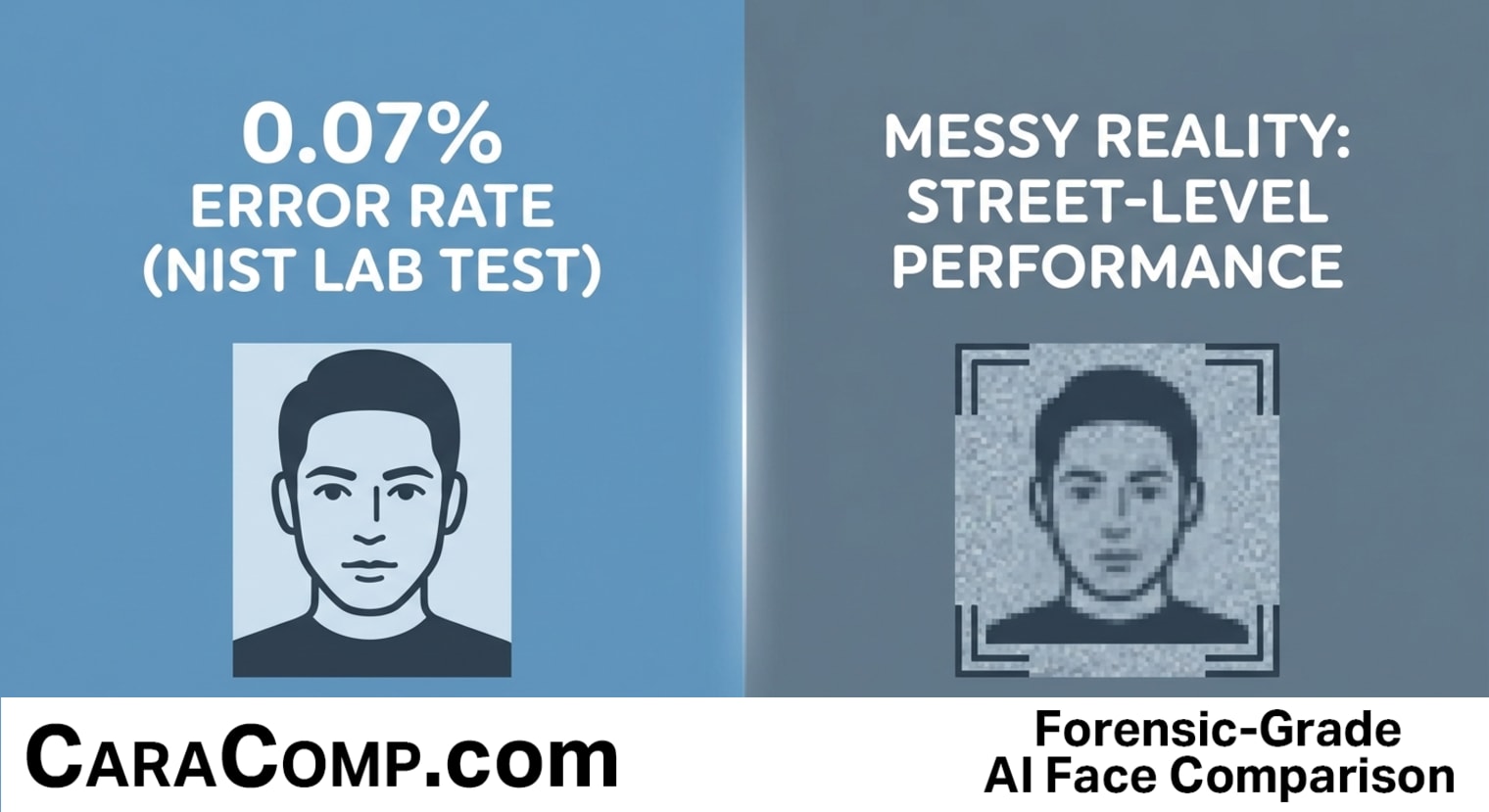
That 0.07% error rate being flaunted by enterprise biometric giants is a fantasy for the average private investigator. While laboratory benchmarks suggest facial technology has reached near-perfection, the reality on the street is far messier. If you are working with a grainy ATM still or a low-resolution social media crop, those high-flying laboratory scores are essentially meaningless.
Recent academic research from the University of Oxford has finally called out the "performance gap" that seasoned investigators have known about for years. Benchmarks like NIST evaluate algorithms using "clean" data—perfect lighting, frontal angles, and high-resolution sensors. In contrast, the field-level investigator deals with motion blur, extreme head rotation, and heavy image compression. When these variables are introduced, the "bulletproof" accuracy of enterprise tools often collapses, leaving solo practitioners to wonder why they are paying thousands of dollars for software that fails when the case gets difficult.
At CaraComp, we view this gap not as a failure of AI, but as a failure of focus. The industry has spent a decade building massive identification databases for government surveillance while ignoring the needs of the forensic investigator performing side-by-side facial comparison. For a solo PI or an OSINT researcher, the goal isn't to scan a crowd of millions; it’s to prove that the person in "Photo A" is the same person in "Photo B" using rigorous Euclidean distance analysis.
The forward-looking investigator doesn't need a lab-certified score; they need a tool that handles the "trash" footage found in real-world case files. By shifting the focus from massive search databases to precise, batch-processed facial comparison, investigators can finally access the same tech caliber as federal agencies without the $2,000-a-year price tag.
- The "Lab-to-Street" accuracy drop is real — Benchmarks measure a ceiling, not a floor. Investigators must rely on tools that provide transparent confidence scores rather than marketing-driven accuracy claims.
- Comparison beats identification for court-ready results — While consumer search tools are often unreliable and lack professional reporting, dedicated facial comparison software allows PIs to present Euclidean distance data that holds up under scrutiny.
- Accessibility is the new frontier — The era of enterprise-only tech is over. Advanced case analysis is now available for the price of a few cups of coffee, leveling the playing field for solo firms.
Read the full article on CaraComp: Benchmark Scores vs. Real-World Results: The Facial Recognition Gap


Comments
Post a Comment