Biometric Machine: Iowa Medics Get $16,510 Drug Lock
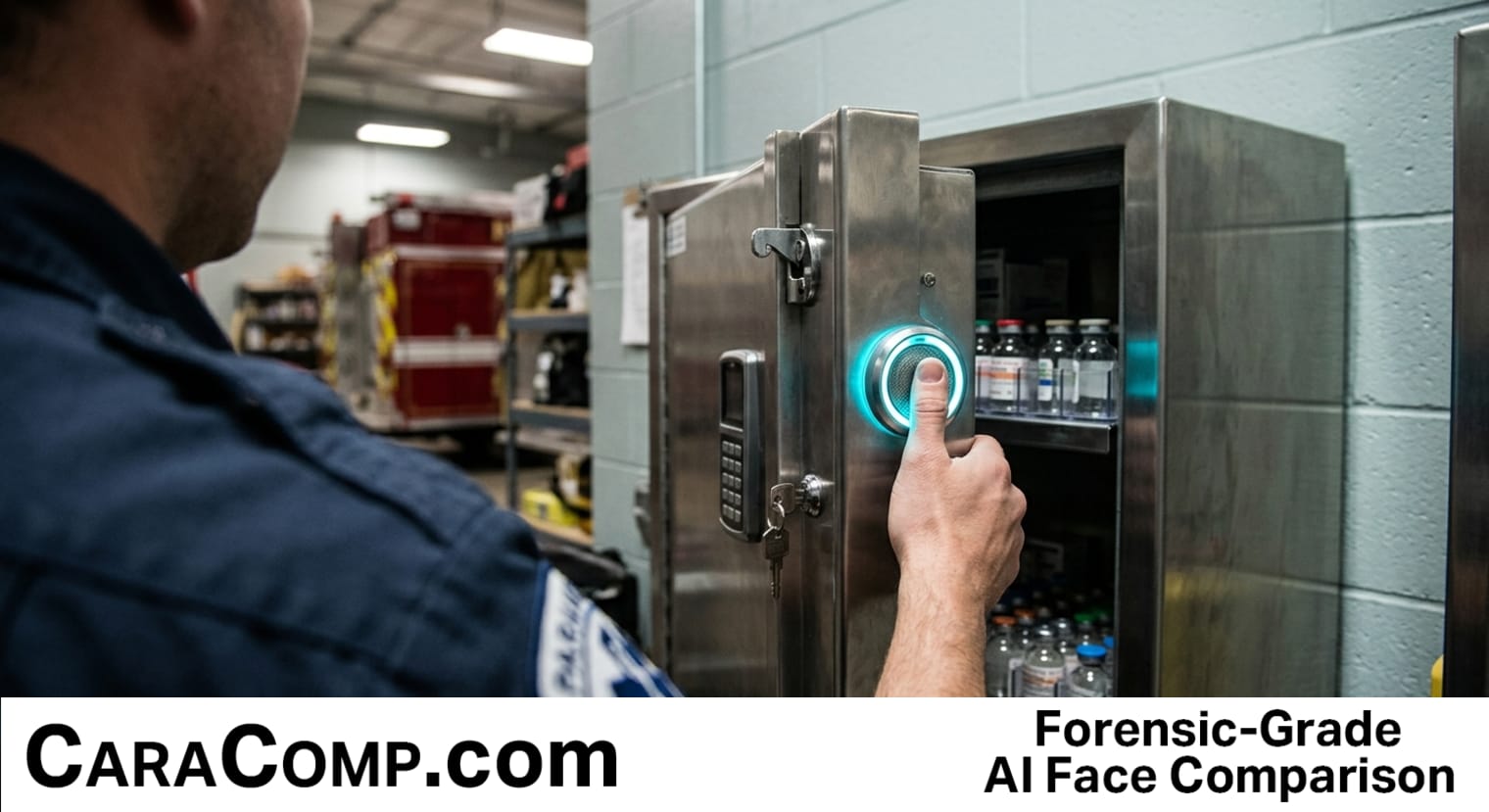
When the Johnston-Grimes Fire District in Iowa secured a $16,510 grant for a biometric drug cabinet, they proved a critical point that the investigative community needs to hear: modern biometric verification is no longer an expensive luxury—it is an operational necessity that kills the trade-off between speed and accountability.
For decades, emergency responders and fraud investigators alike were trapped in the same broken paradigm: choose fast action and compromise recordkeeping, or enforce meticulous manual logs and lose critical time. By turning a fingerprint scan into both a key and an instant, unalterable audit log, emergency medicine just leapfrogged legacy compliance methods. It provides absolute mathematical certainty in milliseconds.
This development sends a clear signal to private investigators, OSINT analysts, and SIU professionals. The exact same shift is reshaping facial comparison technology. Manual photo matching—wasting three hours squinting at case photos or relying on subjective human observation—is the investigative equivalent of a handwritten paper log on a narcotics locker. It leaves cases vulnerable to human error and cross-examination.
Here is what this biometric shift means for the investigative sector:
- Accountability requires mathematical proof: Whether verifying access to controlled substances or comparing case evidence, human verification is being replaced by mathematical templates. In investigation technology, Euclidean distance analysis provides court-ready objective data that removes subjective doubt.
- The death of enterprise exclusivity: High-stakes biometric security used to require six-figure government budgets. That barrier is crumbling, allowing smaller agencies and solo investigators to deploy identical precision tools without bloated contracts.
- Speed and legal defensibility must coexist: In active case analysis, you cannot afford to sacrifice speed for thoroughness. Advanced verification systems safeguard evidence integrity while dramatically accelerating case turnaround.
Biometric infrastructure is quietly resetting professional standards across every sector. For modern investigators, relying on outdated manual workflows is no longer just slow—it is a professional liability that clients and courts will increasingly reject.
Read the full article on CaraComp: Biometric Machine: Iowa Medics Get $16,510 Drug Lock


Comments
Post a Comment