Biometric Building Access Control: 3 Checks, Not 1
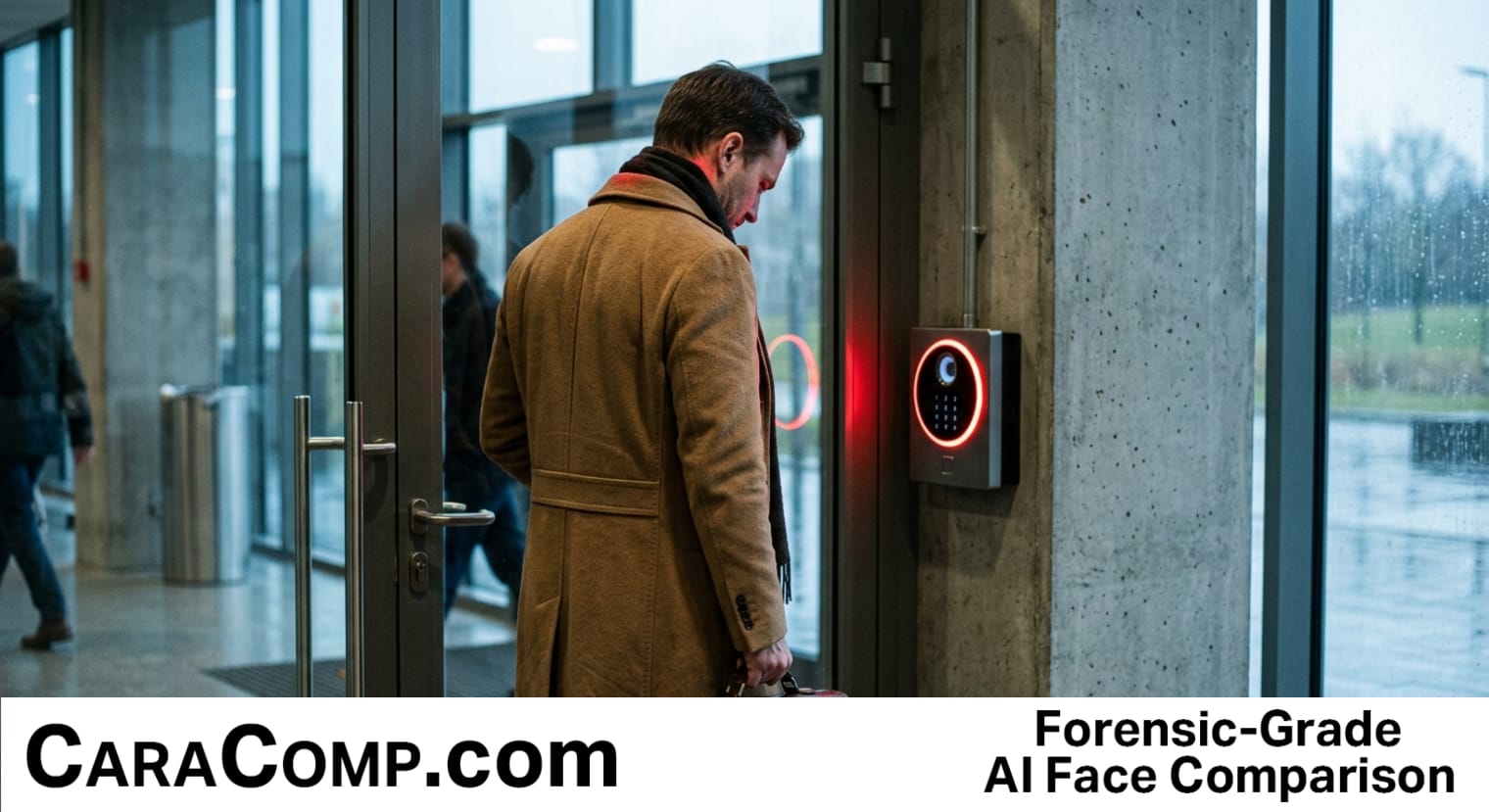
A 99.999% accurate biometric match will still let an unauthorized stranger walk through a standard 1,000-person office lobby roughly once every hundred days. Yet lawmakers and landlords in New York City are currently locked in a fierce legal battle over biometric building restrictions because both sides are fundamentally confusing visual identity with active permission.
The political fight surrounding New York’s proposed biometric legislation exposes a dangerous misconception that permeates commercial security and investigative fields alike. Building operators tout facial scanning as an infallible, frictionless master key, while privacy advocates push back with a blunt truth: you can change a compromised password, but you cannot cancel your face. The underlying flaw in this dispute is that commercial vendors have conditioned the market to believe that confirming a face template is the entire access decision.
For professional investigators and security analysts, facial comparison is an exact mathematical science designed to establish identity through Euclidean distance analysis across image data. But granting access to a physical facility or restricted zone requires two distinct database queries: confirming that an individual's enrollment remains active, and verifying their permission scope for that exact door and hour. When access systems skip those secondary checks, they turn mathematical comparison into an operational liability.
The industry must recognize several critical takeaways from this legislative showdown:
- Identity is not authorization: Algorithmic feature matching confirms who an individual is, but it never answers whether a former tenant, dismissed employee, or visitor has active clearance for a specific secure zone.
- Lazy software architecture invites regulatory bans: Single-step implementations that treat a visual match as an instant green light are fueling heavy-handed legislative crackdowns that threaten legitimate biometric verification tools.
- Multi-layered validation is non-negotiable: Modern security frameworks must decouple identity verification from access control logic, ensuring high-stakes entry decisions never depend on a single template match.
Biometric traits cannot be reissued after an operational failure. If enterprises and security professionals want to deploy biometrics responsibly without triggering public bans, they must implement rigorous, multi-step verification rather than relying on flawed all-in-one shortcuts.
Read the full article on CaraComp: Biometric Building Access Control: 3 Checks, Not 1


Comments
Post a Comment