Your Face Is About to Silently Decide Your Bank Claim, Your Job, Your Insurance
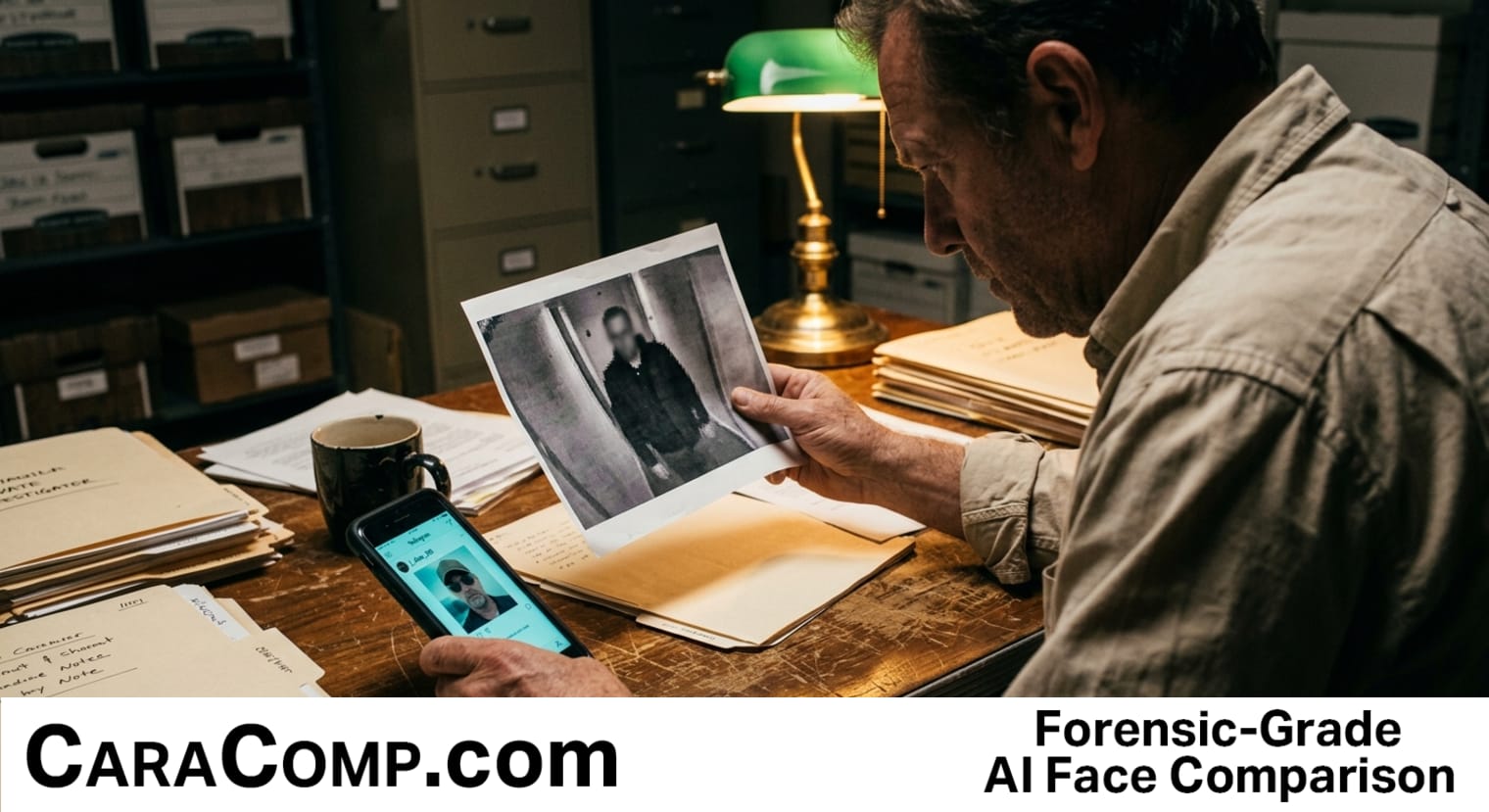
The bank already knows if you are lying about your identity before you finish your first sentence, but many solo private investigators are still squinting at blurry JPGs for three hours to make the same determination. New data from the National Institute of Standards and Technology (NIST) proves that the "accuracy gap" between elite government software and accessible tools has effectively vanished. For the modern investigator, this isn't just a tech update—it is a total shift in how we handle evidence.
When 45 out of 105 tested algorithms can hit a 99% accuracy rate, the excuse that professional facial comparison is "too expensive" or "too complex" for a small firm is dead. We are moving out of the phase where only federal agencies have the power to perform high-level Euclidean distance analysis. Today, the same math used to secure a bank claim is available to a solo PI working an insurance fraud case from a home office. If you are still relying on manual "eyeballing" to verify a subject, you aren't just being traditional; you are being negligent.
The real takeaway for the OSINT and investigative community is the distinction between mass surveillance and professional comparison. While the public frets over crowd-scanning, the real revolution is happening in one-to-one case analysis. Having the ability to batch-process photos and generate a court-ready report with a definitive similarity score is what separates the tech-savvy professional from the amateur. Clients no longer want to hear that a subject "looks similar"—they want the data that proves it.
- The democratization of high-tier biometrics means that "enterprise-grade" is now a price point, not a barrier to entry. Solo investigators can now leverage the same Euclidean distance math as federal agencies for the price of a couple of lunches.
- Manual comparison is becoming a liability. As 99% accuracy becomes the industry standard for banks and insurers, investigators who rely on "gut feeling" will find their testimony shredded by more tech-forward peers in court.
- Professional reporting is the new differentiator. The shift toward automated comparison allows investigators to spend less time on tedious manual labor and more time on high-value case strategy.
The industry is moving fast. If your toolkit doesn't include reliable, affordable comparison tech, you aren't just behind the curve—you're invisible to the clients who matter most.
Read the full article on CaraComp: Your Face Is About to Silently Decide Your Bank Claim, Your Job, Your Insurance


Comments
Post a Comment