That "Weird Fingers" Deepfake Trick? It's Why You'll Get Scammed Tonight
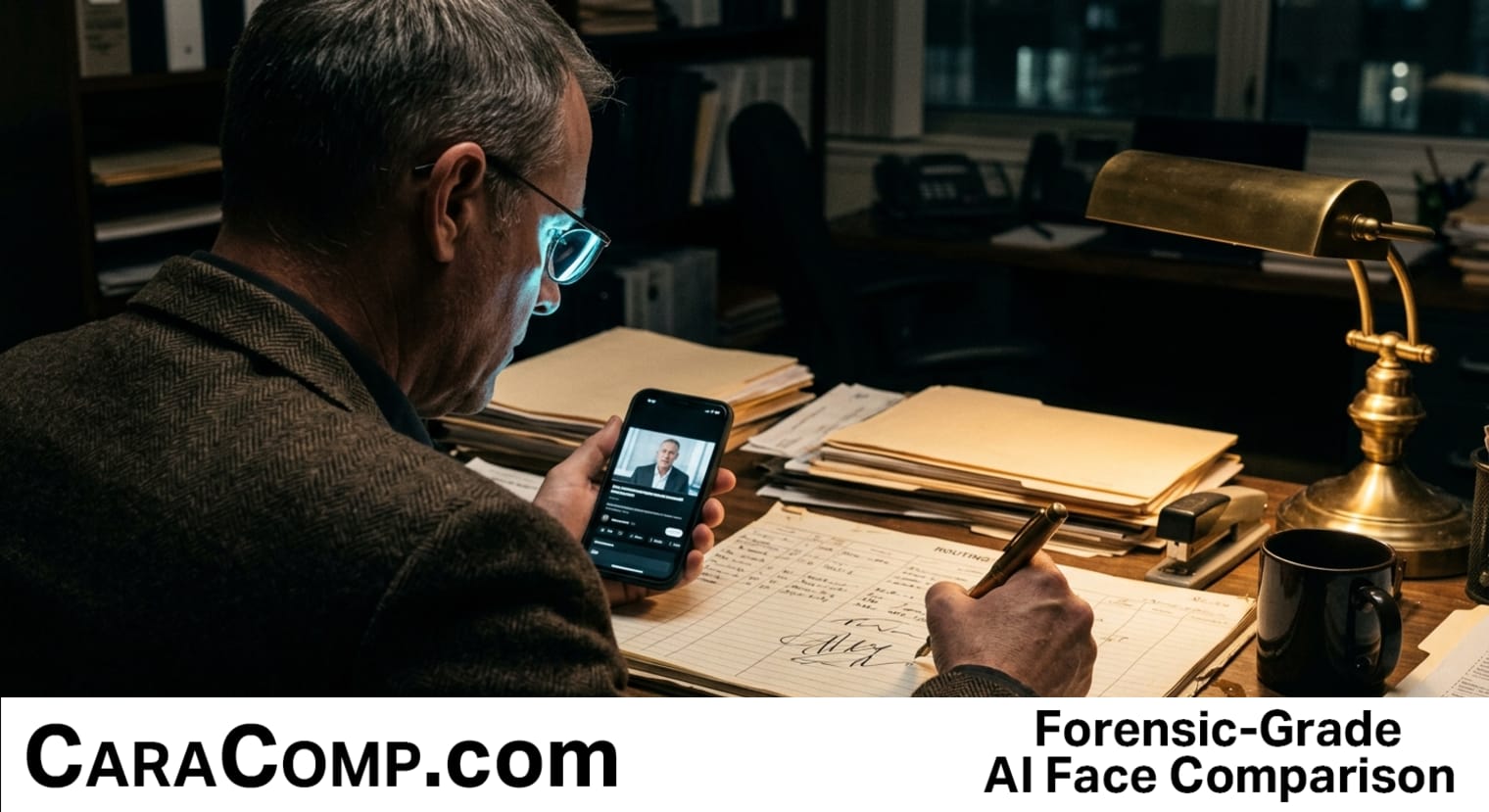
Forget the "weird fingers" trick. If your investigative strategy for 2025 involves squinting at earlobes or counting digits to spot a deepfake, you are essentially bringing a magnifying glass to a drone fight. The $200 million lost to synthetic media fraud in early 2025 didn't happen because victims were "uninformed"—it happened because AI has mastered the clean render, and our human eyes haven't caught up.
The hard truth for private investigators and OSINT professionals is that visual "tells" are a disappearing luxury. As deepfake technology matures, the glitches we used to rely on are being smoothed out by more sophisticated neural networks. Even worse, when these fakes are uploaded to social media, platform compression wipes away the forensic artifacts that high-end detection tools hunt for. If you’re relying on your "gut feeling" to authenticate a subject’s identity in a video or photo, you’re gambling with your professional reputation.
At CaraComp, we see this shifting landscape as a call to move beyond intuition and toward objective data. This is where the distinction between facial recognition and facial comparison becomes critical for the modern investigator. We aren't scanning crowds for surveillance; we are using Euclidean distance analysis to compare two distinct images. While a deepfake might look "right" to a human, the underlying geometry—the mathematical distance between facial landmarks—often tells a different story. If the measurements don't align with known samples of the subject, the "perfect" render becomes irrelevant.
The era of the "detective's hunch" regarding digital media is over. If you want to survive as a solo investigator or a small firm, you need to stop acting as a visual judge and start acting as a data analyst. Enterprise-grade comparison tech is no longer just a "nice-to-have" for federal agencies; it is the only way to verify identity in an age of synthetic deception.
- The "vibe check" is a professional liability. Human intuition is easily manipulated by photorealistic AI, making objective mathematical comparison the only reliable standard for identity verification.
- Platform compression is a forensic eraser. Because social media degrades pixel data, investigators must rely on geometric facial comparison that survives low-resolution re-encoding.
- Mathematical certainty beats visual observation. Euclidean distance analysis provides a court-ready, quantifiable metric that holds up under scrutiny where "I thought he looked real" fails.
Read the full article on CaraComp: That "Weird Fingers" Deepfake Trick? It's Why You'll Get Scammed Tonight


Comments
Post a Comment