That Voice on the Phone Isn't Your Boss — and Your Eyes Can't Save You
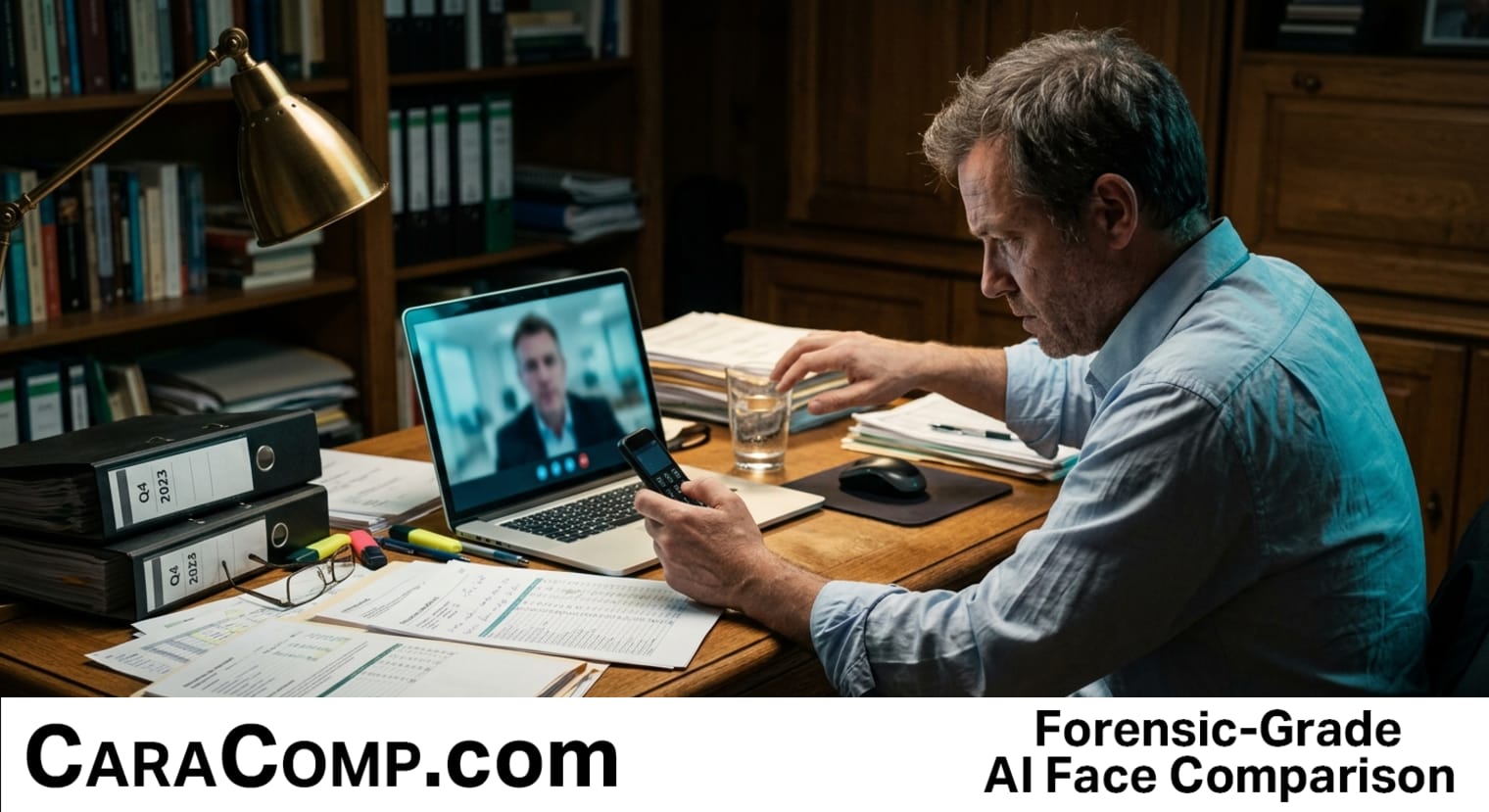
Your eyes are lying to you, and if you are a solo investigator relying on manual facial comparison, your reputation is currently on the line. A recent study found that when people were asked to identify AI-generated fakes, their accuracy rate was a dismal 21.6%. Even worse? The people who were most confident in their "sharp eyes" performed no better than those guessing at random. For the professional private investigator or OSINT researcher, this isn't just a trivia point—it’s a warning that the "naked eye" methodology is officially obsolete.
Many investigators still operate under the myth that they can accurately verify identity across case photos by simply "looking closely." They spend three or more hours squinting at pixels, convinced their intuition is a match for modern biometrics. But as the surge in deepfake phishing proves, human perception is a broken tool in an AI-driven landscape. When human detection fails at a rate of nearly 80%, staking your professional reputation on manual analysis isn't just outdated; it’s a liability that won't hold up in a modern courtroom.
This is why the industry is shifting toward Euclidean distance analysis. At CaraComp, we see this as the "second channel" of verification. Just as security drills now teach employees to pause and verify a voice through a separate channel, expert investigators must use technology to provide a mathematical baseline for their findings. It’s no longer about whether a face "looks" like your subject; it’s about whether the biometric distance between markers confirms the match with enterprise-grade precision.
- Human intuition is a professional liability: With detection rates barely beating a coin flip, relying on manual comparison leaves you open to catastrophic false positives that can ruin a case or a career.
- Scientific verification is the new industry standard: Professionalism now demands data-backed reporting. Moving from "I think this is him" to a Euclidean distance report changes the conversation with clients and legal counsel.
- The "Pause and Verify" reflex applies to photos: Just as deepfake drills train employees to slow down, batch processing tools allow investigators to step back from manual guesswork and let algorithms handle the heavy lifting of case analysis.
The safest investigator in the age of AI isn't the one with the sharpest eyes—it's the one who refuses to let intuition replace objective verification. When you provide a report to a client, they aren't paying for your gut feeling; they are paying for a level of certainty that only technology can provide. Don't let a "confident" mistake be the reason you lose your next contract.
Read the full article on CaraComp: That Voice on the Phone Isn't Your Boss — and Your Eyes Can't Save You


Comments
Post a Comment