That Doctor Selling You a Miracle Pill Online? He Never Said a Word
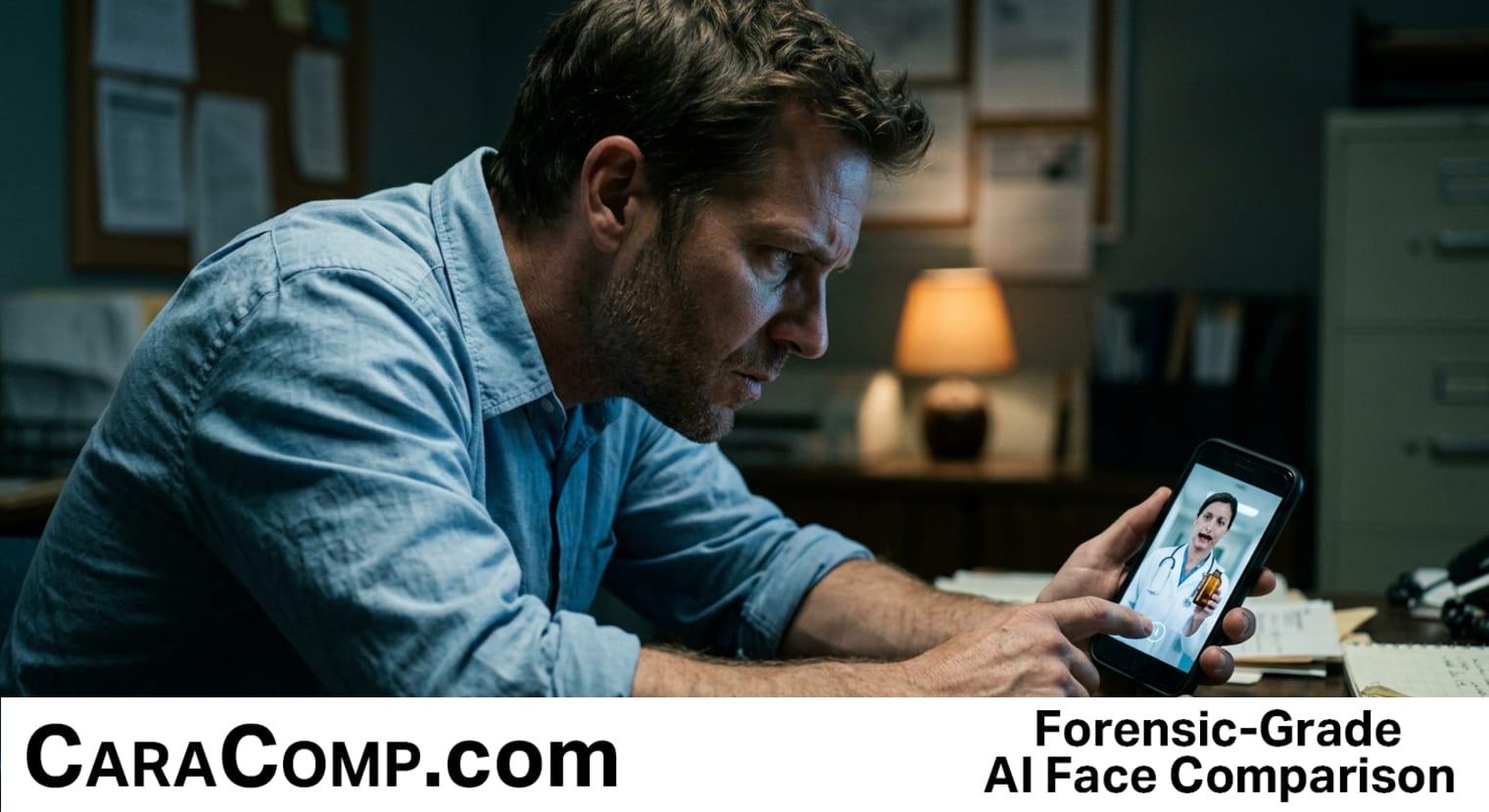
When a physician’s own family member falls for an AI-generated video and buys a counterfeit medical treatment, human visual verification is officially obsolete. Deepfaked doctors are no longer an experimental gimmick; they are an industrialized fraud model. Major European hospital networks are issuing urgent alerts after discovering their top surgeons' faces hijacked to sell unauthorized pharmaceuticals, exploiting an authority bias that bypasses even clinical professionals. Research tracking hundreds of fraudulent health campaigns reveals that roughly 72% now rely on synthetic footage, voice cloning, or stolen professional identities.
This explosion of synthetic media fundamentally changes the stakes for private investigators, insurance SIU analysts, and OSINT professionals. For decades, matching a face across suspect case media relied on manual inspection. Today, attempting to "eyeball" whether a subject in a video matches a target profile is an investigative liability. Bad actors are mass-producing synthetic personas, meaning investigators must shift from subjective observation to rigorous, mathematical facial comparison.
- Visual intuition cannot defeat synthetic generation: When deepfaked media easily tricks both the public and clinical peers, relying on manual photo comparison leaves cases vulnerable to critical errors and missed matches.
- Mathematical comparison is the new standard of evidence: Establishing whether an online persona matches a real individual requires objective Euclidean distance analysis. Benchmarking extracted suspect frames against verified identity files provides empirical certainty that holds up in court.
- Identity verification must become proactive: Fraudsters target high-stakes sectors where trust is intrinsic. Modern case analysis requires rapid, accessible comparison tools to verify or debunk digital identities before fraudulent claims cause irreparable damage.
The healthcare fraud crisis demonstrates a broader reality: visual trust is broken. As AI-generated deception scales across digital channels, investigators who still rely on manual image review will fall behind. Closing modern fraud cases demands fast, repeatable facial comparison that separates authentic subjects from synthetic impostors.
Read the full article on CaraComp: That Doctor Selling You a Miracle Pill Online? He Never Said a Word


Comments
Post a Comment