How to Detect Deepfakes: People Miss 75% of Fake Videos
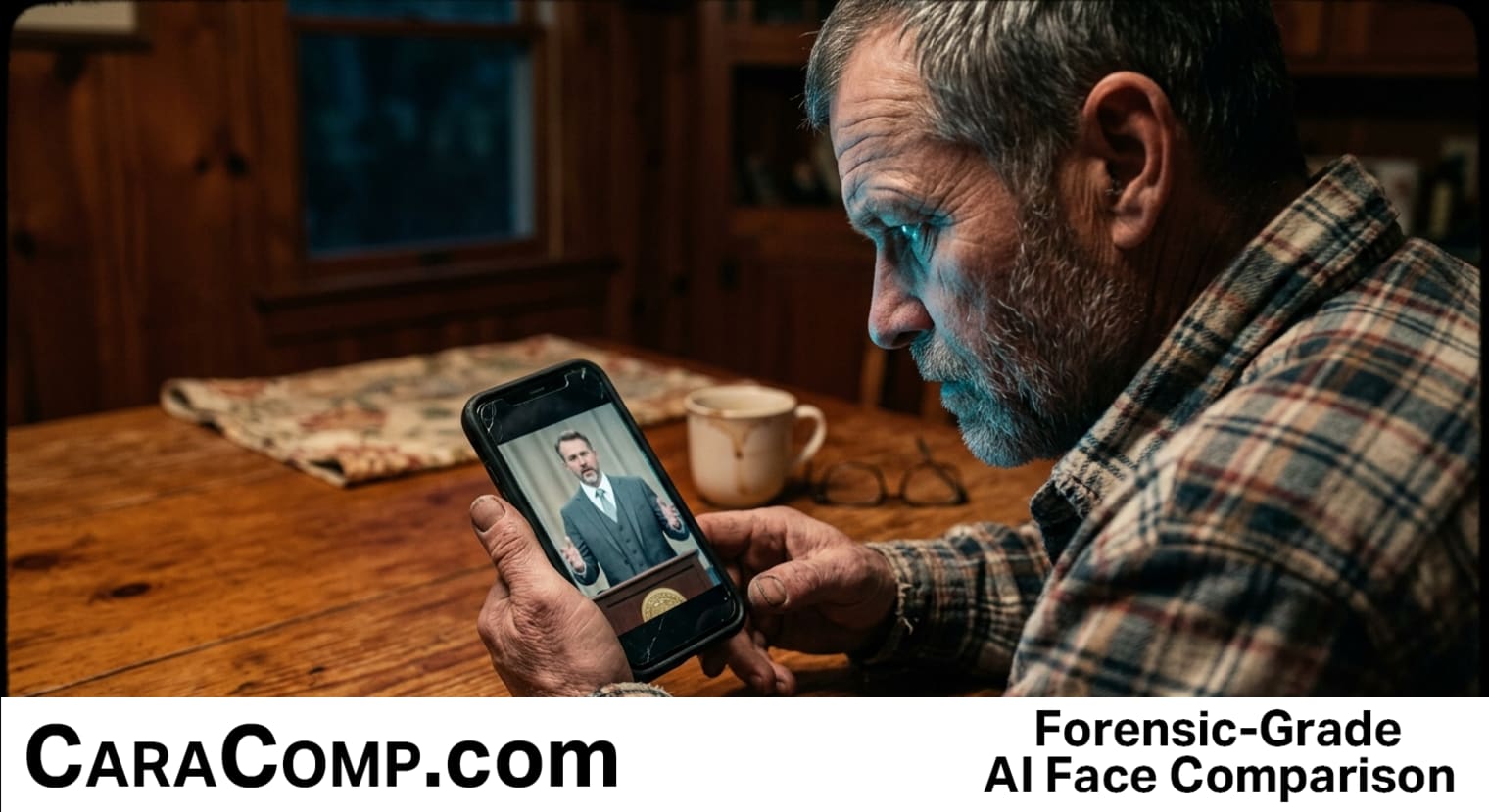
When a central bank governor has to repeatedly take to the airwaves just to prove he was not in a brawl or shilling fraudulent investment schemes, the reality facing the investigation sector is unmistakable: relying on the naked eye is now an operational liability. Synthetic media has reached an inflection point where criminal syndicates can turn thirty seconds of public audio and a handful of press photos into multi-million-dollar fraud operations.
Controlled research reveals a harsh truth for investigators: people fail to detect deepfake videos roughly 75% of the time. Three out of four synthetic assets slip right past human visual scrutiny undetected. Yet, while bad actors deploy automated generative tools to forge trusted authority figures, private investigators, fraud analysts, and OSINT researchers are often still expected to evaluate visual evidence through manual, subjective comparison.
This technical asymmetry cannot hold. In an investigative environment increasingly polluted by synthetic media and fabricated faces, relying on unassisted visual observation is an open invitation for missed matches and flawed case files. Defending client interests requires objective, mathematical verification rather than human guesswork.
The core implications for investigators and digital evidence specialists are clear:
- The collapse of manual visual review: With human observers missing 75% of deepfakes, manual photo-matching is no longer defensible in professional case analysis. High-stakes investigations require objective metrics to confirm or exclude identities.
- Authority bias as a primary attack vector: Fraud syndicates are moving past anonymous fake profiles to clone recognizable leaders, exploiting pre-established credibility and demanding rapid, reliable facial comparison to separate real records from fabrications.
- The necessity of mathematical precision: Countering sophisticated image manipulation demands rigorous investigation technology—specifically Euclidean distance analysis—that generates verifiable, court-ready reporting without requiring bloated enterprise budgets.
As synthetic media continues to blur the line between authentic evidence and calculated forgery, successful investigators will be those who abandon manual guesswork in favor of precise, automated facial comparison methodology.
Read the full article on CaraComp: How to Detect Deepfakes: People Miss 75% of Fake Videos


Comments
Post a Comment