Europe Now Scans Your Face at the Border — and Keeps It for 3 Years
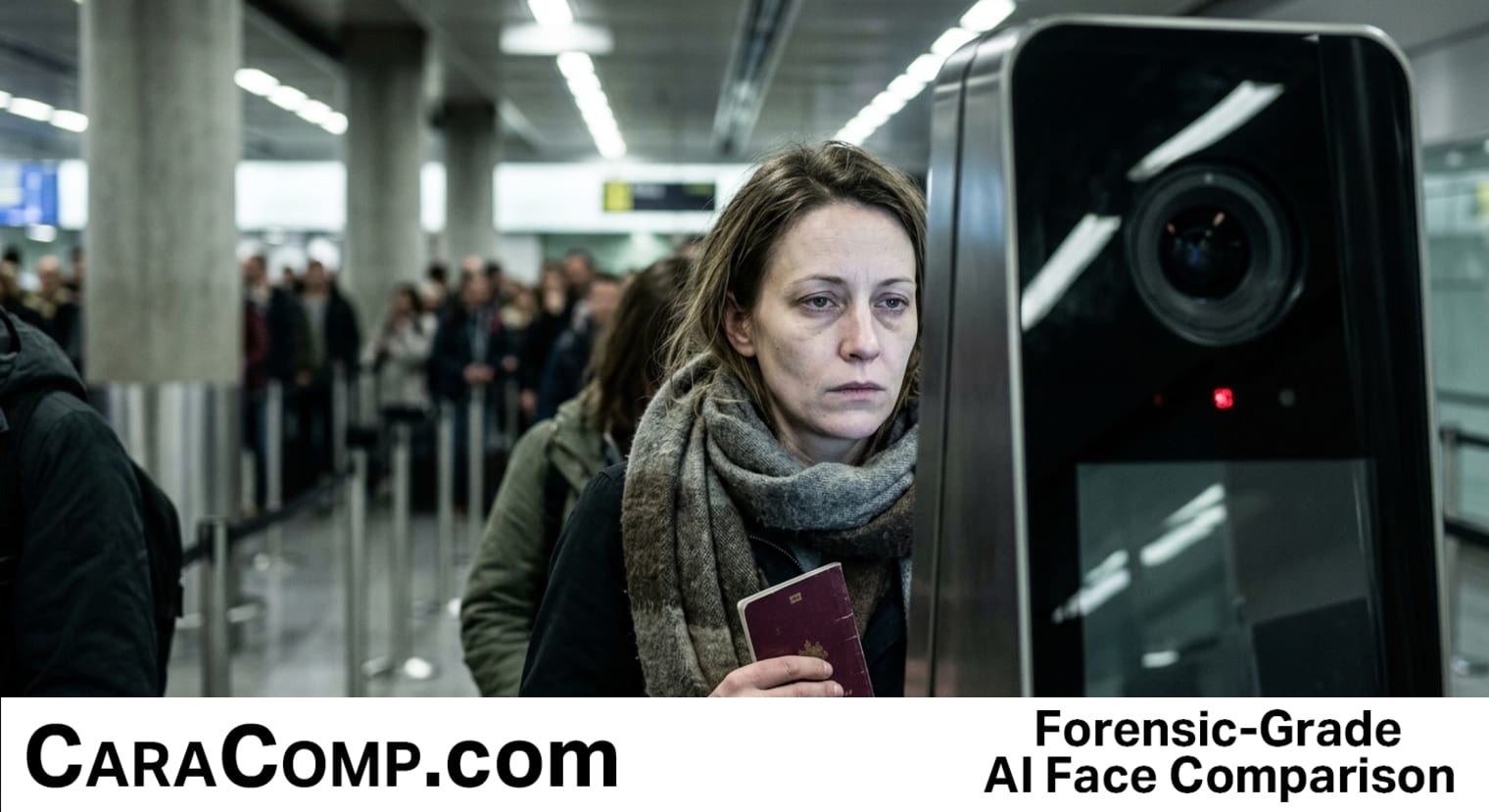
Thirty-two thousand people turned away at the border is more than just a travel statistic; it is a warning shot for every investigator who relies on automated systems to verify identity. Europe’s Entry/Exit System (EES) has officially gone live, processing 66 million crossings with a mandate to capture facial biometrics and store them for three years. While the EU frames this as a security upgrade, the reality on the ground—three-hour queues and "system-off" manual overrides—reveals a massive gap between enterprise promises and field-level reliability.
For those of us in the OSINT and private investigation world, this rollout is a case study in the difference between mass surveillance and precise facial comparison. The EU claims to use "one-to-one" verification, matching a live face to a stored document. This is exactly the type of Euclidean distance analysis we use to close fraud cases or identify subjects in the field. However, when billion-dollar government systems struggle with algorithmic bias and false positives, it reinforces why solo investigators cannot simply trust "black box" consumer tools or overpriced enterprise contracts that offer no transparency.
The industry is hitting a crossroads. We are seeing facial comparison shift from a "luxury" intelligence asset to a baseline requirement for border security and legal evidence. If you aren't using professional-grade comparison tech to verify your subjects, you aren't just behind the curve—you’re risking a "32,000-person error" of your own. You need tools that provide the same mathematical rigor as these border systems but without the bloated costs and privacy nightmares associated with mass data retention.
- Professional facial comparison is now a global standard: As biometrics become the primary "passport" for international travel, investigators must adopt court-ready comparison tools to maintain credibility with clients.
- Reliability over Reach: The EES failures prove that even the most expensive systems can buckle. Small firms need accessible, high-precision Euclidean analysis to verify matches without the "false positive" risks inherent in low-grade consumer apps.
- The "Comparison vs. Surveillance" distinction is vital: Ethical investigators focus on comparing specific case photos rather than scanning crowds, a methodology that avoids the regulatory heat currently hitting large-scale government databases.
The EES rollout proves that facial data is the new currency of identity. For the sharp investigator, the goal isn't to build a three-year database, but to use that same technology to get a definitive match and close the case today.
Read the full article on CaraComp: Europe Now Scans Your Face at the Border — and Keeps It for 3 Years


Comments
Post a Comment