Biometric Login: AI Rebuilds Fingerprints From One Photo
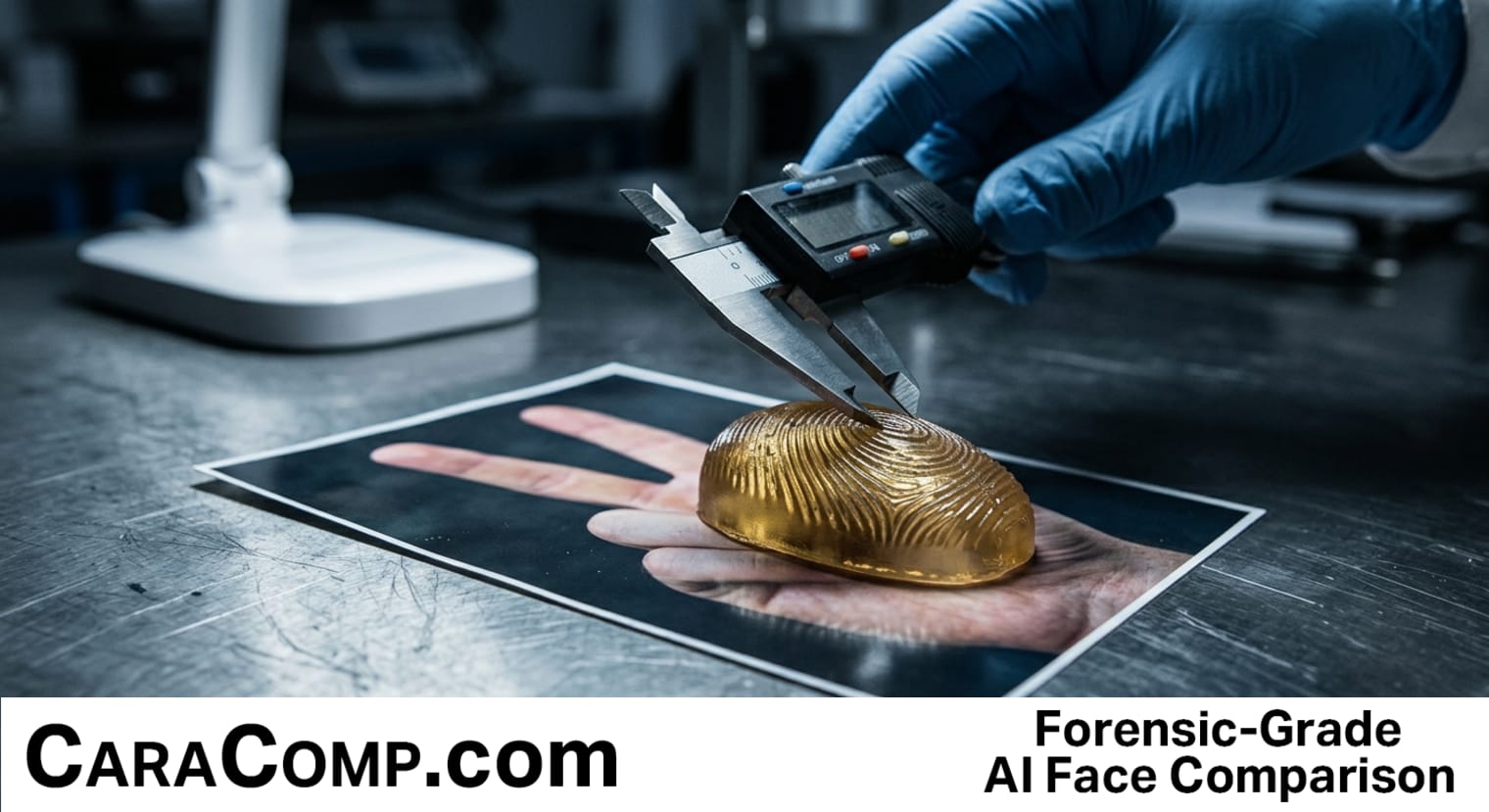
Flashing a casual peace sign in a photo within five feet of a smartphone lens is now enough for AI to reconstruct your physical 3D fingerprint. Security researchers confirmed what forensic specialists have long warned: off-the-shelf AI upscaling and computer vision tools can extract, sharpen, and model microscopic ridge patterns directly from standard social media snapshots. Biometric secrecy is officially dead.
For private investigators, OSINT professionals, and intelligence analysts, this technical milestone confirms a critical operational shift. Physical biometric traits can no longer be treated like private cryptographic keys. Your face, irises, and now fingertips are routinely documented across high-resolution digital environments. When a clear image provides enough geometric data to reconstruct a physical print, relying on casual visual inspection in modern investigations becomes an indefensible liability.
The breakthrough underscores the true power of mathematical measurement over human intuition. Whether resolving fine ridge geometry or executing rigorous Euclidean distance analysis across facial landmarks, modern investigation technology treats photographic evidence as structured datasets rather than static pictures. As consumer-grade AI makes trait reconstruction easier, the burden falls on professional investigators to adopt defensible, scientifically backed analytical workflows.
Here is what this biometric evolution means for the investigative industry:
- Biometric data is permanently public: High-resolution case photography exposes irrevocable physical markers. Investigators must understand that static physical traits will inevitably be captured, making structured verification protocols and multi-layered analysis non-negotiable.
- Forensic-level extraction is now democratized: Capabilities that previously required specialized forensic hardware are now accessible via algorithmic software, drastically lowering the barrier to deep digital photo analysis across case files.
- Objective measurement replaces guesswork: As AI tools advance, manual photo comparison fails to meet evidentiary standards. Investigators need precise, reproducible comparison methodologies that quantify structural variance and produce court-ready results.
Investigators who recognize that photographic evidence is pure spatial data are closing cases faster and presenting unshakeable findings. The technology has evolved—your investigative methodology must evolve with it.
Read the full article on CaraComp: Biometric Login: AI Rebuilds Fingerprints From One Photo


Comments
Post a Comment