Your Watch Says 110 BPM. Should You Panic? Depends on One Thing.
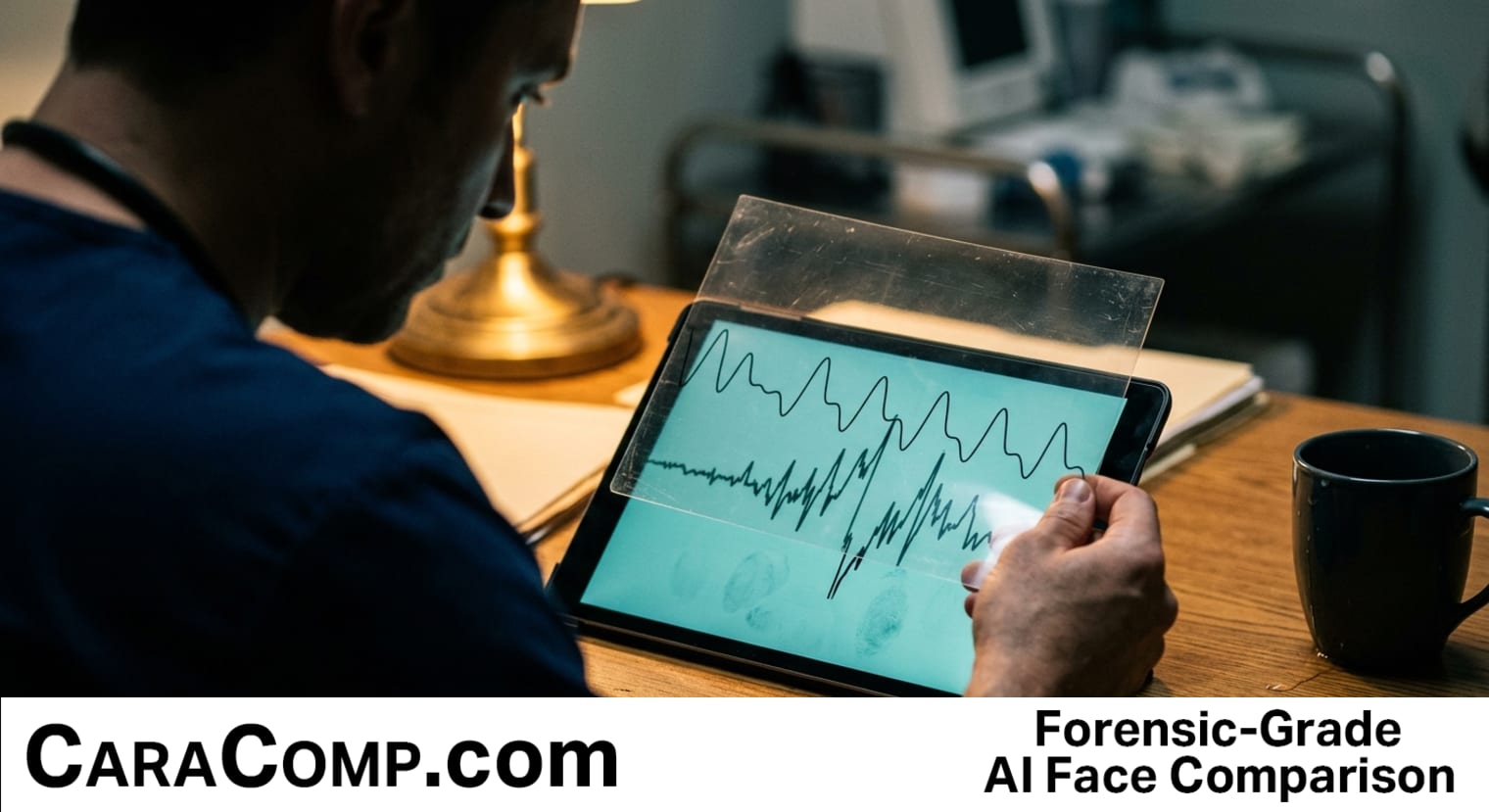
A heart rate of 110 BPM is either a sign of an impending medical emergency or a perfectly normal response to a brisk walk—the number itself is utterly useless without a baseline. This "baseline problem" is currently haunting the biometric industry, proving that data without personal context isn't just unhelpful; it’s dangerously misleading. For the private investigator or OSINT professional, this isn't just a health tech debate—it’s a fundamental lesson in how to build a case that actually holds up under scrutiny.
The same fallacy that causes "wearable panic" plagues the investigative world. When you rely on low-grade consumer facial search tools, you are essentially comparing a subject against a noisy population average. You get a "match score" that looks impressive but lacks the mathematical rigor required for a courtroom or a high-stakes insurance fraud report. Real investigative clarity doesn't come from scanning the world; it comes from the precise Euclidean distance analysis between two specific data points: your subject and your evidence.
At CaraComp, we see the industry shifting away from broad-spectrum surveillance and toward targeted facial comparison. Just as a cardiologist cares more about your personal resting heart rate than a national average, a sharp investigator cares about the specific biometric markers that link a claimant to a social media profile. The "noise" of population-wide data is being replaced by the "signal" of side-by-side, case-specific analysis. This is why enterprise-grade tools have historically been so expensive—they prioritize the baseline over the crowd.
- The baseline is the only metric that matters: Whether it’s heartbeats or facial geometry, a data point is only "abnormal" or "matching" when compared against a known, stable reference.
- Reliability requires 1-to-1 precision: Moving away from generic search results toward mathematical Euclidean distance analysis is the difference between a "guess" and a professional investigative finding.
- Technology is closing the "Enterprise Gap": The high-level biometric analysis once reserved for federal agencies is now accessible to solo PIs, allowing them to provide court-ready reporting without the five-figure price tag.
Investigators who continue to rely on manual "eye-balling" or unreliable consumer apps are essentially checking a pulse with their thumb—it’s better than nothing, but it won’t stand up when the pressure is on. The future of the field belongs to those who embrace tools that provide professional-grade baselines at a fraction of the traditional cost.
Read the full article on CaraComp: Your Watch Says 110 BPM. Should You Panic? Depends on One Thing.


Comments
Post a Comment