Your Kid's Face Unlocks the Vending Machine. A Stranger's Rules Decide What They Eat.
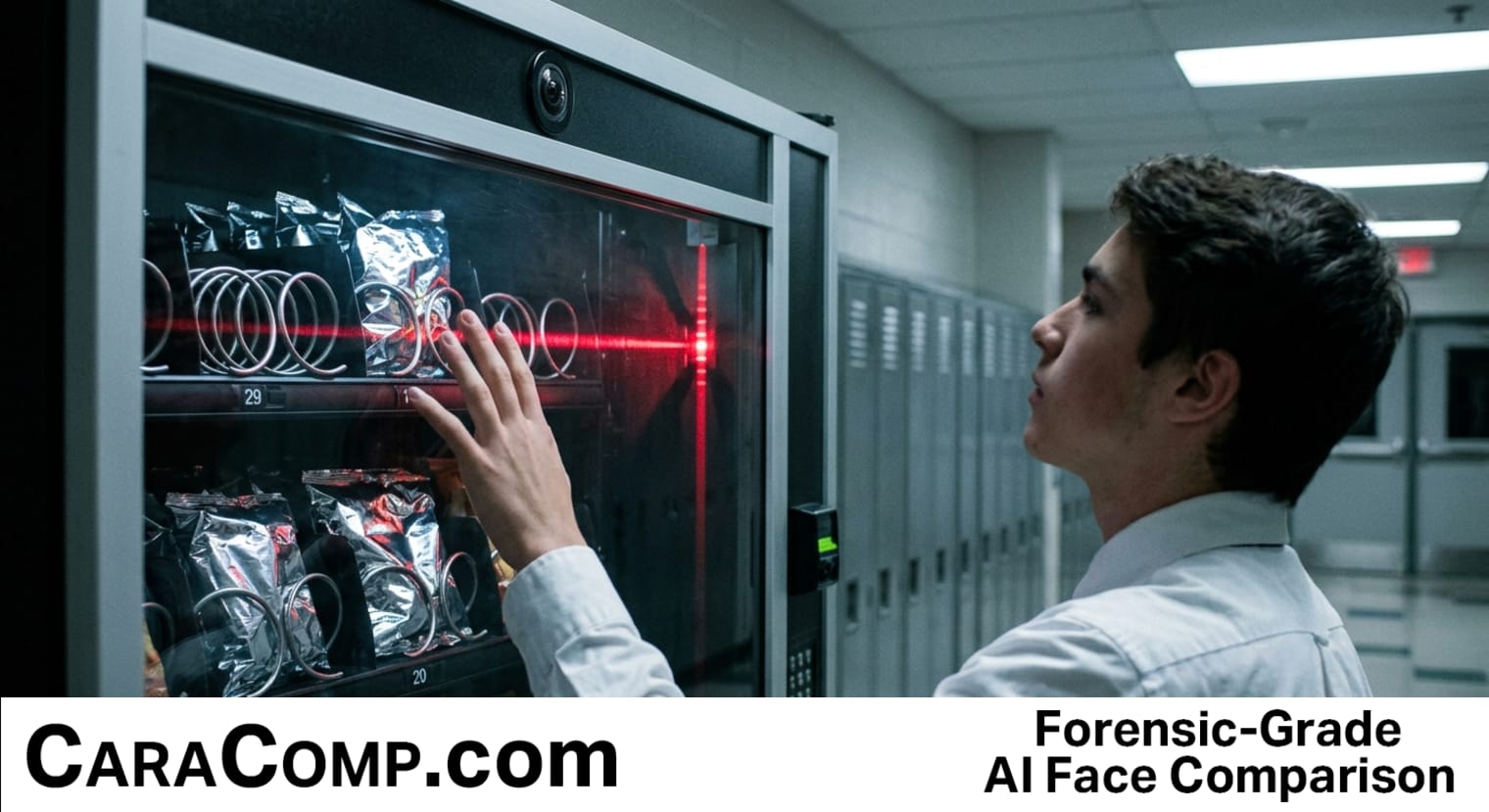
The vending machine knew exactly who the student was—and it still refused to give them the chips. In a recent pilot in the UAE, school vending machines successfully blocked over 200 snack purchases not because of a technical glitch, but because the face match worked perfectly. The machine identified the student, checked their dietary "rules," and issued a hard denial. This is the provocative reality of modern biometrics: the match is just the beginning of the chain.
For investigators and OSINT professionals, this story isn't about snacks; it’s about the professionalization of facial comparison. Most laypeople view facial recognition as a "yes/no" magic trick. In the industry, we know better. We know that the real work happens when a camera converts a face into a biometric template—a string of numbers—and uses Euclidean distance analysis to measure the gap between that live scan and a stored record. It is pure math, not magic, and it is exactly what allows for the kind of precision that stands up in a professional case report.
At CaraComp, we see this as a turning point for the solo investigator. For years, this level of Euclidean analysis was locked behind enterprise contracts and five-figure government budgets. Now, the same logic that prevents a child with a nut allergy from buying the wrong granola bar is available to PIs and fraud researchers. If a vending machine can cross-reference identity against complex rules in milliseconds, why are investigators still spending three hours manually comparing ears and nose shapes across grainy photos?
- The "Match" is a Lookup, Not a Result: A successful facial comparison is simply the key that unlocks a data profile. In an investigation, the math provides the "who," but the investigator provides the "so what."
- Euclidean Distance is the Professional Standard: Professional-grade comparison relies on mathematical distance between facial landmarks. If your tools aren't providing this level of analysis, you aren't doing investigative work—you're guessing.
- Automation is No Longer Optional: The speed of these UAE machines proves that batch processing and real-time comparison are the new baseline. Manual side-by-side comparison is a relic that costs you billable hours and case accuracy.
The gap between "it looks like him" and "the math proves it's him" is where reputations are made. It’s time to stop relying on unreliable consumer tools and start using enterprise-grade comparison logic that actually closes cases.
Read the full article on CaraComp: Your Kid's Face Unlocks the Vending Machine. A Stranger's Rules Decide What They Eat.


Comments
Post a Comment