Your Kid Just Beat the Internet's Age Check With a Fake Moustache
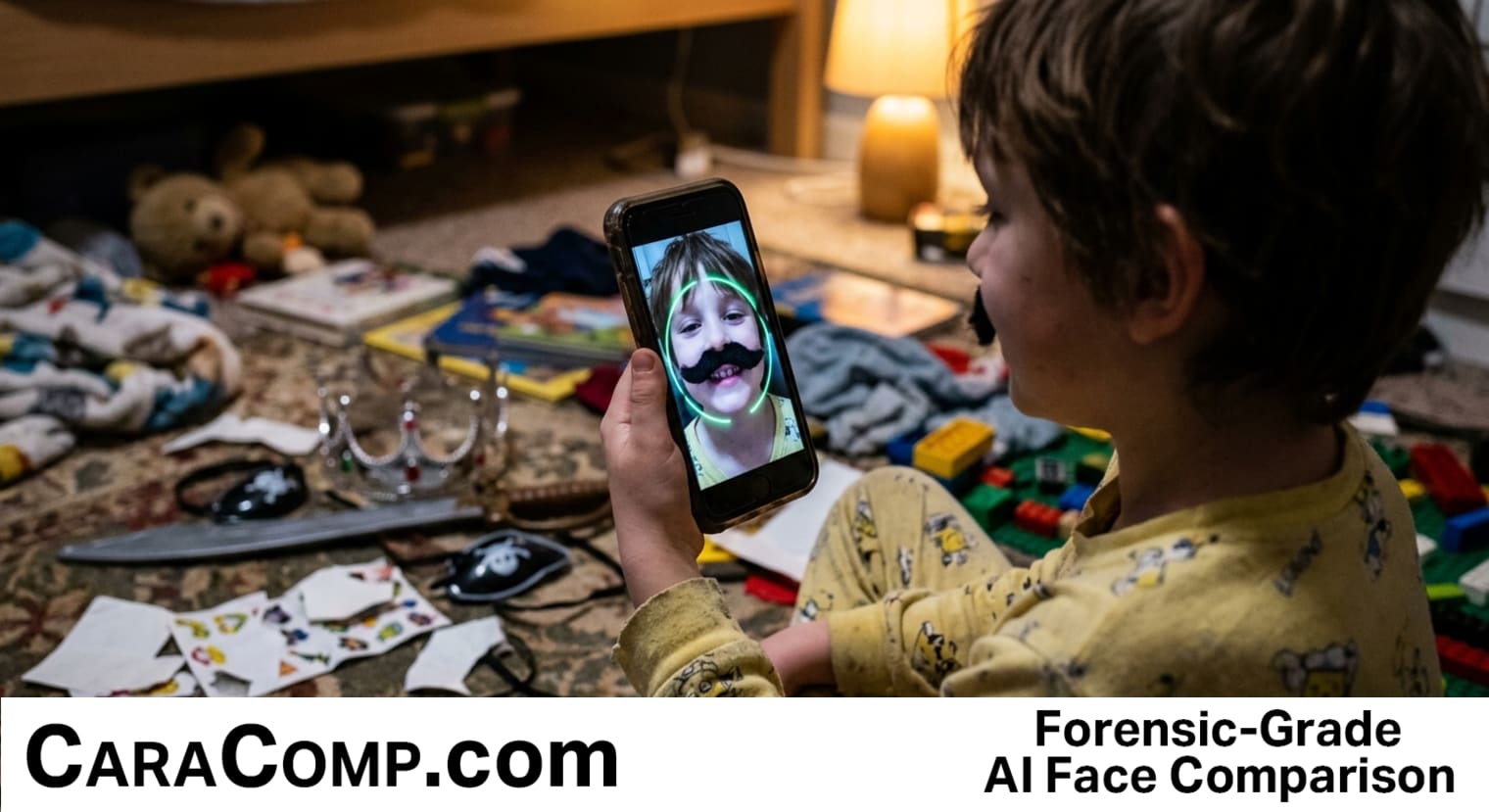
A 12-year-old with an eyebrow pencil and a fake moustache has more power than a billion-dollar tech company’s security gate. This isn’t a hypothetical security flaw; it’s the current reality of online age verification. When a middle-schooler can bypass "sophisticated" facial analysis by raiding a costume box, it exposes a massive credibility gap in how we deploy biometric technology.
The core of the problem lies in the distinction between facial estimation and professional facial comparison. Most platforms are currently using estimation—a visual "best guess" based on patterns like jawline definition or skin texture. It’s essentially an AI vibe check. For an investigator, relying on this kind of guesswork is a professional liability. If a system can be fooled by a pencil-drawn moustache, it certainly can’t be trusted to provide court-ready evidence in a high-stakes insurance fraud or missing persons case.
In the world of OSINT and private investigation, we don't have the luxury of "guessing." We need Euclidean distance analysis—the same mathematical rigor used by federal agencies to compare two faces and determine a match based on anatomical reality, not superficial patterns. While social media giants are busy getting outsmarted by 7th graders, serious investigators are shifting toward tools that prioritize comparison over surveillance.
The rise of "adversarial adaptation"—where kids use AI-aged selfies and VPNs to circumvent gates—proves that the "black box" approach to AI is failing. Professional investigators need transparency. They need a tool that doesn't just give a thumbs up or down, but provides a detailed analysis that holds up under scrutiny. This news is a wake-up call: the gap between "consumer-grade" facial tools and professional investigative technology has never been wider.
- The Estimation Trap: Visual "guessing" software is a liability shield for corporations, not a security tool for professionals. True investigation requires mathematical comparison, not probabilistic patterns.
- Adversarial Adaptation is Here: As "life hacks" to fool AI circulate on TikTok, investigators must use enterprise-grade Euclidean distance analysis to ensure their matches are spoof-proof.
- Courtroom Credibility: Relying on unreliable, consumer-facing biometric "guesses" will eventually lead to tossed evidence. Professional reporting is the only way to maintain a tech-savvy edge.
Read the full article on CaraComp: Your Kid Just Beat the Internet's Age Check With a Fake Moustache


Comments
Post a Comment