Why Your Phone Won't Unlock With Wet Hands — And What Airports Know That Your Bank Doesn't
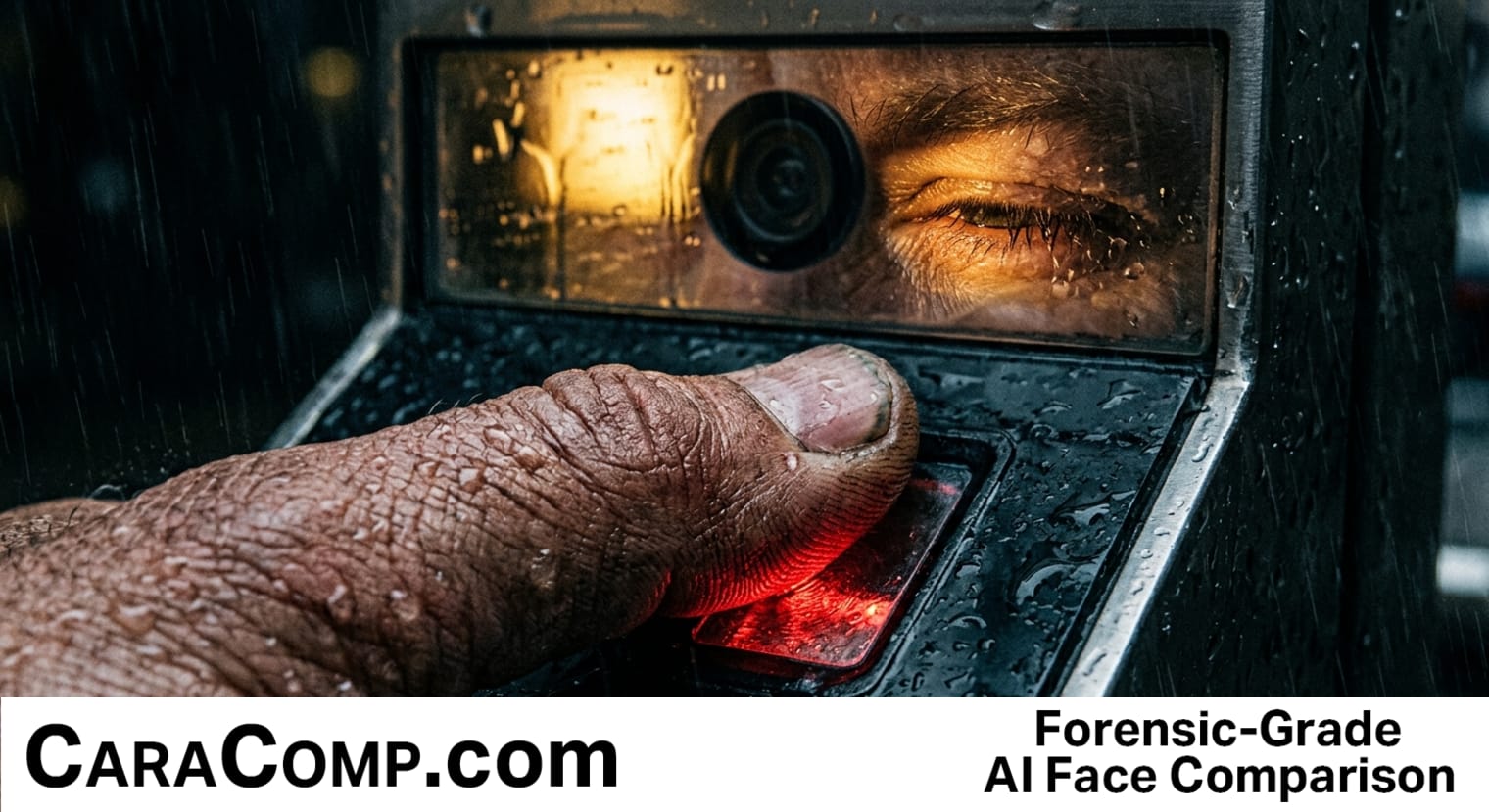
A wet thumb is a minor inconvenience for a smartphone user, but for a professional investigator, a biometric failure is a blown lead. While the tech world debates whether iris scanning or fingerprinting is the "superior" biometric, they are missing the point that actually matters for field work: every biometric is only as good as the raw data you can extract from it. For years, the gold standard of identity verification—iris recognition—has been locked behind a five-figure paywall, leaving solo private investigators and small firms to rely on manual, error-prone methods or unreliable consumer-grade tools.
The reality is that iris recognition is statistically 12 times more accurate than fingerprints, yet it fails for the exact same reason a bad facial comparison does: poor image quality. When an e-gate at the airport fails to read your eye, it isn't because your biology changed; it's because the sensor couldn't handle the noise. This is the same hurdle investigators face when trying to match a subject across grainy surveillance footage or social media photos. The industry is finally waking up to the fact that you don't need a government-sized budget to access high-level mathematical analysis; you just need the right Euclidean distance algorithms to make sense of the pixels.
At CaraComp, we see this shift as a massive equalizer. For too long, "enterprise-grade" analysis was synonymous with "unaffordable." By focusing on facial comparison—the side-by-side mathematical analysis of two distinct images—we are giving investigators the same depth of data that iris scanners provide, but without the need for specialized infrared hardware. We are moving toward a future where the "correct" biometric isn't a choice between a finger or an eye, but rather the ability to turn any visual evidence into a court-ready report.
- Methodology over Hardware: The shift from physical sensors (fingerprints) to image-based analysis means investigators can now perform high-stakes comparisons using nothing but a standard high-resolution photo and Euclidean distance analysis.
- Accuracy vs. Accessibility: While iris scanning offers 1-in-1.2 million accuracy, its high cost has created a "security gap." Advanced facial comparison software is bridging this gap, offering comparable reliability for case analysis at a fraction of the traditional cost.
- The End of Manual Comparison: As biometric systems become more layered, the expectation for investigators to provide "expert" visual testimony is rising. Manual "eyeballing" is no longer a defensible investigative standard when affordable, automated comparison tools exist.
The industry isn't just getting faster; it’s getting more precise. Whether it’s an iris, a fingerprint, or a face, the goal remains the same: definitive identification that holds up under scrutiny. For the solo PI, the era of choosing between "affordable" and "reliable" is officially over.
Read the full article on CaraComp: Why Your Phone Won't Unlock With Wet Hands — And What Airports Know That Your Bank Doesn't


Comments
Post a Comment