The Stranger Next to You Is Wearing a Camera — and It Knows Your Address
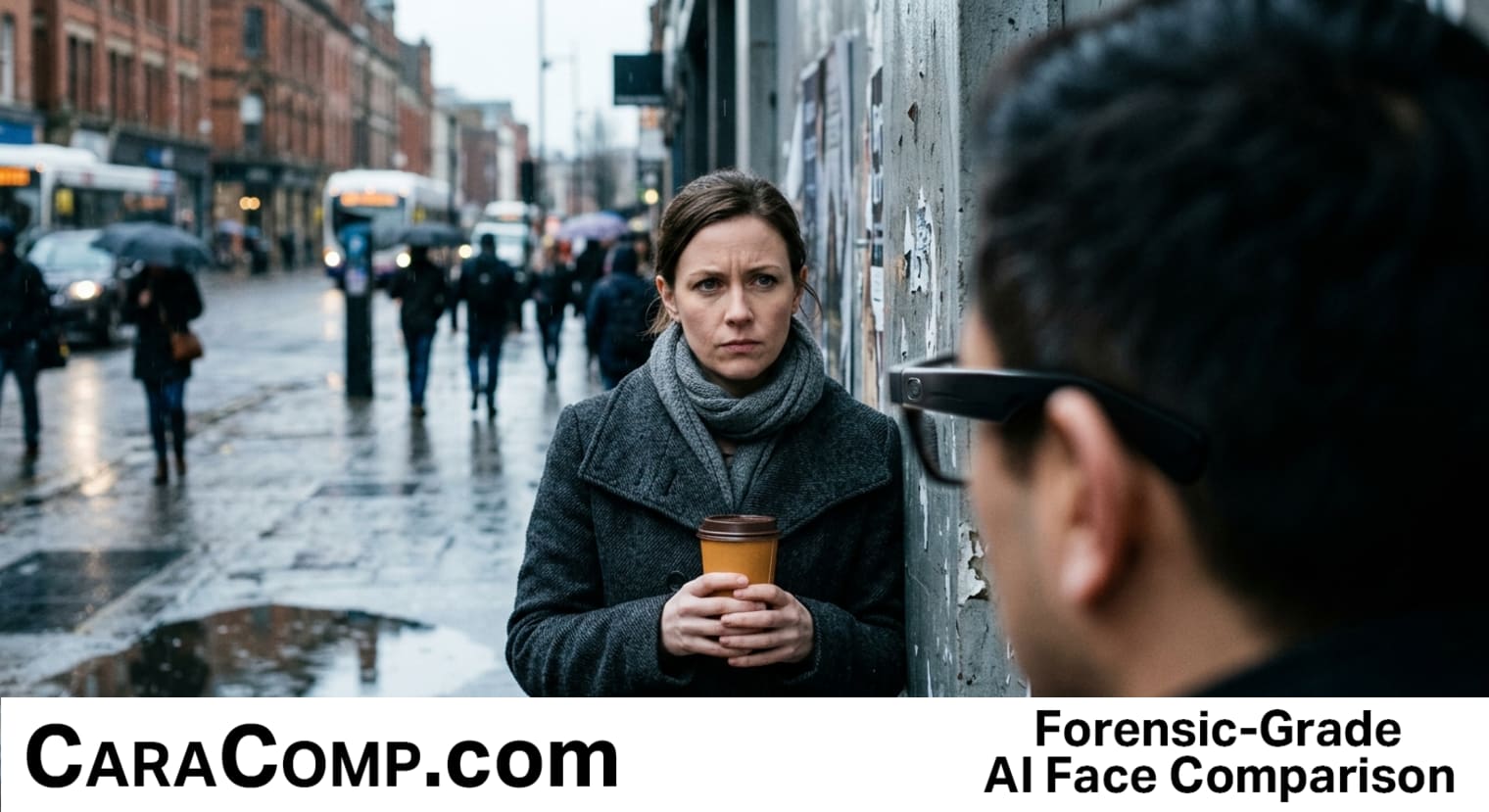
A stranger on a subway can now uncover your home address, phone number, and family history before the train reaches the next stop, all while simply looking in your direction. This isn't a theoretical threat; it was recently demonstrated using consumer-grade smart glasses and public data scraping. For professional investigators, this headline highlights a massive shift in the biometric landscape: the wall between "high-tech intelligence" and "publicly available tools" has officially crumbled. While hardware manufacturers scramble to add privacy lights that bystanders largely ignore, the real story is the democratization of identification technology.
As industry insiders, we see a clear distinction that the general public often misses. There is a world of difference between mass crowd-scanning and professional facial comparison. The former is a chaotic privacy nightmare, while the latter is a disciplined investigative methodology. For the solo private investigator or OSINT researcher, these developments are a double-edged sword. On one hand, the tech is becoming more powerful; on the other, the scrutiny on how we handle biometric data has never been higher. To stay ahead, professionals must move away from unreliable consumer "search" tools and adopt enterprise-grade analysis that is built for the courtroom, not for social media stunts.
- The Shift from Search to Comparison: Modern investigators are moving away from mass-web scraping and focusing on "one-to-many" batch comparison. By using Euclidean distance analysis on their own authorized case photos, PIs can achieve federal-level accuracy without the ethical or legal liabilities of unauthorized crowd scanning.
- Evidence Reliability is the New Currency: As consumer tools become more common, their high false-positive rates become a liability. Professional investigators need court-ready reporting that proves a match through mathematical distance, not just a "looks like" visual guess.
- The Accessibility Revolution: You no longer need a $2,400-a-year government contract to access high-caliber biometric tools. The technology that once required an agency budget is now available at a fraction of the cost, allowing solo firms to outperform larger competitors through sheer technical efficiency.
The gap between "knowing a face" and "closing a case" is narrowing. While the public debates the ethics of smart glasses, the tech-savvy investigator is busy leveraging these same mathematical principles to solve insurance fraud and locate missing persons in record time. The future belongs to those who use the best tech without the enterprise price tag.
Read the full article on CaraComp: The Stranger Next to You Is Wearing a Camera — and It Knows Your Address


Comments
Post a Comment