The Fingerprint Scanner at Work Doesn't Know You. Someone Set a Dial That Decides If You Get In.
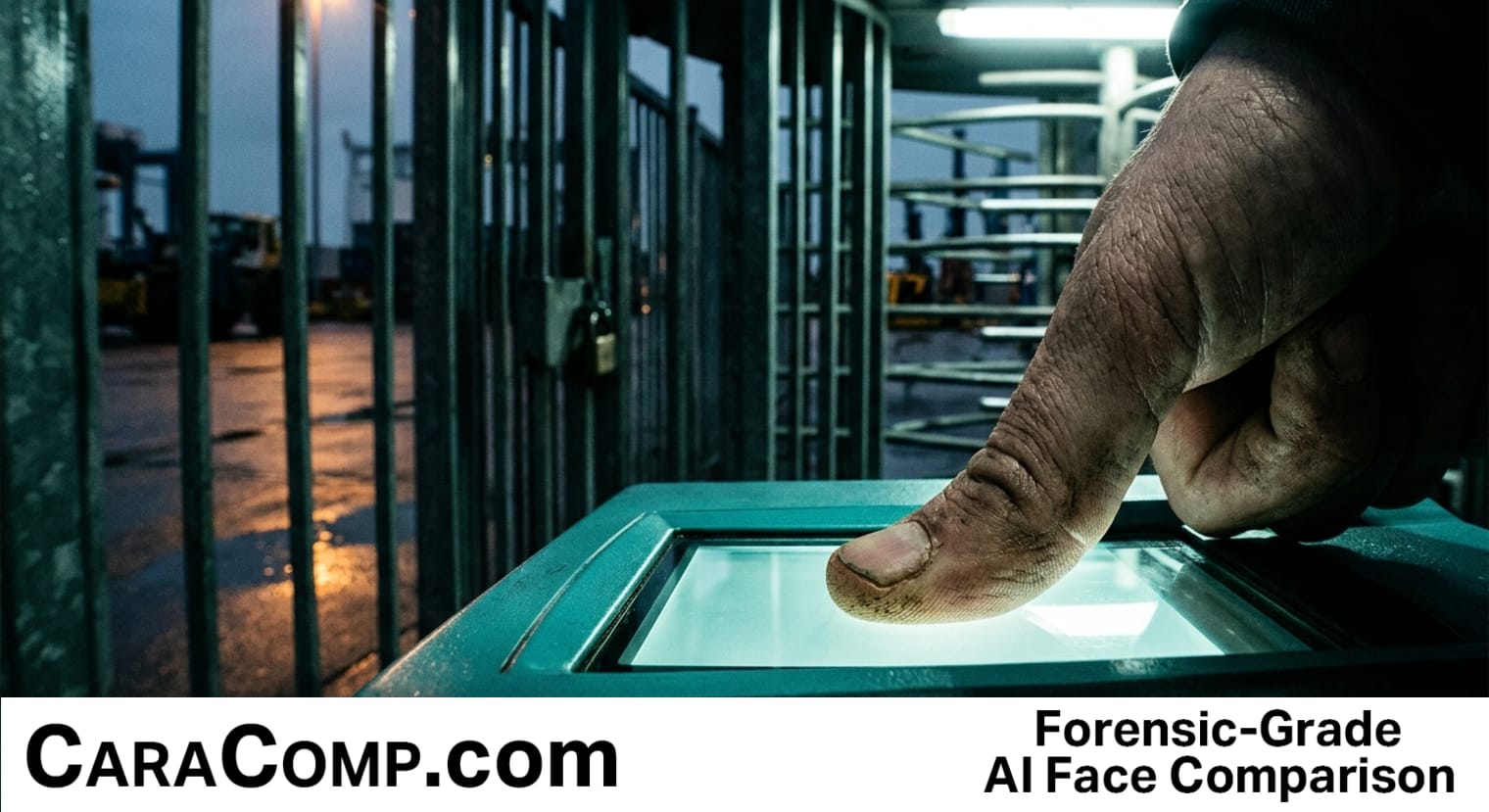
The biometric scanner at your office door doesn't actually have a memory; it has a math problem. Every time you scan your face or thumb, the system isn't "recognizing" you in the human sense—it's running a similarity score against a threshold that an administrator set behind the scenes. If your score is 0.01% too low because of bad lighting or a new pair of glasses, you are effectively a stranger to the machine. The lock doesn't "know" you; it just likes your math today.
For the professional investigator, understanding this "invisible dial" is the difference between a closed case and a wasted afternoon. In our world, we call this Euclidean distance analysis. It is the same fundamental logic used by high-end biometric access points, but when applied to facial comparison, it is what separates a professional PI from an amateur. Most people think AI tools are looking for a visual "match," but they are actually measuring the mathematical gap between two digital templates. If you can’t see the math, you can’t trust the result.
The real shift in our industry isn't about mass surveillance; it is about forensic verification. While the public conversation focuses on one-to-many crowd scanning, the sharpest OSINT and private investigators are focused on one-to-one comparison. They need to know if the person in the grainy surveillance footage is the same individual on the insurance claim. By treating biometrics as a mathematical score rather than a "feeling," investigators can provide court-ready reporting that holds up under cross-examination. This is how you move from "I think it's him" to "the Euclidean distance confirms it."
The enterprise secret has always been that this math isn't actually expensive—the gatekeepers just want you to think it is. You don't need a six-figure government contract to use the same logic that secures a nuclear facility. You just need a tool that lets you set the threshold and see the data for yourself, without the enterprise price tag or the unreliability of "free" consumer apps that fail when the reputation of your firm is on the line.
- The "Match" is a Choice: Every biometric result is a probability, not a certainty. Understanding how to interpret similarity scores is the most critical skill a digital investigator can possess in the AI age.
- Comparison Over Surveillance: Professional-grade tools focus on one-to-one verification, avoiding the privacy pitfalls of mass scanning while providing higher accuracy for specific case files.
- Democratized Euclidean Math: The same mathematical distance analysis used by federal agencies is finally available to solo firms, effectively closing the "tech gap" that previously favored only the largest firms.
Read the full article on CaraComp: The Fingerprint Scanner at Work Doesn't Know You. Someone Set a Dial That Decides If You Get In.


Comments
Post a Comment