That "Verified" Selfie Isn't Proving What You Think It Is
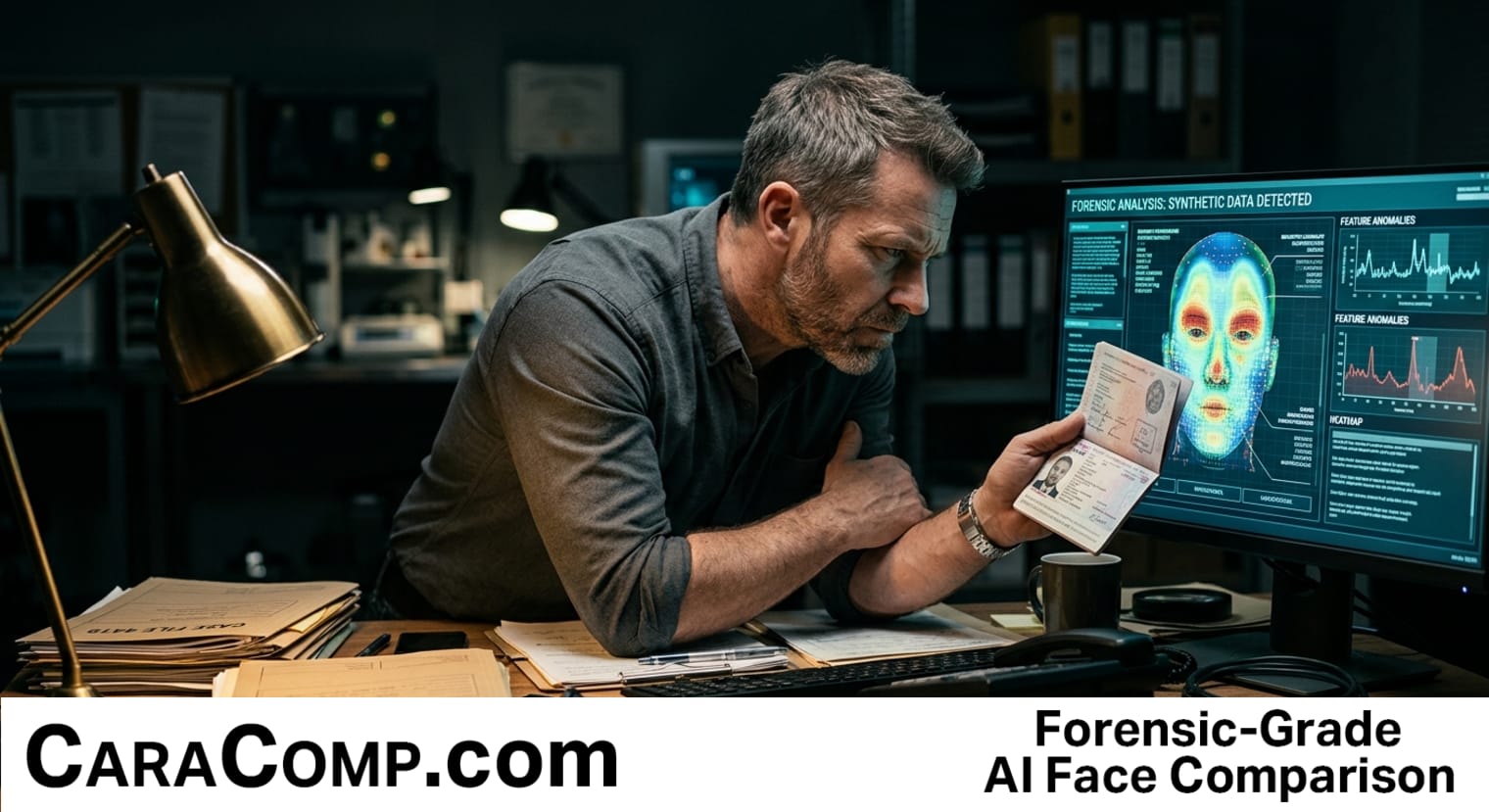
Injection attacks on identity verification systems surged 1,151% on iOS last year. That isn't just a statistical spike; it is a total collapse of the traditional "selfie-as-proof" model. While most people still believe a quick blink-and-smile test proves someone is real, the most sophisticated fraudsters aren't even using the camera anymore—they are plugging AI-generated video directly into the software stream. For the professional investigator, this reality changes the stakes of every case.
If you are a private investigator or an OSINT researcher still relying on manual "eyeball tests" to verify a subject's identity across photos, you are playing a dangerous game with your reputation. The human eye is no longer a match for synthetic media. When identity checks can be bypassed by feeding video into a virtual webcam, the only defense left for the modern detective is rigorous, mathematical facial comparison. It’s no longer enough to say two people "look the same" in a court-ready report; you have to prove it with Euclidean distance analysis.
The industry has reached a tipping point where enterprise-grade analysis is no longer a luxury—it is a requirement for survival. Yet, for too long, these tools were locked behind $2,000-a-year contracts designed for federal agencies. This created a massive gap: solo PIs and small firms were left using unreliable consumer search tools that lack professional reporting or, worse, spending hours squinting at pixels. We know that 90% of investigation technology is priced for governments, but the burden of proof falls just as heavily on the solo investigator.
Key implications for the investigative industry:
- The "eyeball test" is officially dead: With injection attacks and deepfakes becoming commoditized, manual comparison is a liability that won't hold up under professional scrutiny.
- Mathematical certainty is the new standard: Utilizing Euclidean distance analysis to measure the physical geometry of a face is the only way to provide objective, court-admissible evidence that bypasses the flaws of human perception.
- Technology democratization is non-negotiable: Solo investigators must adopt enterprise-caliber comparison tools to maintain their competitive edge against larger firms and sophisticated fraudsters.
The difference between a "close enough" match and a scientifically verified comparison is the difference between a closed case and a lawsuit. It’s time for investigators to stop guessing and start measuring.
Read the full article on CaraComp: That "Verified" Selfie Isn't Proving What You Think It Is


Comments
Post a Comment