That "Grandson" Begging You for Money Tonight? Hang Up and Call Him Back.
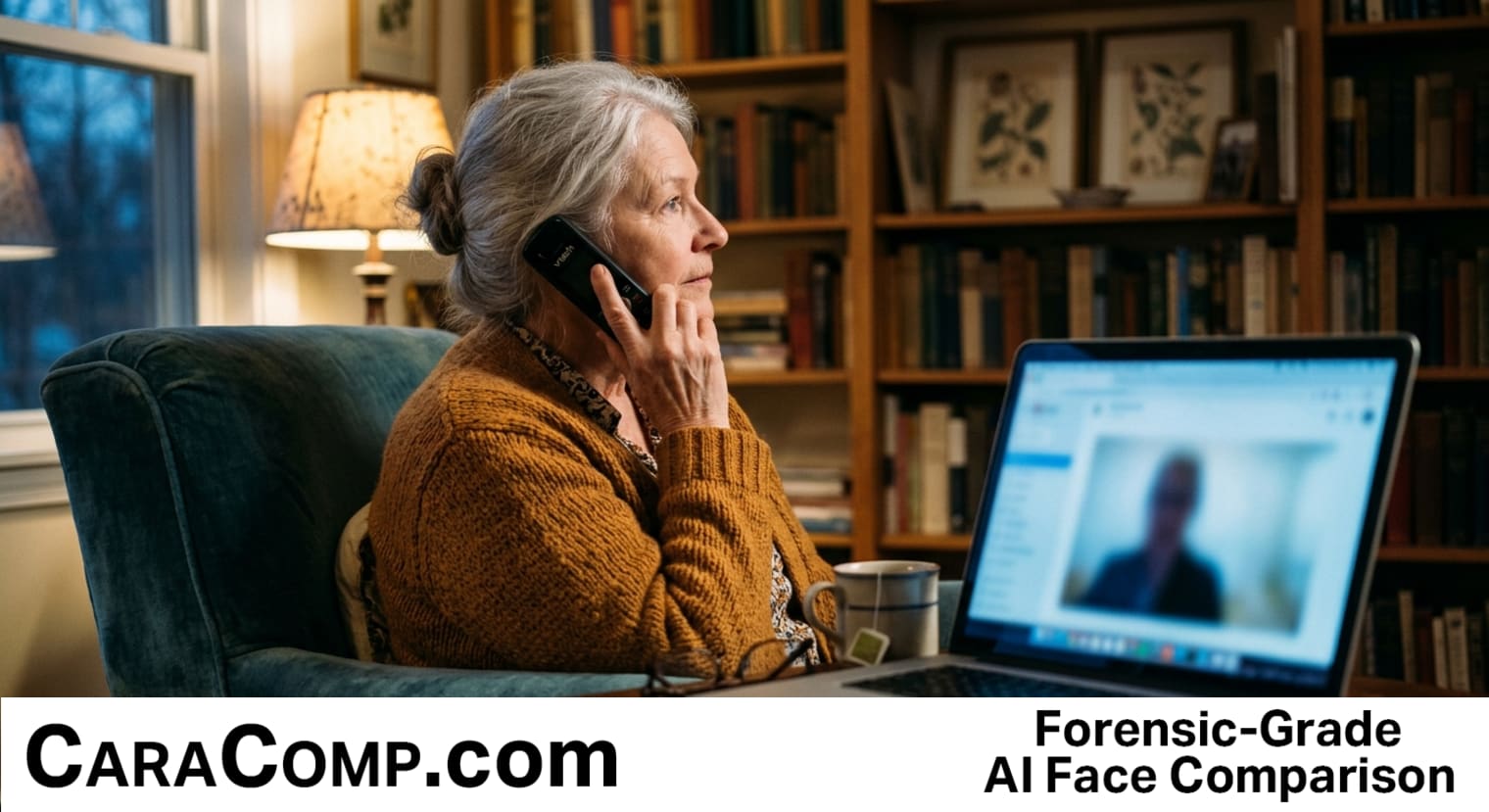
Your eyes are already obsolete when it comes to verifying identity. While digital literacy programs are busy teaching people to look for "weird pixels" or unnatural blinking in deepfake videos, they are missing the broader, more dangerous reality: the technology has already scaled past our biological ability to detect it. The news that scammers are successfully using AI-generated "grandsons" to fleece families isn't just a warning for seniors—it’s a wake-up call for every private investigator and OSINT professional who still relies on manual "eyeballing" to close cases.
The core of the deepfake scam isn't actually the video; it’s the engineering of urgency. Scammers use panic to bypass the analytical brain. In the world of insurance fraud or skip-tracing, we see a parallel vulnerability. If you are spending hours manually comparing faces across social media profiles and case photos, you are operating on the same flawed logic as a scam victim. You are susceptible to the "looks right" trap. When you’re tired, under a deadline, and juggling five cases, your brain is primed to see matches that don’t exist or miss the subtle geometric discrepancies that prove two faces are not the same person.
At CaraComp, we view the rise of synthetic media as a signal that the "gut feeling" era of investigation is over. When a face can be fabricated with a few clicks, your reputation as an investigator hinges on objective, biometric analysis—not just observation. We shouldn't be asking "Does this look like the subject?" We should be asking what the Euclidean distance analysis says. By moving from subjective visual checks to data-driven facial comparison, we remove the "panic" and "urgency" that scammers exploit, replacing it with court-ready precision.
Key implications for the investigative industry:
- The "Manual Eyeball" is a Professional Liability: As deepfakes become indistinguishable from reality, relying on manual facial comparison is a risk that leads to false positives and compromised evidence.
- Verification Requires Science, Not Just Habits: While a "call back" rule protects families, investigators need side-by-side biometric reports to prove identity in a world of synthetic media and OSINT-driven fraud.
- Math Beats Manipulation: Professional-grade tools that analyze facial geometry strip away the emotional and visual tricks used by bad actors, ensuring that your case analysis holds up under scrutiny.
Professional investigators don't have the luxury of guessing. You need to strip away the "trust" layer and look at the cold, hard geometry of the data. Anything less is just a gamble.
Read the full article on CaraComp: That "Grandson" Begging You for Money Tonight? Hang Up and Call Him Back.


Comments
Post a Comment