Started a New Job Online? Here's What's Really Happening to Your ID
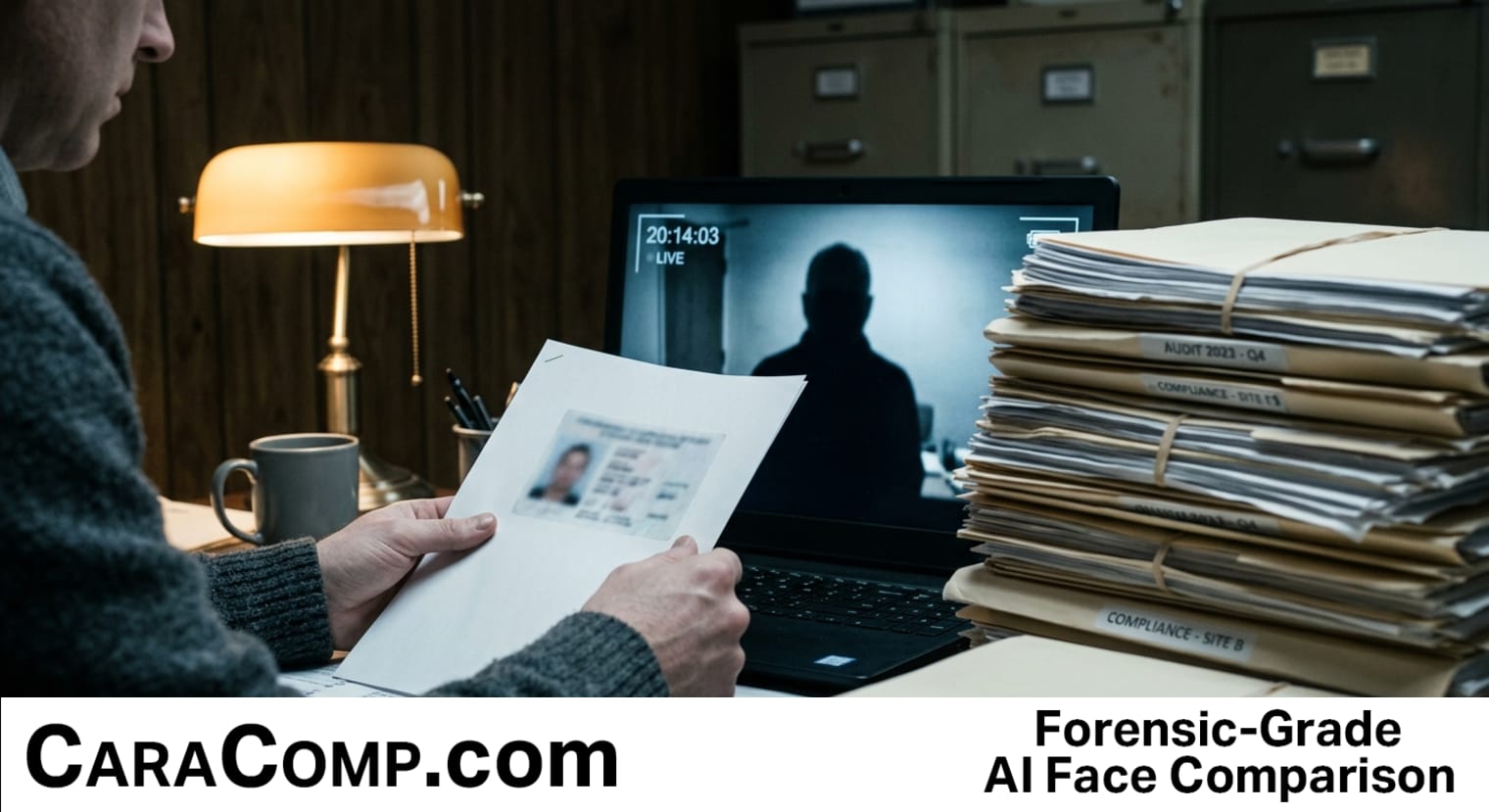
A "perfect" facial match is often the biggest red flag in modern identity verification. While HR departments scramble to master the three-day window for remote I-9 compliance, professional investigators are seeing a much more dangerous trend: the weaponization of high-resolution digital fakes that pass basic liveness checks but crumble under rigorous Euclidean distance analysis.
The recent shift toward remote hiring has exposed a massive vulnerability in how we verify identity. HR teams are finding that a "match" on a screen doesn't equate to a verified human being. For the solo private investigator or OSINT researcher, this news is a wake-up call. If federal-level document verification can be fooled by a sophisticated scan and a liveness bypass, your manual "eyeballing" of case photos isn't just slow—it’s a liability. We are moving toward a landscape where facial comparison is no longer a luxury for federal agencies; it is a baseline requirement for anyone handling insurance fraud or skip tracing.
The industry is finally realizing that facial recognition and facial comparison are two entirely different animals. While recognition is often a broad, controversial dragnet, comparison is a surgical investigative methodology. It’s about taking YOUR case photos and proving, with mathematical certainty, that the subject in Document A is the same person in Photo B. As the I-9 news proves, the "paperwork is the verification." If you aren't producing court-ready reports that show the geometric distance between facial landmarks, you aren't just behind the curve—you’re failing to provide admissible evidence.
Key Implications for Investigators:
- The "Audit Trail" is the New Standard: Just as HR needs a timestamped record for I-9 audits, investigators now need professional, batch-processed reports to survive cross-examination. A screenshot of a search result is no longer enough.
- Comparison Over Recognition: The future of the field isn't in scanning crowds, but in the side-by-side analysis of specific subjects using enterprise-grade algorithms to detect fraud that the human eye misses.
- The Death of Manual Review: Spending three hours manually comparing ears and nose bridges is a recipe for a missed match. Digital tools now provide 1/23rd the cost of enterprise software, making high-level analysis accessible to solo firms.
If you aren't using mathematical comparison to verify your subjects, you're betting your reputation on a visual "best guess." In a world of synthetic identities, that’s a bet you’re going to lose.
Read the full article on CaraComp: Started a New Job Online? Here's What's Really Happening to Your ID


Comments
Post a Comment