Your Kid's Career Could Hinge on a Camera That Says "Not You"
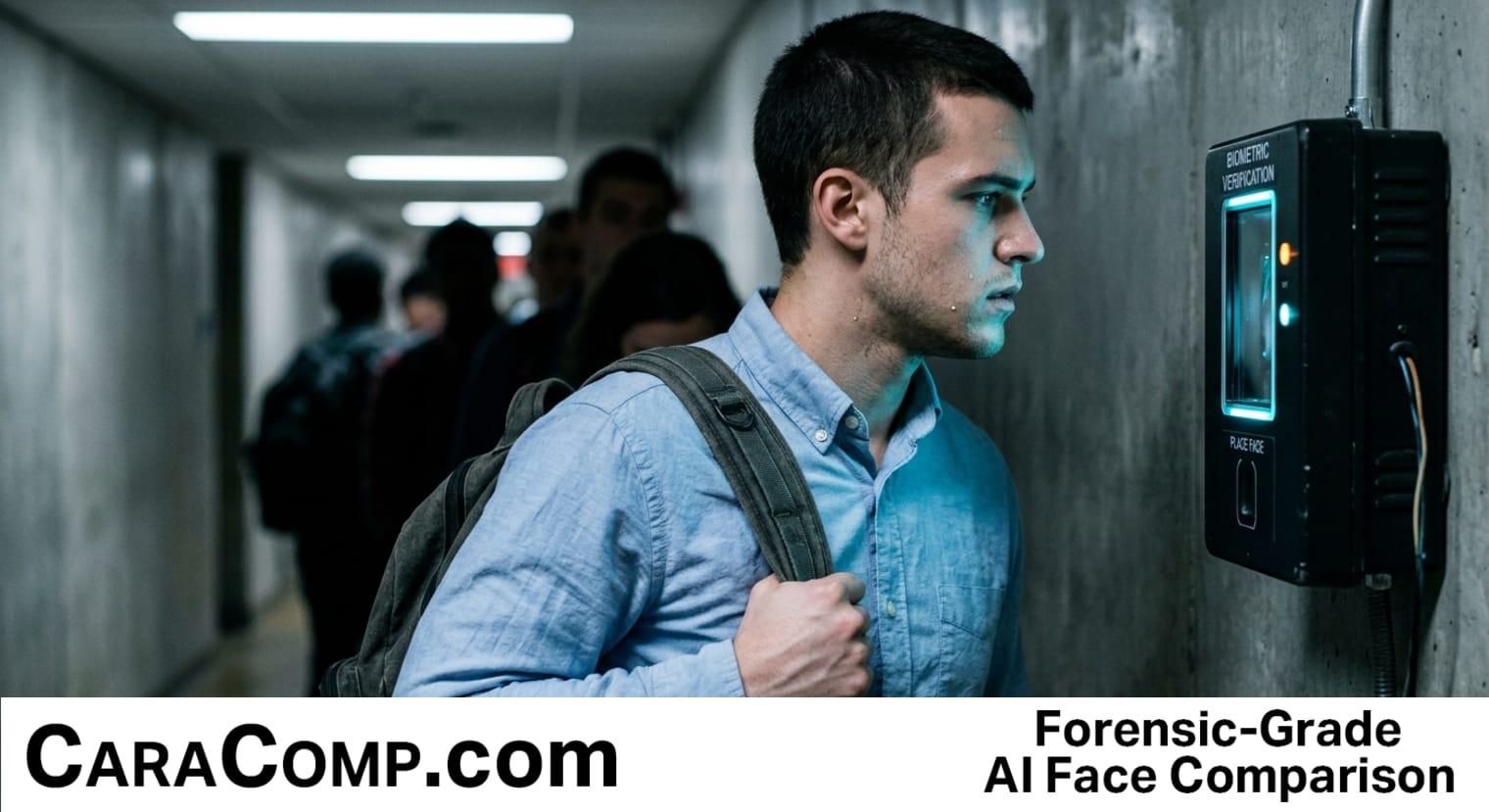
Imagine a 99.9% success rate that still ruins 600 lives in a single morning. In Maharashtra, India, over 600,000 teaching candidates are facing an AI-powered gatekeeper: a facial verification check that determines if they even get to sit for their career-defining exam. For the professional investigative community, this isn't just a distant headline—it’s a massive proof-of-concept for the technology we use every day, and a stark warning about why biometric accuracy is everything.
This isn't about mass surveillance; it’s a high-stakes application of facial comparison. The system uses Euclidean distance analysis to match a live scan against a government ID record. For private investigators, OSINT researchers, and fraud specialists, this is the exact same logic we use to bust insurance scammers or verify a subject’s identity across disparate digital footprints. The difference is the margin for error. When a government system fails at the door, a candidate loses a year of their life. When an investigator’s tool yields a false positive, they lose their professional reputation and their case.
At CaraComp, we view this rollout as a global validation of our methodology. Facial comparison—specifically matching Photo A to Photo B to determine identity—is rapidly becoming the gold standard for professional verification. However, the Indian exam rollout highlights a massive gap in the current market. While government agencies spend millions on these enterprise-level gatekeeping systems, solo investigators have historically been stuck between $2,000-a-year contracts and unreliable consumer "search" tools that offer zero court-ready reporting.
- Facial comparison is officially replacing manual verification in high-stakes environments. Whether it is a state exam or a multi-million dollar fraud case, the days of "eyeballing it" are over.
- The "human override" is becoming a myth. As systems scale to handle hundreds of thousands of people, the algorithm’s decision becomes final. This makes the reliability of the comparison tool the single most important factor in the investigator's toolkit.
- Euclidean distance analysis is now a professional requirement, not a luxury. To compete with agencies, solo PIs must use the same mathematical rigor used by state-level entities to ensure their evidence holds up under scrutiny.
If 600,000 people are being vetted by an algorithm in a single day, the industry has shifted. You need tools that provide the same analytical power as a federal agency, without the enterprise price tag. Anything less is just guesswork.
Read the full article on CaraComp: Your Kid's Career Could Hinge on a Camera That Says "Not You"


Comments
Post a Comment