Your ID Has Secret Ink — And It's Why Fake Faces Don't Fool the System
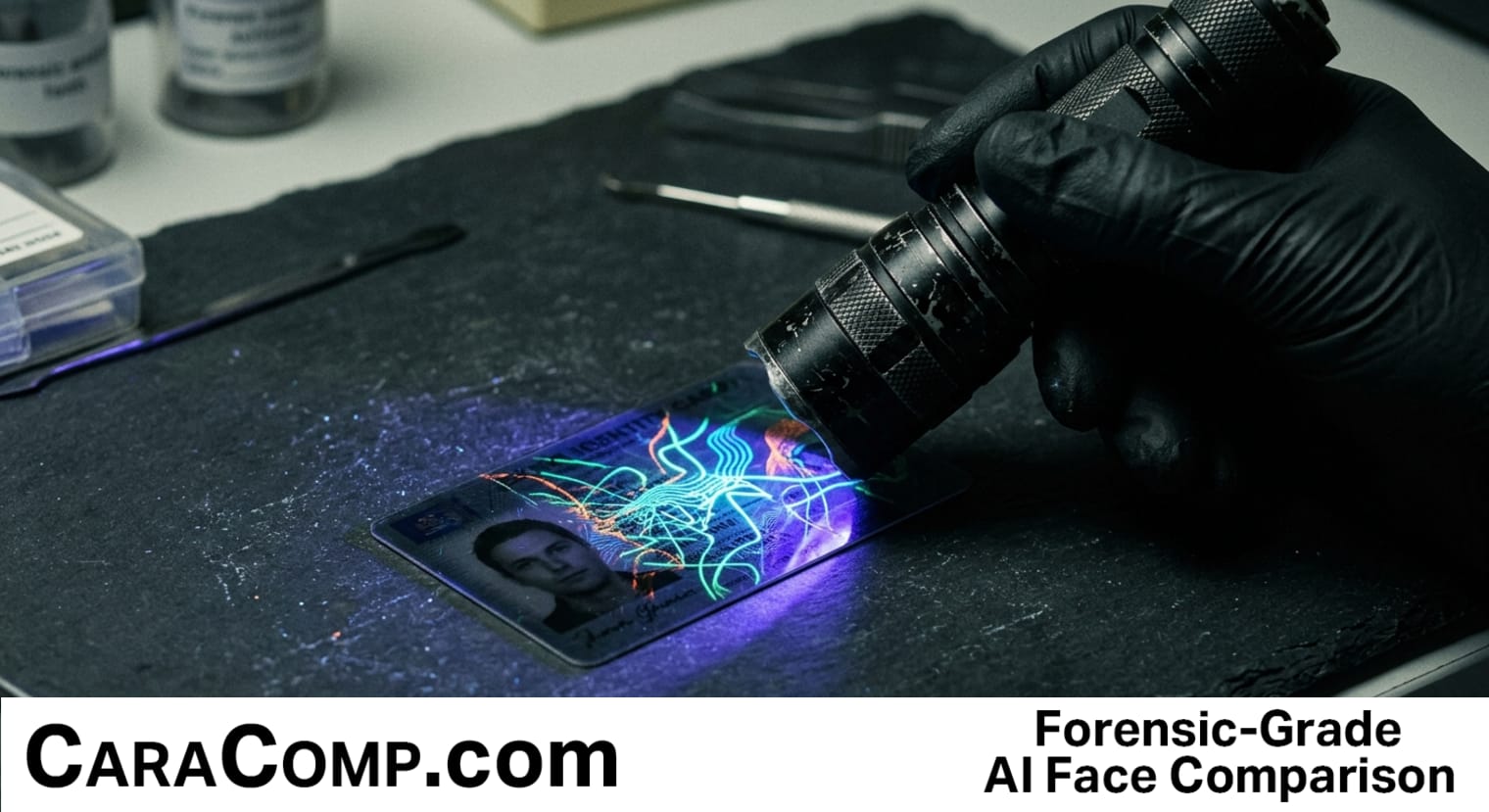
Stop obsessing over deepfakes for a second. The most sophisticated identity verification systems on the planet don't even look at a person’s face until they’ve interrogated the chemistry of their driver’s license. While most solo investigators are losing sleep over synthetic identities, they’re missing the invisible reality: a perfect facial match is a professional liability if you’re matching against a document that shouldn’t exist.
The news that modern IDs undergo over 50 forensic checks—ranging from UV-reactive ink to infrared-responsive printing—highlights a massive tech gap in the private investigation industry. High-level agencies use chemistry to verify the document, but for the boots-on-the-ground PI, the challenge remains the second gate: the facial comparison. If the document is the "lock," the face is the "key," and far too many investigators are still trying to turn that key using manual, "eyeball" methods that wouldn't pass a basic reliability test in court.
As OSINT and fraud cases become more complex, the "trust but verify" mantra is evolving into "analyze or fail." The hidden layers of security in modern IDs prove that identity is a multi-stage puzzle. For an investigator, confirming a document's physical legitimacy is only half the battle. The real work begins when you have to compare a subject's face across various case photos with mathematical precision. You cannot rely on a 2.4/5 rated consumer tool or a manual glance to determine Euclidean distance. You need enterprise-grade analysis that mirrors the rigor of these forensic document checks without the $2,400 annual price tag.
Key Implications for Investigators:
- The "Face-First" Fallacy is Over: True identity verification is sequential. Document authentication proves the "what," but professional facial comparison proves the "who." If you aren't using algorithmic tools to back up your visual matches, you're only doing half the job.
- Manual Comparison is a Reputation Risk: Just as automated systems replaced manual document review because humans "lose quality," manual facial comparison is now a liability. Investigators need court-ready reporting that proves a match via Euclidean distance analysis, not just "gut feeling."
- Tech Parity is Finally Affordable: You no longer need a federal budget to access the same caliber of analysis used in 50-gate authentication systems. The tools to close the "identity gap" are now accessible to solo firms.
Read the full article on CaraComp: Your ID Has Secret Ink — And It's Why Fake Faces Don't Fool the System


Comments
Post a Comment