Your Face Is Just 128 Numbers — And a Seal Just Proved It
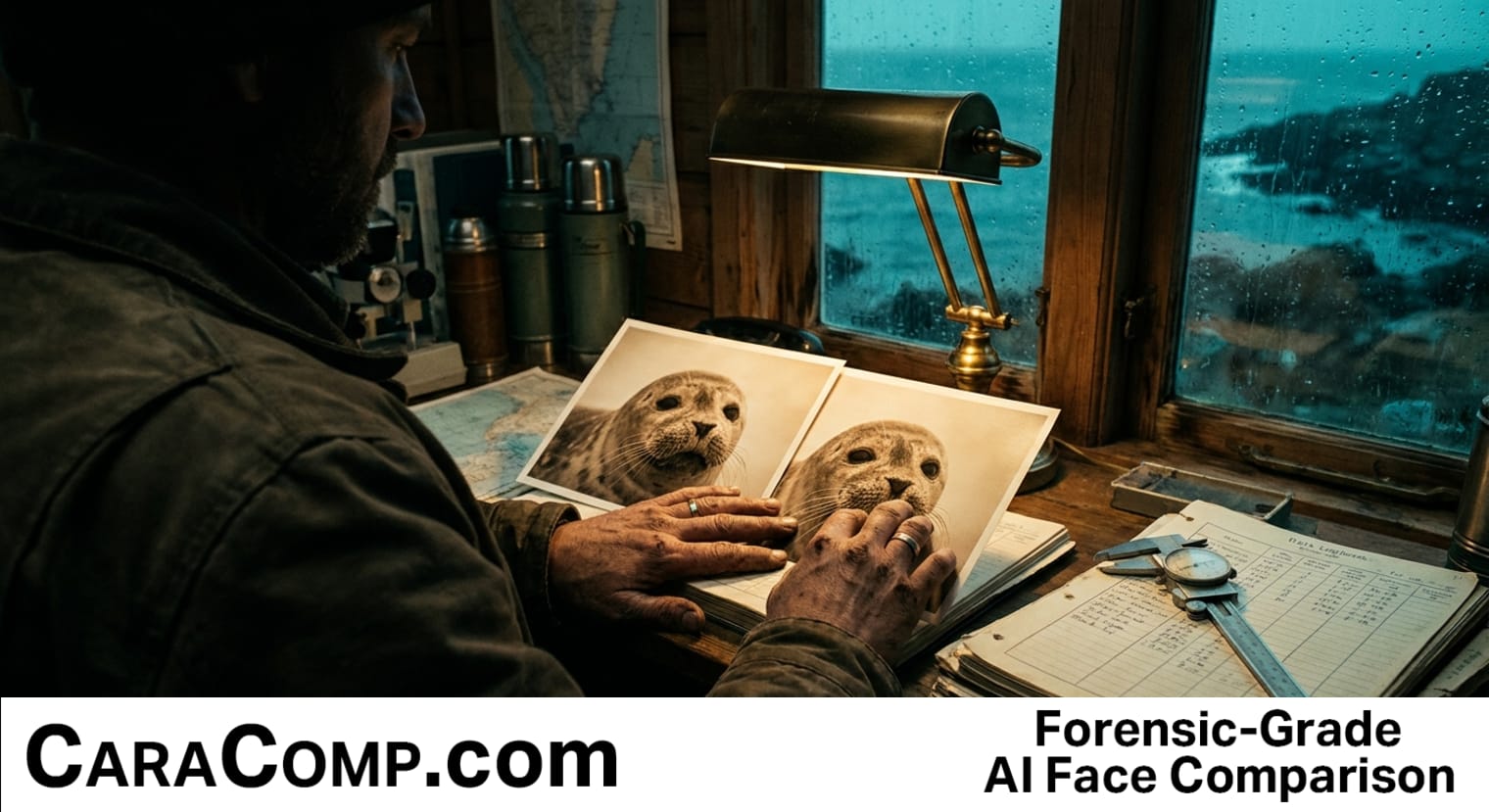
If a computer can distinguish one harbor seal from a colony of hundreds just by measuring the geometry of its nose and eyes, there is zero excuse for a private investigator to still be manually "eyeballing" photos in a fraud case. The recent SealNet study, which successfully used facial comparison to identify individual seals with 88% accuracy, reveals a truth we’ve championed at CaraComp for years: identity isn't a name or a social security number; it’s a mathematical coordinate.
Researchers proved that you don't need tags, collars, or a government-run database to prove two images show the same subject. By converting seal faces into 128-number feature vectors and calculating the Euclidean distance between them, they turned a grueling manual task into a streamlined digital process. For the solo investigator, this is the ultimate proof of concept. If this technology can handle slippery, molting aquatic mammals in shifting coastal light, it can certainly handle your subject’s social media profile versus a grainy doorbell camera image.
The industry is hitting a tipping point where manual comparison isn't just slow—it's negligent. While "enterprise" tools try to gatekeep this Euclidean distance analysis behind $2,000 yearly contracts, the seal study proves the methodology is now a standard investigative tool, not a luxury. Whether you are an OSINT researcher or a solo PI, you should be leveraging these algorithms to do the heavy lifting. Why spend four hours squinting at pixels when you can generate a court-ready report based on the same math used by top-tier researchers?
At CaraComp, we believe that providing this caliber of analysis to the "little guy" is what levels the playing field. Stop treating facial comparison like a futuristic secret. It is a fundamental part of modern case analysis that turns "maybe" into "mathematically probable."
- Math replaces manual labor: Euclidean distance analysis removes human bias and fatigue from the comparison process, providing a verifiable similarity score for every match.
- Comparison over identification: This technology excels at analyzing YOUR specific case photos to find matches within a dataset, making it a professional, standard methodology for private investigators.
- Enterprise power is now accessible: High-level accuracy no longer requires a federal agency budget; solo firms can now access the same tech used in biological research to close cases faster.
Read the full article on CaraComp: Your Face Is Just 128 Numbers — And a Seal Just Proved It


Comments
Post a Comment