Your Boss Just Called You on Video. It Wasn't Him. $25M Is Gone.
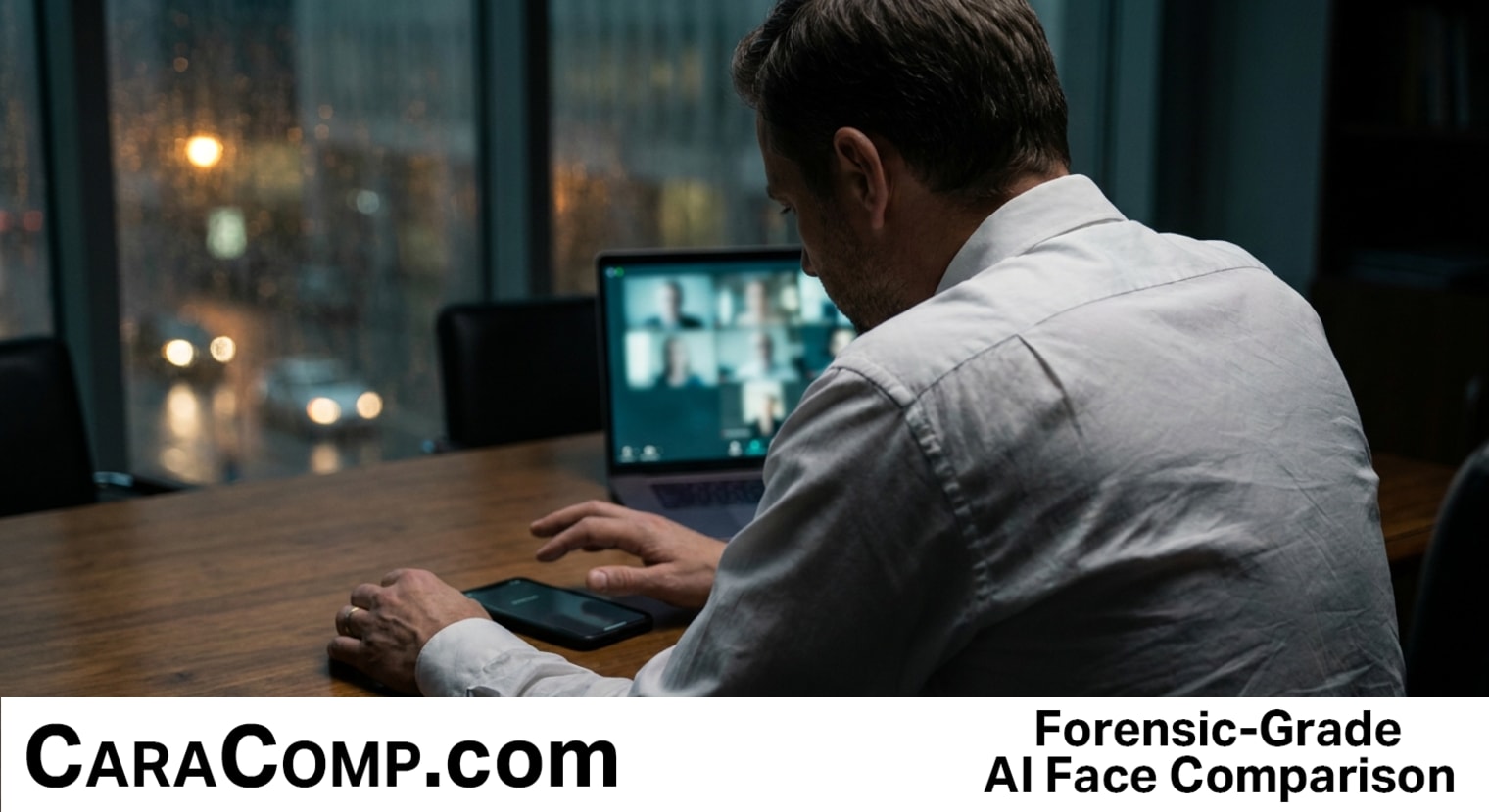
Your eyes are officially lying to you. If a finance professional can sit through a full video conference with his "CFO" and "colleagues" and not realize he’s talking to a digital ghost, the era of trusting your "gut feeling" in an investigation is over. The $25 million heist at Arup wasn't just a failure of corporate policy; it was a total collapse of human visual verification.
For private investigators and OSINT researchers, this story is a tectonic shift. We’ve spent decades relying on the "eyeball test" to confirm a subject's identity. But when a scammer can clone a voice from 30 seconds of audio and map a face onto a live video feed with a 75% success rate against human detection, the manual method isn't just slow—it’s dangerous. If you are still relying on your own vision to match a skip-trace subject or a fraud suspect across grainy surveillance footage, you are a liability to your clients.
At CaraComp, we see this as the definitive argument for moving away from "recognition" and toward rigorous, mathematical facial comparison. Scammers thrive on the "good enough" sync that fools the human brain's natural bias toward familiar faces. They cannot, however, fake the underlying Euclidean distance between facial landmarks that a computer sees. Professional investigation now requires a transition from subjective "looks like him" reporting to objective, data-driven analysis that can survive a courtroom challenge.
The implications for the investigative industry are immediate and unforgiving:
- The "Vibe Check" is Legally Dead: Visual confirmation without biometric data is becoming hearsay. In a world of $25 million deepfakes, "I recognized him" will no longer hold up under cross-examination without supporting mathematical comparison.
- Geometry Over Appearance: Investigators must pivot to analyzing the fixed geometry of the face—Euclidean distance—rather than lighting, cadence, or expression, which are now easily spoofed by generative AI.
- Verification Must Be Multi-Channel: Just as the "two-channel rule" stops wire fraud, professional case reports must now include multi-source facial comparison to ensure a single spoofed image hasn't compromised an entire file.
If you aren't using enterprise-grade comparison tools to verify your subjects, you aren't just behind the curve—you're leaving yourself open to the same level of catastrophic error that cost Arup $25 million. It’s time to stop trusting what you see and start trusting what you can prove with math.
Read the full article on CaraComp: Your Boss Just Called You on Video. It Wasn't Him. $25M Is Gone.


Comments
Post a Comment