Your Boss Just Called. It Wasn't Him — and It Cost $25 Million.
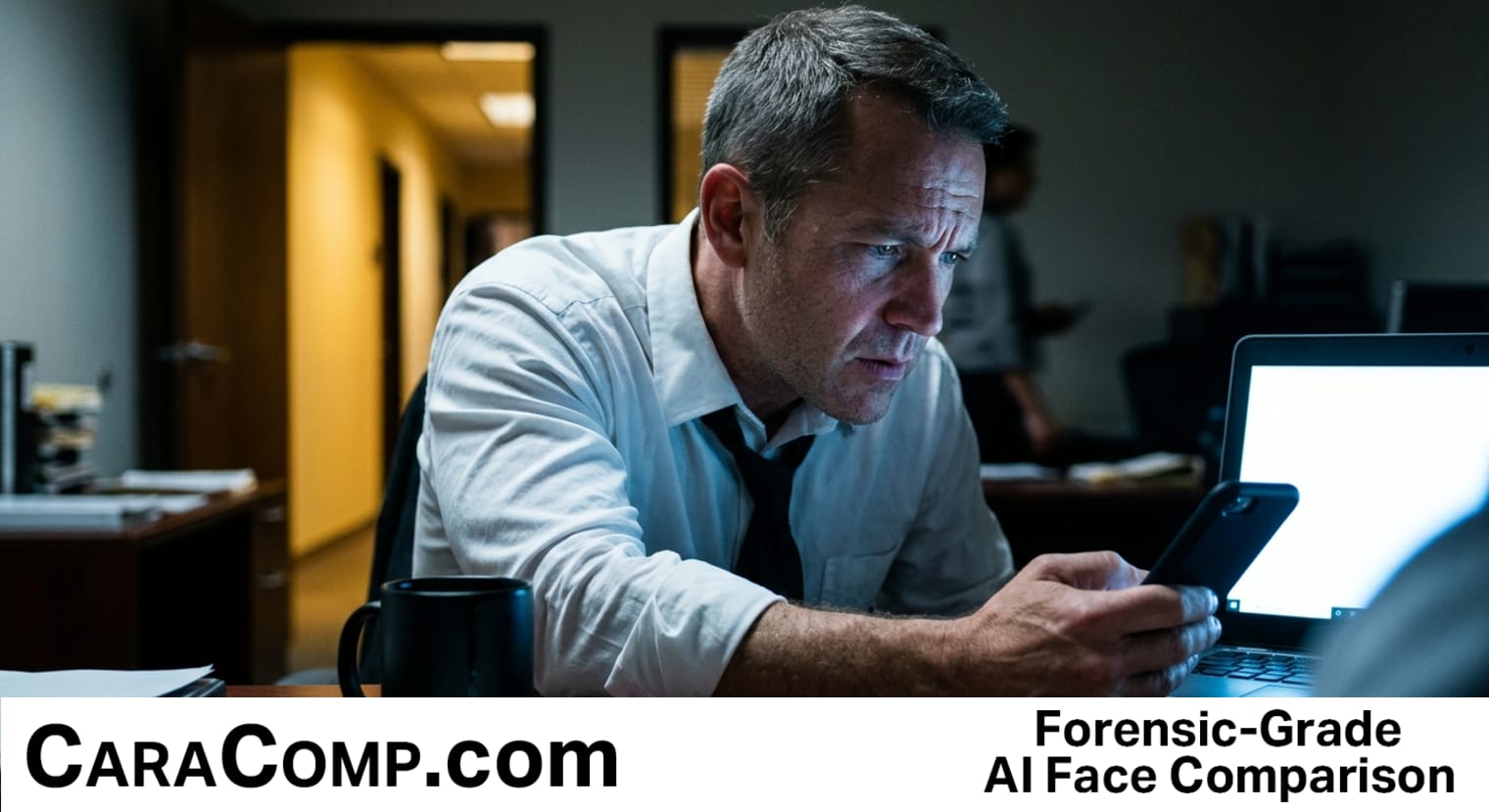
Criminals are now renting your target's face for the price of a cheap lunch. With dark web "Deepfake-as-a-Service" posts surging by 39%, the barrier to entry for high-level identity fraud has effectively vanished. When a Hong Kong CFO wires $25 million because a deepfaked executive team told him to, it’s a siren for every investigator: if you are still relying on your "gut feeling" or manual "eyeballing" to verify identities in a case, you are already behind the curve.
For the solo private investigator or OSINT researcher, this 39% spike isn't just a corporate security problem—it is a direct threat to the integrity of your evidence. We are entering a period where "looks like him" is no longer a professional standard. As scammers weaponize AI to create synthetic identities, investigators must weaponize Euclidean distance analysis to dismantle them. The reality is that humans are naturally wired to trust a familiar face, a biological loophole that fraudsters are now exploiting at scale.
At CaraComp, we see this shift clearly. The market for fake identities is becoming a "franchise" model, complete with customer support and service guarantees. To counter this, the modern investigator needs more than just a sharp eye; they need mathematical certainty. Facial comparison—not mass surveillance—is the only way to provide court-ready proof that holds up under scrutiny. While enterprise-grade tools used to be locked behind $2,400-a-year contracts, the democratization of fraud means we must democratize the defense.
- The "Manual Eye" is a Liability: When synthetic faces are generated for $15, relying on manual side-by-side photo comparison is an invitation for a catastrophic error in your case file.
- Euclidean Distance is the New Evidence Standard: To stand up in court or satisfy a skeptical client, you need objective metrics, not subjective opinions. Mathematical analysis of facial landmarks is the only way to separate a real person from a high-fidelity fake.
- Affordability Determines Survival: As fraud tech becomes cheaper, investigators who don't adopt enterprise-grade comparison tools will be priced out of the market by those who can verify identities in seconds.
The dark web’s 39% surge proves that the "fake boss" isn't an anomaly; it’s a business model. For the investigator on the front lines, the choice is simple: upgrade your toolkit to include rigorous facial comparison, or wait for a deepfake to blow your next big case.
Read the full article on CaraComp: Your Boss Just Called. It Wasn't Him — and It Cost $25 Million.


Comments
Post a Comment