Your Boss Just Called for €220K. It Wasn't Him.
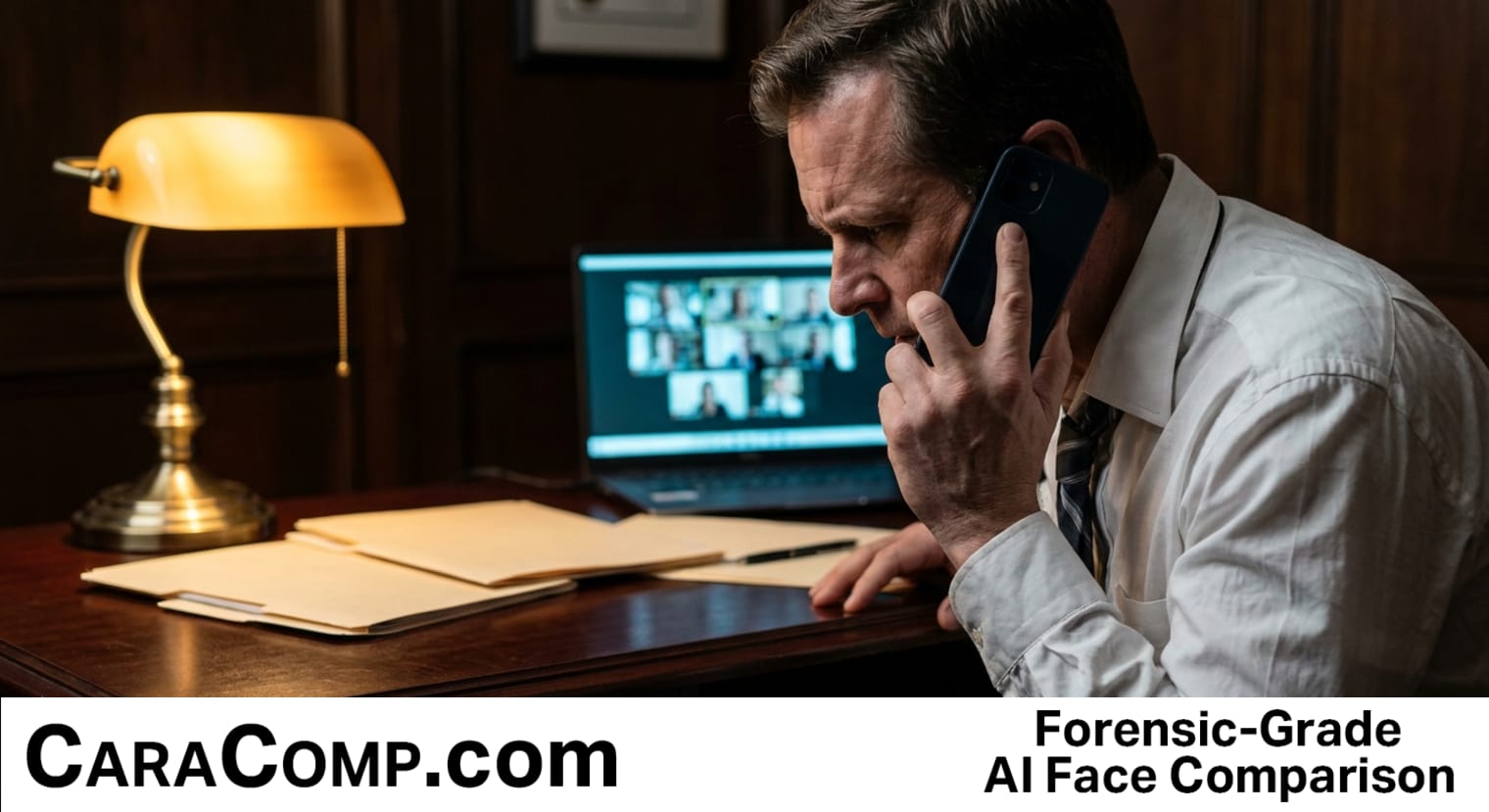
A three-second audio clip just cost a company €220,000, proving that the traditional "gut feeling" is officially a liability in modern investigations. When a CEO at a UK energy firm transferred a small fortune because he recognized the "melody" and accent of his boss’s voice, he wasn't just a victim of a scam; he was a victim of his own biology. AI has reached a point where human intuition is actually worse than a coin flip at detecting a fake, and for professional investigators, this is a massive wake-up call.
If a scammer can weaponize a 10-second LinkedIn clip to bypass a high-level executive's skepticism, what does that mean for the visual evidence you handle every day? For years, private investigators and law enforcement have relied on manual facial comparison—staring at two photos and deciding if they "look" like the same person. But just as the energy CEO was fooled by a familiar accent, investigators are frequently misled by lighting, age, or cognitive bias. The reality is that we can no longer trust our eyes to verify identity in a world where synthetic media is cheap and ubiquitous.
At CaraComp, we see this shift every day. Verification is moving away from perception and toward mathematical proof. For an OSINT researcher or a solo PI, the stakes are too high to rely on manual methods or unreliable consumer-grade search tools. You need the same Euclidean distance analysis used by federal agencies to ensure a match is scientifically sound before you present it in a court-ready report. This isn't about surveillance; it's about using precision technology to protect your reputation and your client’s interests.
- Human intuition is no longer a forensic tool. Research shows humans correctly identify AI-generated media only 48% of the time. Relying on "the eye test" for facial comparison is a professional risk that no modern firm should take.
- The "Verification Gap" is the new crime scene. Scammers use urgency to kill the verification process. Investigators must adopt batch processing and automated comparison tools to close cases faster than the tech-enabled criminals can move.
- Enterprise-grade analysis must be democratized. When a deepfake operation can be launched for $60, investigators cannot be expected to pay $2,000 a year for comparison software. Professional-grade Euclidean distance analysis must be accessible to the solo investigator to level the playing field.
The energy CEO’s mistake wasn't his lack of technology—it was his reliance on a channel he didn't control. For the modern investigator, controlling the channel means moving beyond manual comparison and adopting tools that provide objective, data-driven results. If you aren't using math to verify identity, you're just guessing—and that's a €220,000 gamble.
Read the full article on CaraComp: Your Boss Just Called for €220K. It Wasn't Him.


Comments
Post a Comment