That Video From Your Boss? Your Eyes Just Failed the Test 49% of the Time
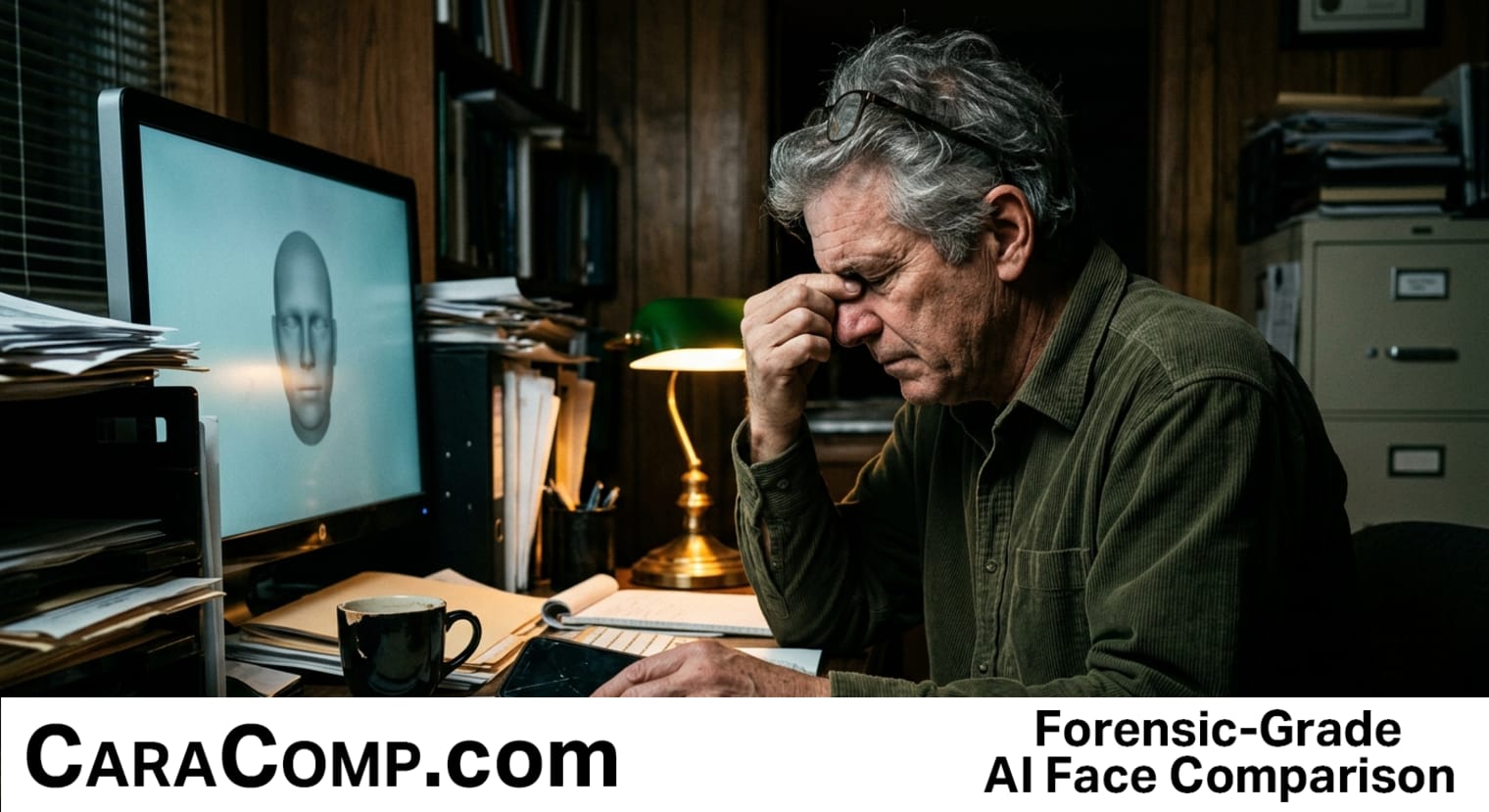
Stop trusting your "experienced eye." If you are a private investigator or OSINT professional still relying on manual visual inspection to verify a subject’s identity across case photos, you are effectively flipping a coin with your professional reputation. New data from Communications of the ACM has confirmed a brutal reality: human accuracy in detecting AI-generated content has hit 51.2%. That is a statistical tie with pure, dumb luck.
For the solo investigator, this isn't just an interesting tech stat—it is a professional liability. We have long prided ourselves on "knowing a face" or "spotting the anomaly," but the gap between human perception and synthetic reality has closed. When you present evidence to a client or a court, "it looks like him to me" is no longer a valid investigative methodology. The tools of the trade must evolve because the subjects of our investigations already have.
The problem is that most investigators feel trapped between two bad options: continuing with unreliable manual comparisons or shelling out $2,000 a year for enterprise software designed for federal agencies. This "identity gap" is where cases are lost. You cannot stake a fraud investigation or a missing persons case on a 51% probability. To stay ahead of the curve, investigators must shift from subjective "looking" to objective "analysis."
Using Euclidean distance analysis—the same mathematical backbone used by high-end agencies—is now the only way to provide court-ready results that bypass the failures of human biology. This isn't about scanning crowds or mass surveillance; it’s about the surgical comparison of your specific case photos to ensure that your "match" is backed by data, not a guess.
Key implications for the modern investigator:
- The death of the "Expert Eye": Prior knowledge and training in deepfakes or facial anatomy do not improve detection rates; mathematical verification is the only remaining safeguard.
- Liability is the new baseline: Relying on manual comparison in a world of 50/50 human accuracy opens the door for discredited evidence and professional negligence claims.
- Data over Description: Court-ready reporting now requires objective similarity scores and biometric distance measurements to overcome the inherent skepticism surrounding digital media.
If you aren't using technology to verify what your eyes can no longer see, you aren't just behind the times—you’re likely wrong half the time. It is time to stop guessing and start measuring.
Read the full article on CaraComp: That Video From Your Boss? Your Eyes Just Failed the Test 49% of the Time


Comments
Post a Comment