Mom, Don't Wire That Money: The 6-Word Rule That Stops a $1M Deepfake Cold
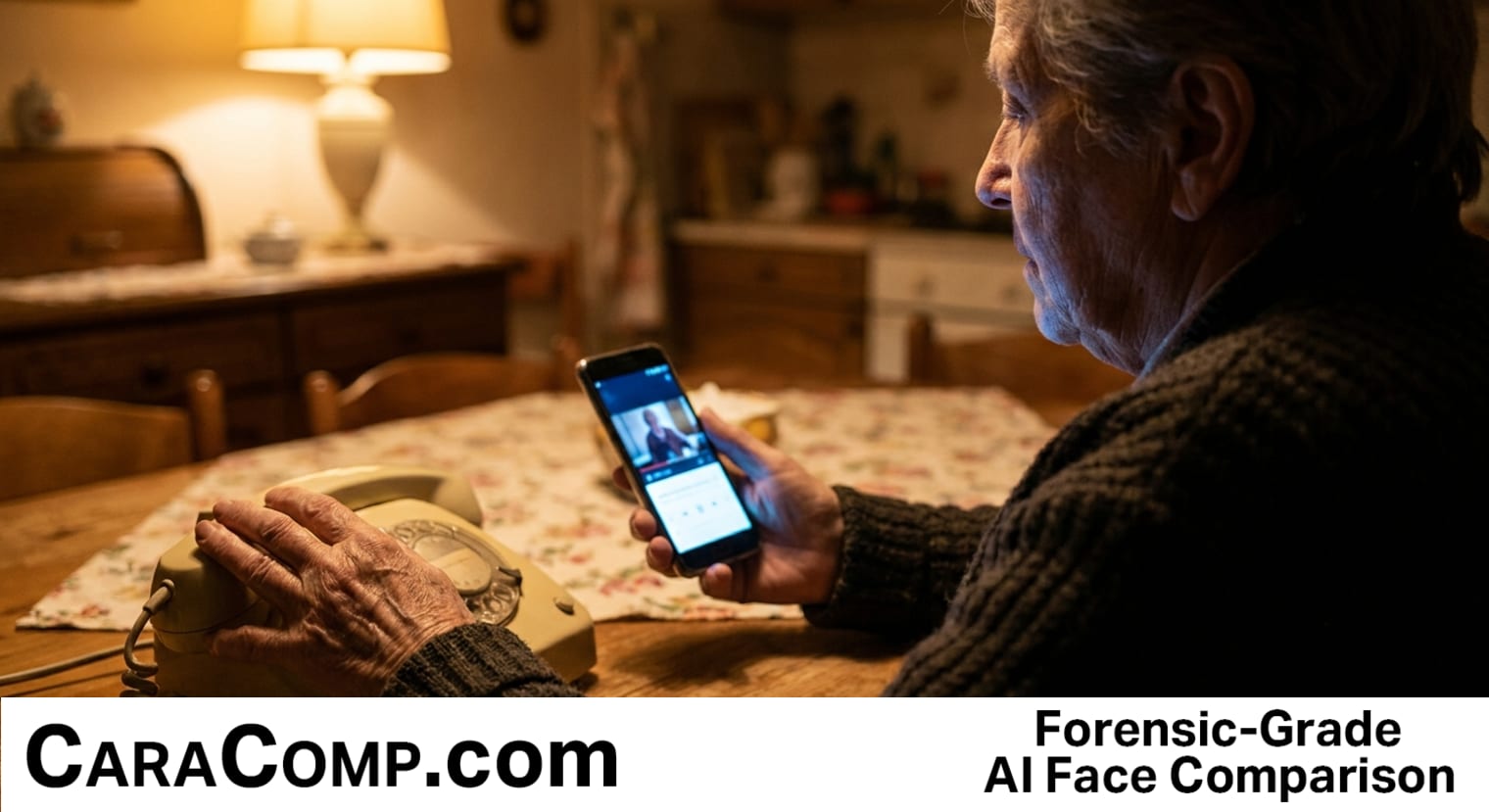
If you still believe your eyes are your greatest investigative asset, you are officially a liability to your clients. The recent news of a senior losing nearly $1 million to a deepfake video of a world leader isn't just a tragic fraud story—it’s a final wake-up call for the private investigation industry. When 70% of people fail to distinguish an AI-generated face from a real person, the "gut feeling" method of facial identification is effectively dead.
For the modern investigator, this news highlights a massive professional gap. We are entering a period where visual evidence can no longer be taken at face value. If an AI can mimic the mannerisms, vocal patterns, and facial structures of a Prime Minister well enough to bankroll a seven-figure heist, how can a solo PI possibly rely on manual photo comparison to close a high-stakes fraud or domestic case? The answer is: they can't. Relying on your "sharp eye" to compare a subject across multiple low-quality social media photos is no longer just outdated; it’s negligent.
The industry is splitting into two camps: those who still play a guessing game with their reputation, and those who adopt enterprise-grade verification. At CaraComp, we see this as the definitive shift toward Euclidean distance analysis—moving from subjective "looks like him" opinions to objective, mathematical data points. Professional facial comparison isn't about scanning crowds; it's about having the technical firepower to verify that YOUR case photos actually match, using the same logic as the high-priced tools used by federal agencies.
- Visual proof has been permanently decoupled from identity. A convincing face is no longer evidence of presence; it is merely evidence of access to sophisticated software. Verification must now happen through independent, technical channels.
- The "Trust Gap" is an investigative opportunity. As deepfakes flood the zone, the value of an investigator who can provide court-ready, batch-processed facial comparison reports will skyrocket.
- Manual comparison is a professional risk. If you aren't using systematic investigation technology to cross-reference images, you are one "false positive" away from a ruined reputation and a lost client.
The days of spending three hours squinting at pixels are over. You need to verify, not just look. The technology to do this used to cost $2,000 a year, but those barriers have vanished. It’s time to stop guessing and start measuring.
Read the full article on CaraComp: Mom, Don't Wire That Money: The 6-Word Rule That Stops a $1M Deepfake Cold


Comments
Post a Comment