Her Fingerprints Faded. Now the Government Says She Doesn't Exist.
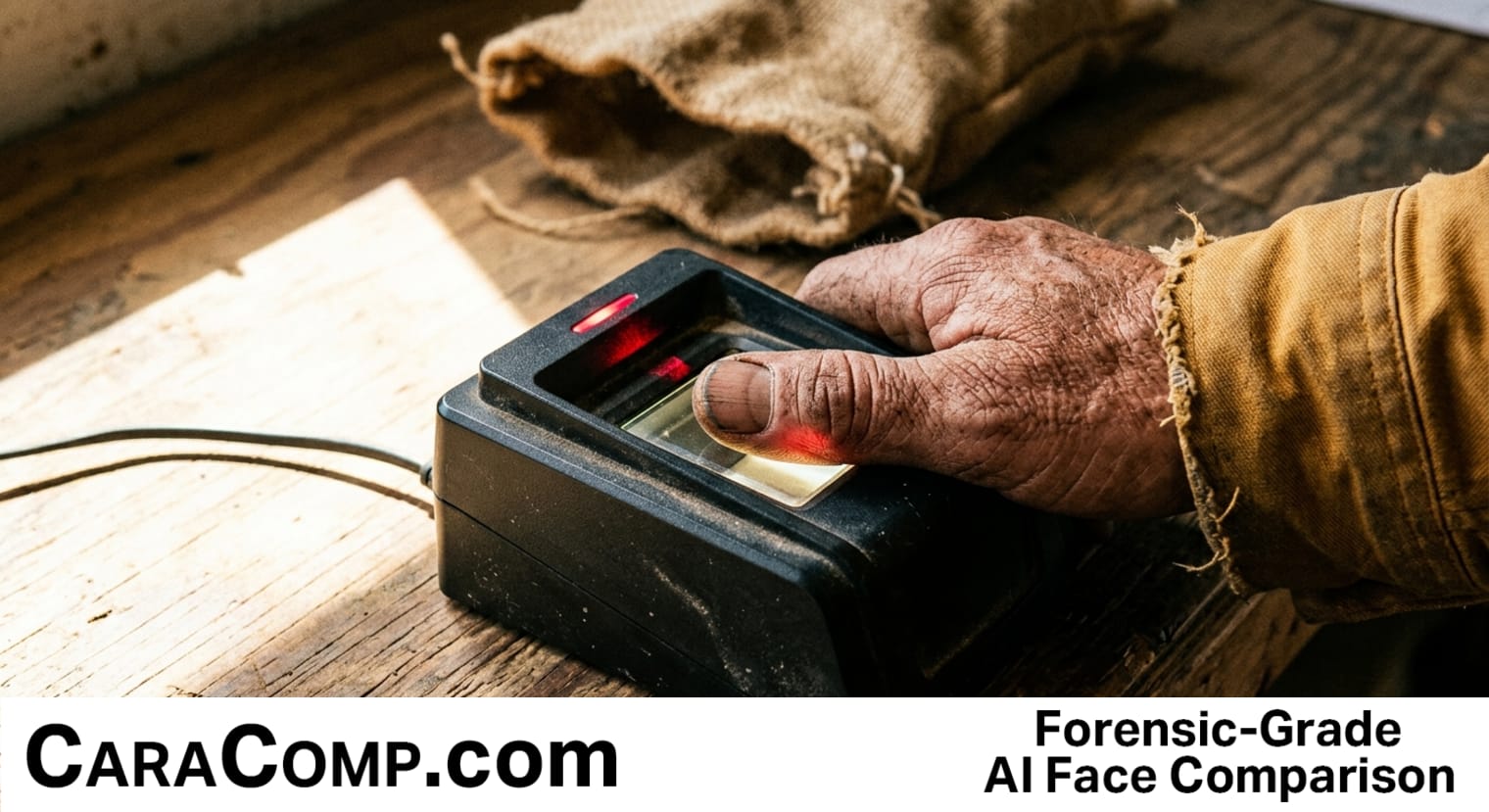
A 12% failure rate would get any private investigator fired, yet that is the exact margin of error Rajasthan is now forcing onto its most vulnerable citizens. By making fingerprint and iris scans mandatory for food rations, the government has turned the human body into a fallible password. For the elderly whose fingerprints have faded and the laborers whose hands are worn smooth, the "system" has effectively deleted their existence. This isn't just a bureaucratic glitch; it is a warning shot for anyone in the investigation and OSINT community about the absolute necessity of reliable biometric methodology.
In our line of work, we see this tech gap every day. Solo investigators often feel trapped between two extremes: wasting three hours manually squinting at grainy case photos or risking their reputation on "free" consumer search tools that are about as reliable as a Rajasthan fingerprint scanner. When the stakes are high—whether it’s a family’s dinner or a court-admissible fraud case—a 12% failure rate is a total collapse of the mission. The transition from manual guesswork to algorithmic precision isn't just about speed; it’s about ensuring that the person you are looking at is, mathematically, the person you think they are.
The Rajasthan crisis proves that legacy biometrics are failing. For professional investigators, the move toward Euclidean distance analysis—the same math used in high-level facial comparison—is the only way to bypass the "faded fingerprint" problem. While governments struggle with hardware bottlenecks and massive database errors, the smart investigator is adopting enterprise-grade tools that offer certainty without the five-figure price tag.
- The Death of Legacy Biometrics: Fingerprints are fragile and easily altered by age or labor. Facial comparison remains the most resilient biometric marker for investigators because it relies on bone structure and facial geometry that doesn't "fade" over time.
- The Exclusion of the Unverified: When a biometric system has no manual override, the "false negative" becomes a life-altering event. Investigators must use tools that provide professional, court-ready reporting to prove their matches are based on data, not just a machine’s "best guess."
We are entering a period where your ability to accurately compare and verify identity defines your success as an investigator. If you are still relying on manual methods or unreliable consumer-grade search tools, you are leaving your results up to chance. It’s time to close the gap and start using the same Euclidean analysis that the big agencies use, at a price that actually fits a solo firm's budget.
Read the full article on CaraComp: Her Fingerprints Faded. Now the Government Says She Doesn't Exist.


Comments
Post a Comment