He Wired $25M After a Video Call With His Boss. His Boss Wasn't There.
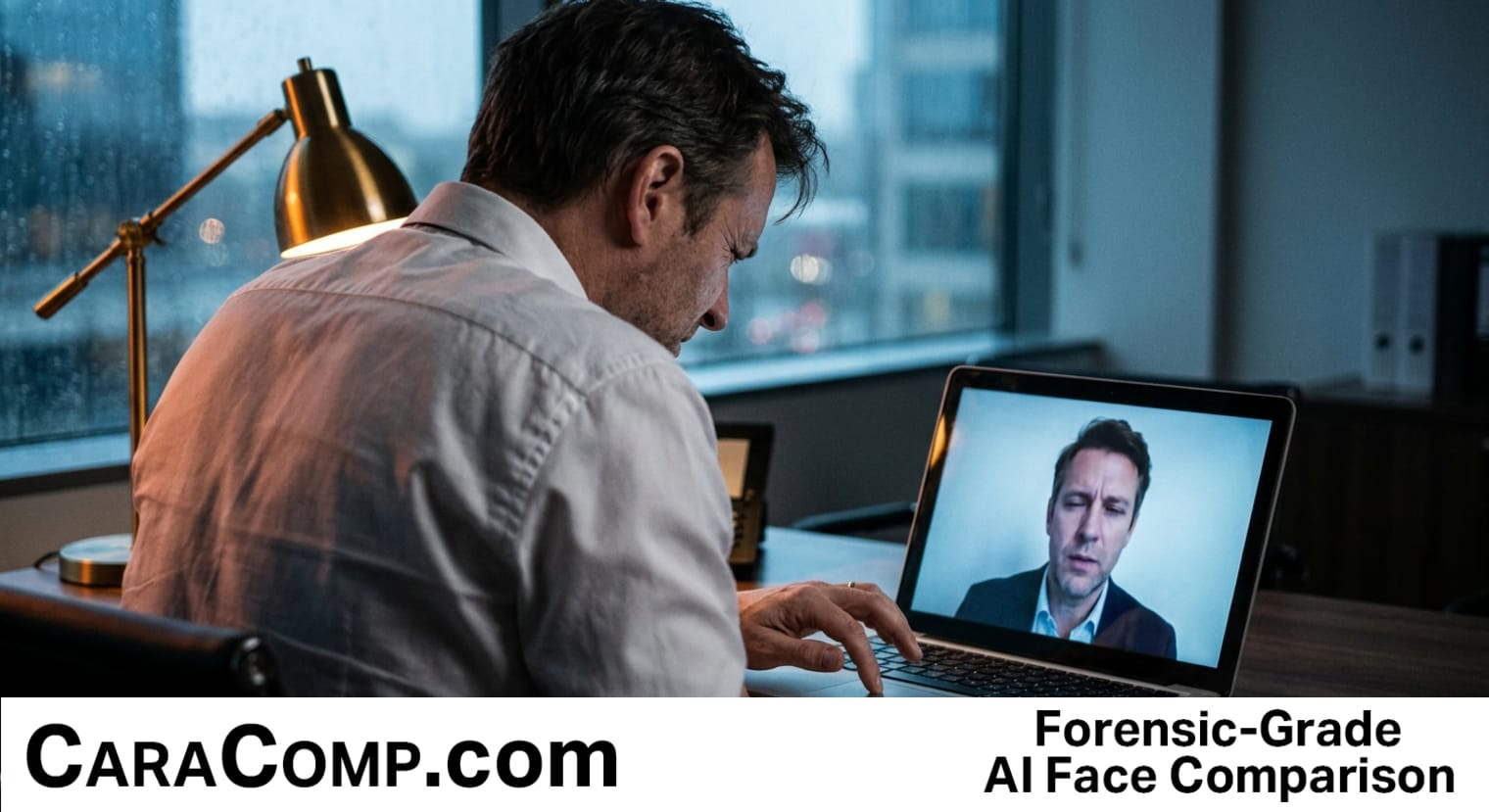
Your eyes are officially a liability. The recent news of a finance worker wiring $25 million to scammers after a video call with a deepfaked CFO isn't just a headline about corporate fraud; it’s a funeral for the "eye test" in professional investigations. If an employee can sit through a full meeting with an entire digital gallery of his colleagues and not spot the fraud, we have reached the point where subjective visual observation is professionally negligent.
For the solo private investigator or OSINT researcher, this story is a massive wake-up call. We’ve spent decades relying on our instincts and "good enough" manual comparisons to verify identities. But when sophisticated AI can replicate mannerisms, voices, and facial structures well enough to bypass a $25 million gatekeeper, your manual side-by-side comparison of a social media profile and a surveillance photo is no longer a standard—it’s a risk. If you aren't using mathematical verification to back up your visual claims, you’re betting your reputation on a coin flip.
The industry is shifting. We are moving away from "it looks like him" toward objective, data-driven analysis. Investigators who fail to adopt enterprise-grade facial comparison tools are going to find themselves on the wrong side of a court-admissible report. The irony is that while the scammers are using high-end tech to deceive, many investigators are still using manual methods because they think reliable tech is priced for federal agencies only. That gap is where the danger lives.
- Subjectivity is now a professional risk: Relying on human sight alone to verify a subject’s identity in a world of deepfakes and AI-generated personas is no longer defensible in a professional investigation.
- Mathematical distance is the new gold standard: Effective investigation now requires Euclidean distance analysis—the same math used by high-level agencies—to provide a confidence score that holds up under scrutiny.
- The "Enterprise Gap" is disappearing: You don’t need a six-figure government budget to access the technology required to debunk a fake or confirm a match; you just need to stop relying on manual comparison.
The Arup case proves that the stakes have never been higher. Whether you're tracking insurance fraud or conducting high-stakes OSINT, the toolset you use defines your credibility. Stop manual "eyeballing" and start using the math that scammers are already using to stay ahead of you.
Read the full article on CaraComp: He Wired $25M After a Video Call With His Boss. His Boss Wasn't There.


Comments
Post a Comment