Cops Lost His Kids Over an 85% Guess — Your Face Could Be Next
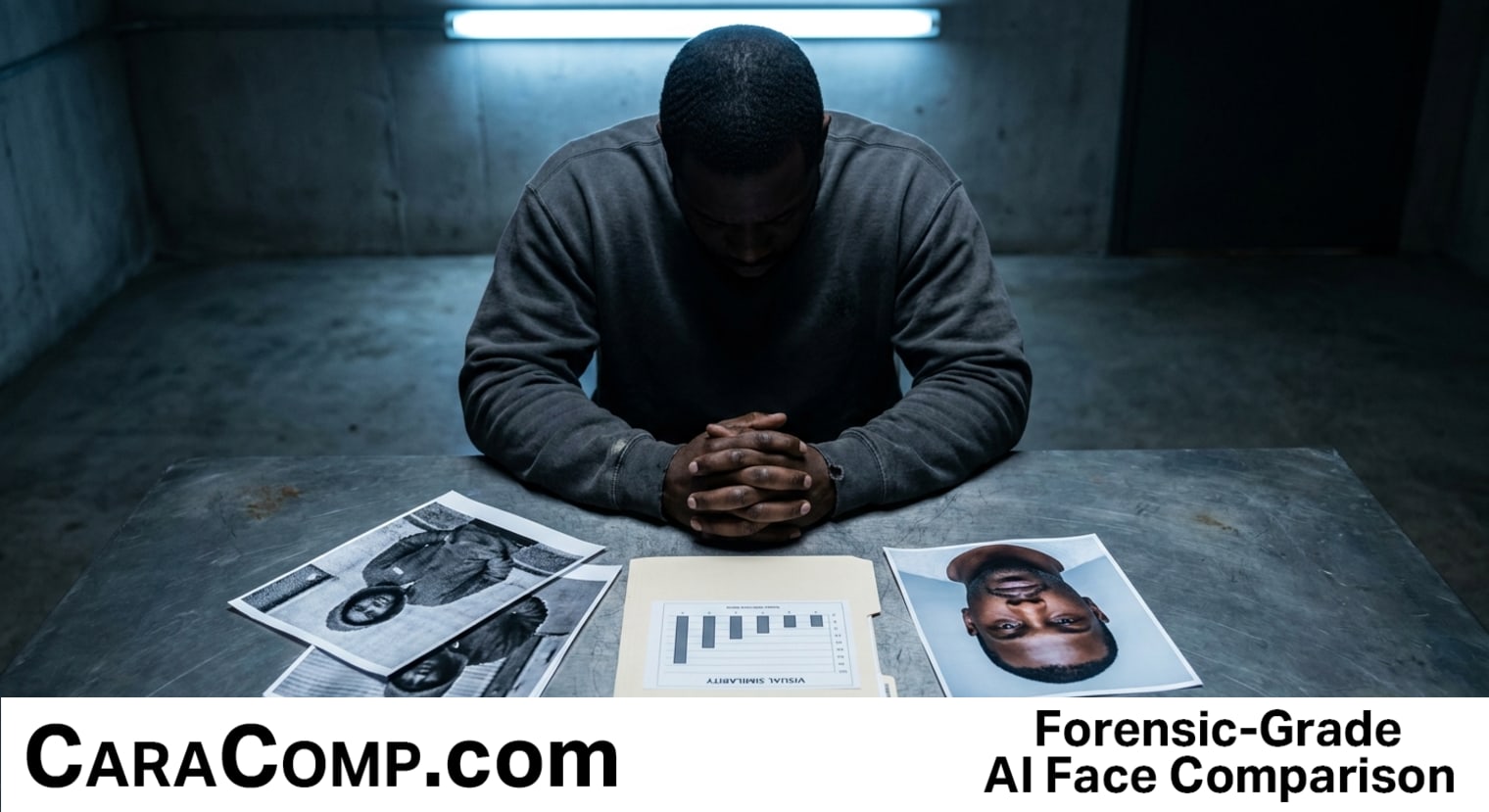
An 85% match is not a fingerprint—it’s a digital suggestion that can cost a man his home, his job, and his children if the person behind the screen gets lazy. The news of an innocent man spending two months in jail because a software "guess" was treated as a verdict is a wake-up call for the entire investigative community. It highlights a dangerous, fundamental misunderstanding of what facial comparison technology is actually for.
In the world of OSINT and private investigation, we don't need "Big Brother" scanning crowds; we need high-fidelity, side-by-side analysis that builds a case rather than shortcutting it. The failure in these wrongful arrest cases isn't just a technical glitch; it’s a process failure. When agencies treat a similarity score as a conclusion, they abandon the rules of professional investigation. At CaraComp, we maintain a hard line between facial recognition (the controversial surveillance of the public) and facial comparison (the targeted analysis of specific photos within a case file). One is a dragnet; the other is a standard investigative methodology using Euclidean distance analysis.
The problem for solo PIs and small firms has long been the "Enterprise Gap." For years, you either used unreliable consumer tools with abysmal reliability or paid $2,400 a year for government-grade software. This forced many to rely on manual comparisons—a grueling, three-hour task prone to human fatigue. We are moving toward a future where the solo investigator has the same mathematical rigor as a federal agency, but that tech must be used to generate leads, not replace boots-on-the-ground verification.
- Similarity scores are leads, not evidence: An 85% confidence interval means a 15% margin for error. In a professional investigation, that is a massive hole. Euclidean distance analysis is the starting point for deeper verification, never the sole basis for a report.
- Professional reporting is the shield against liability: Using "free" or consumer-grade search tools without court-ready reporting puts an investigator’s reputation at risk. Real cases require batch processing and mathematical proof that can stand up to scrutiny.
If you've ever spent hours squinting at grainy surveillance photos to find a match, you know the pressure to get it right. Technology should make us faster, not more reckless. Have you ever had a tool give you a "match" that you knew, instinctively, was a false positive? Drop a comment below.
Read the full article on CaraComp: Cops Lost His Kids Over an 85% Guess — Your Face Could Be Next


Comments
Post a Comment