Your Ears Can't Catch a Deepfake. The Waveform Can.
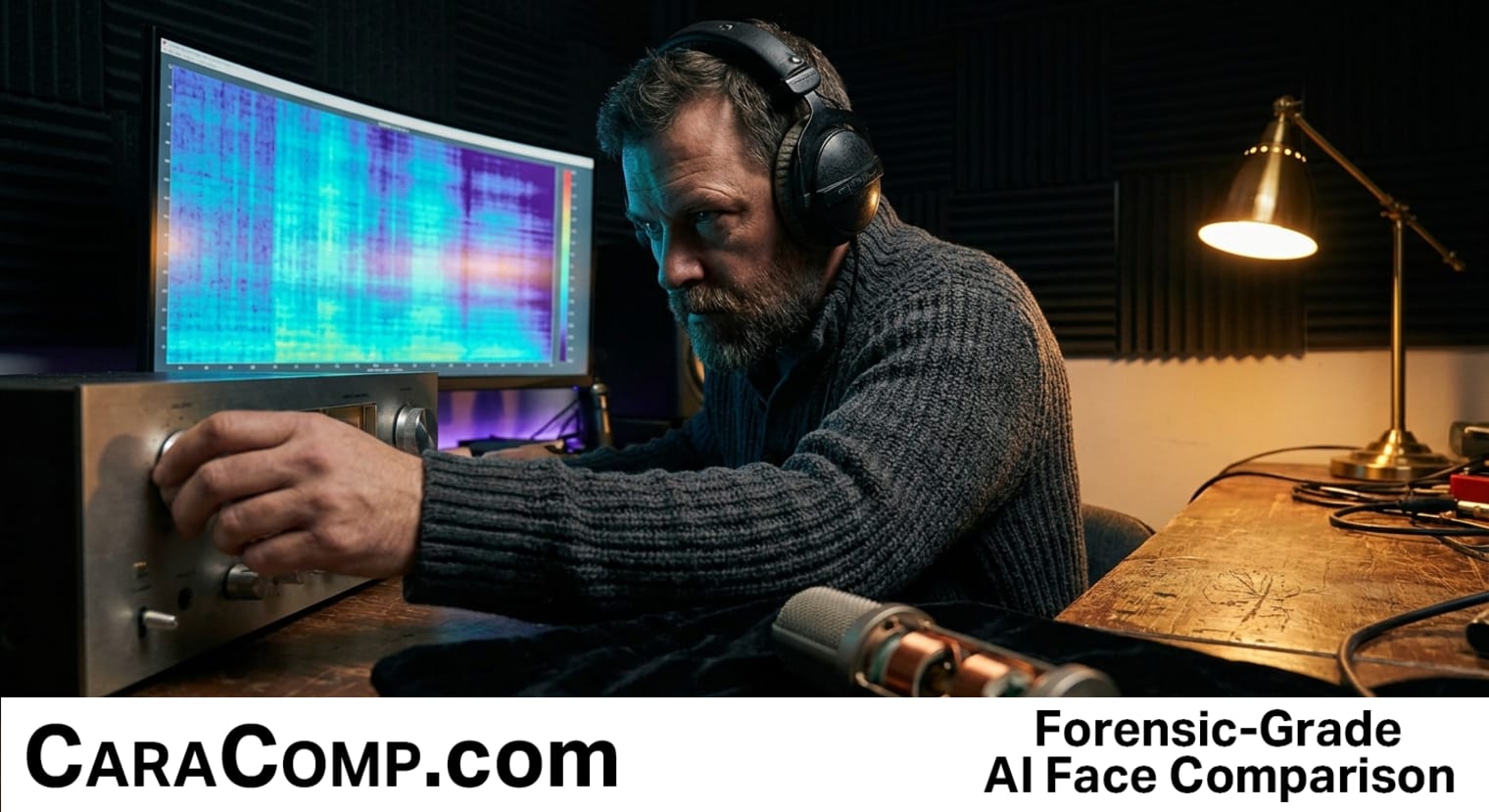
If you think you can "just tell" when a voice recording is fake, you’re statistically likely to be wrong. Recent data shows that even trained listeners identify deepfake audio with less than 60% accuracy. For a private investigator or a detective, those are career-ending odds. Relying on biological intuition in a digital-first investigation isn't just outdated; it’s a liability. The real battle for truth isn't happening in your ears—it’s happening at the waveform level where biological artifacts like jitter and shimmer leave a trail that synthetic models still can’t perfectly replicate.
At CaraComp, we see this same dangerous "intuition gap" in facial comparison. Many solo investigators still spend hours manually eyeballing photos, convinced their experience is better than an algorithm. But just as synthetic audio fails the test of physical biomechanics, manual facial comparison fails the test of Euclidean distance analysis. Whether you are analyzing a voice or a face, the carrier signal—the mathematical "how" behind the identity—is where the evidence lives. If you aren't using tools that measure these biometric embeddings, you aren't investigating; you’re guessing.
The transition from "looking and listening" to "measuring and comparing" is the hallmark of the modern investigator. We are moving toward a reality where "court-ready" means providing side-by-side analysis that proves physical consistency. For those of us in the OSINT and fraud sectors, the ability to batch-process these comparisons at an affordable price point is what separates the elite firms from those struggling to keep up. You don't need a six-figure government budget to access this level of forensic precision, but you do need to stop trusting your senses over the data.
- Human perception is a failing asset — With detection rates barely beating a coin flip, manual verification of digital evidence is no longer a defensible methodology in court.
- Physics-based detection is the new gold standard — Reliable investigation technology focuses on biological irregularities (like vocal cord jitter or facial geometry) that AI can mimic but not physically replicate.
- The "Enterprise Gap" is closing — Sophisticated Euclidean distance analysis and waveform scrutiny are finally becoming accessible to solo PIs, removing the tech advantage once held exclusively by federal agencies.
Stop eyeballing your cases and start measuring the distance between "looks right" and "is right." The waveform knows what you don't, and the math doesn't lie.
Read the full article on CaraComp: Your Ears Can't Catch a Deepfake. The Waveform Can.


Comments
Post a Comment