Why Your Eyes Can't Spot a Deepfake — And What Actually Can
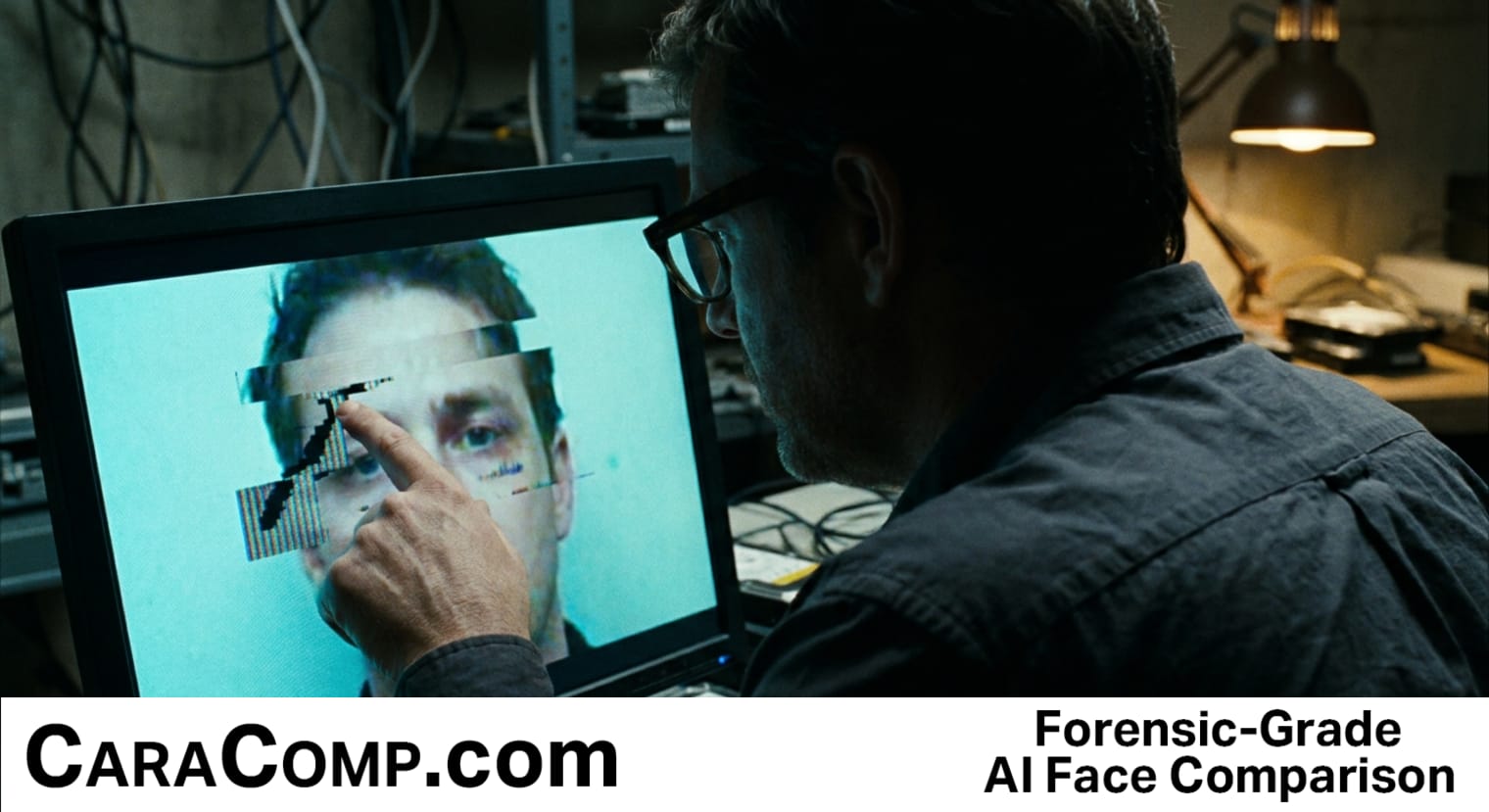
Your eyes are officially a liability. If you believe your "investigator’s gut" is enough to spot a deepfake or confirm a facial match in a high-stakes case, you are flipping a coin with your professional reputation. New research shows that over 53.5% of people are deceived by digitally altered media. In the world of private investigation and OSINT, that failure rate is a career-ender. The era of "looking for the glitch" is dead; the artifacts we used to rely on—bad lighting, weird blinks, sync issues—have been engineered out of existence.
For the solo investigator, this creates a terrifying technical gap. We see it every day at CaraComp: professionals spending hours manually squinting at two photos, trying to decide if the subject in a grainy doorbell cam is the same person in a social media profile. If the average person can’t even tell if a face is real, how can a PI expect to perform precise facial comparison across different lighting, angles, and years of aging without technical backup? Reliance on visual intuition isn't just outdated—it’s dangerous.
The solution isn't to work harder; it's to stop guessing. Professional investigation requires moving beyond the spatial domain of what we see and into the mathematical domain of Euclidean distance analysis. While enterprise-level tools have traditionally kept this tech behind a $2,000-a-year paywall, the need for objective, court-ready analysis has never been more urgent for the small firm. If you aren't using software to validate your visual findings, you aren't conducting a modern investigation—you’re providing an opinion that a defense attorney will tear apart in minutes.
- Visual intuition is a forensic dead end. With humans failing to detect manipulations at a rate barely better than chance, any investigation relying on "eye-balling" a match is susceptible to critical error.
- Euclidean distance is the new gold standard. Modern facial comparison must rely on mathematical distance between facial landmarks, providing a level of precision that survives cross-examination and neutralizes the "deepfake" deception.
- The tech gap is a business risk. Investigators who refuse to adopt affordable, enterprise-grade comparison tools will find themselves unable to compete with tech-forward peers who can close cases with objective data in seconds.
The "visual skill" of detection has been replaced by signal analysis and mathematical comparison. It’s time to stop trusting your eyes and start trusting the math.
Read the full article on CaraComp: Why Your Eyes Can't Spot a Deepfake — And What Actually Can


Comments
Post a Comment