Deepfakes Fool Your Eyes in 30 Seconds. The Math Catches Them Instantly.
Your eyes are lying to you for as little as $300. That is the current market price for consumer-grade deepfake software capable of swindling a victim out of $69,000 in a single video call. While investigators have historically relied on "gut feeling" and manual side-by-side photo reviews, that methodology is now an active liability. In a landscape where synthetic faces are engineered to trigger human trust in under 30 seconds, the "visual match" is officially dead.
The recent surge in deepfake-related fraud—accounting for over $200 million in losses in early 2025 alone—proves that scammers have successfully weaponized human biology. We are evolved to process faces as a whole, a "gestalt" perception that prioritizes speed over accuracy. Scammers don’t need to pass a forensic audit; they just need to pass a glance. For the solo private investigator or OSINT professional, this creates a terrifying gap: if you can't tell the difference between a real subject and a high-fidelity synthetic impersonation, your case integrity is non-existent.
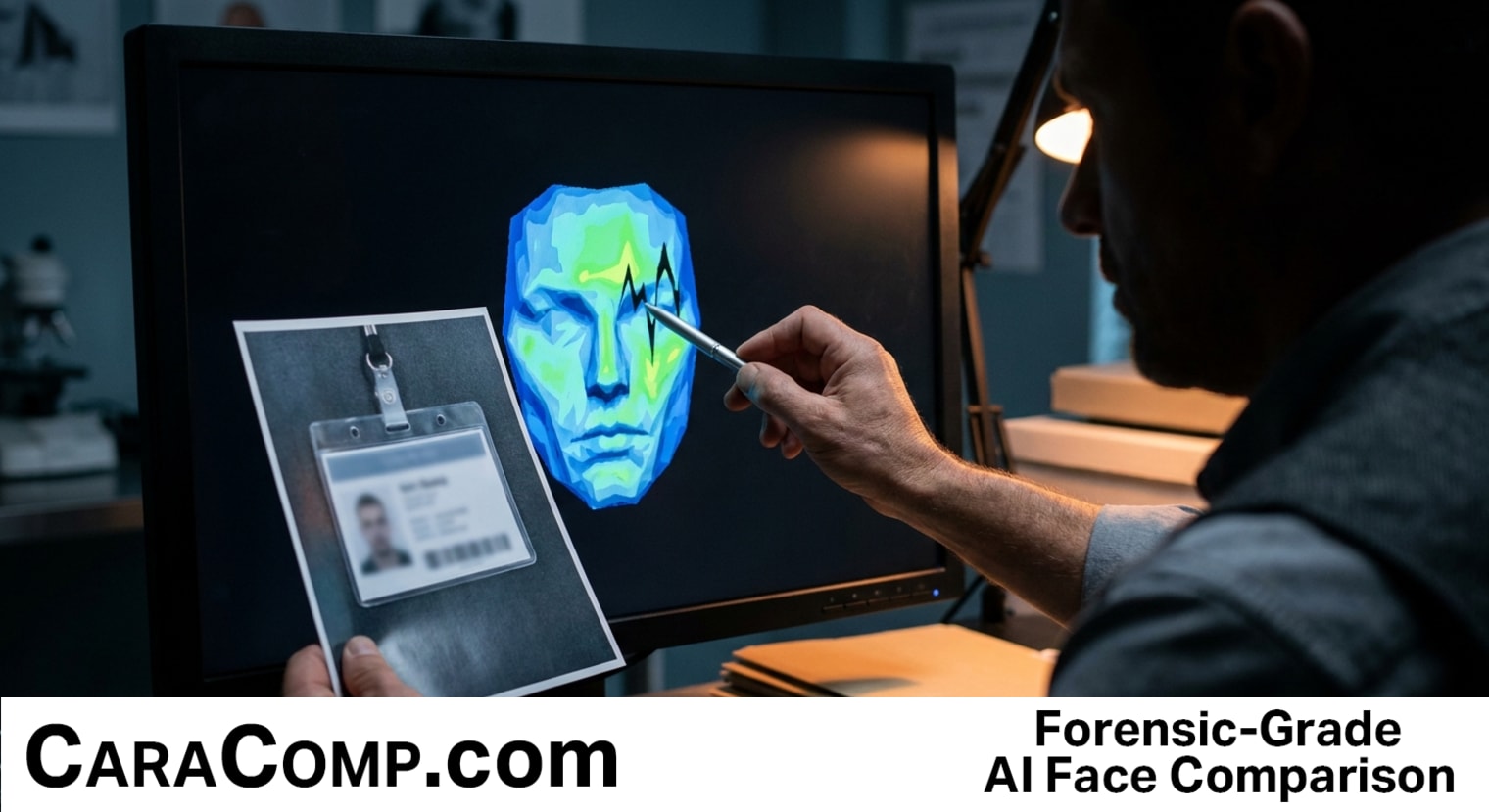
At CaraComp, we look at this through the lens of Euclidean distance analysis. While a deepfake is optimized to look real to a human eye, it is almost never optimized to survive a mathematical vector comparison. When we convert a face into a 512-dimensional numerical map, the "heightened realism" of AI disappears. The math doesn't care about skin texture or a convincing badge; it cares about the precise geometric relationships that stay consistent across a person’s lifetime but collapse in synthetic models.
- Human intuition is now an investigative liability: Deepfakes are specifically designed to exploit the "trust gap" in human perception, making manual visual comparison a high-risk gamble.
- Mathematical verification is the only defense: Professional investigation requires moving beyond "looks like" to "measures as." Euclidean distance analysis provides a defensible, court-ready metric that synthetic faces cannot easily replicate.
- The tech barrier has been broken: Enterprise-grade analysis used to be reserved for federal agencies with six-figure budgets, but solo PIs now have access to the same math to protect their reputations and their clients.
The future of investigation isn't about scanning crowds or surveillance; it’s about the cold, hard math of facial comparison. If you are still relying on a "good eye" to close cases, you aren't just behind the curve—you're the target.
Read the full article on CaraComp: Deepfakes Fool Your Eyes in 30 Seconds. The Math Catches Them Instantly.


Comments
Post a Comment