Your Fingerprint Never Logged You In. Here's What Actually Did.
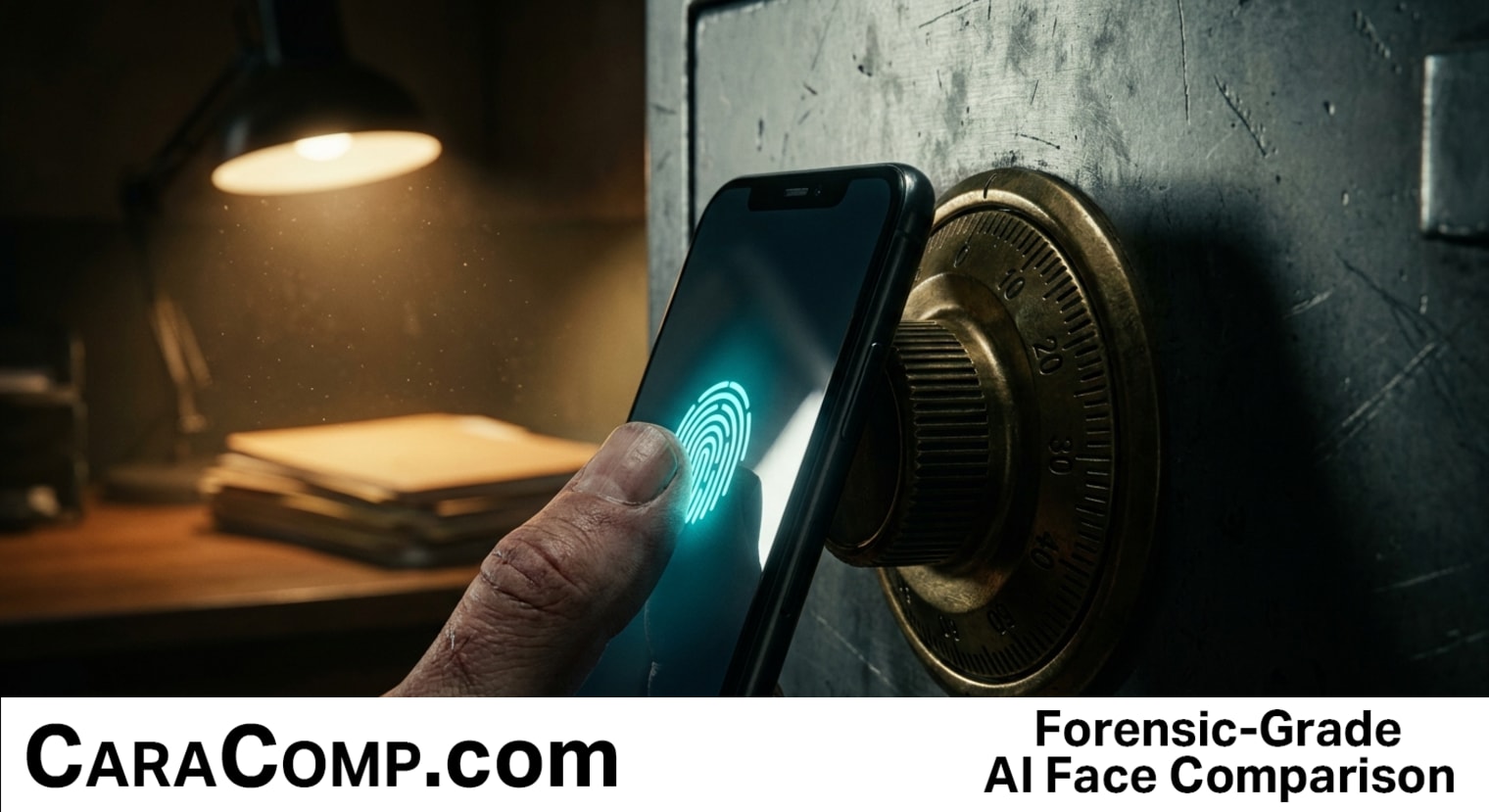
Stop telling your clients that biometric login is an unhackable wall. Your face isn't actually a password—it is a glorified shortcut. The startling reality of digital architecture is that your fingerprint has likely never authenticated you to a remote server in your life. Instead, it simply unlocks a local "vault" on your device that hands over a standard, vulnerable password. The password never went away; it just got a more expensive front door.
For the modern investigator, this distinction is the difference between closing a case and chasing a ghost. We often see OSINT professionals and private investigators treat biometric access as the "end of the road" for security, but understanding that a master credential still exists behind the scenes changes the entire investigative strategy. If the password still exists, the recovery paths—SMS resets, email fallbacks, and secondary PINs—still exist. These are the independent attack surfaces where real digital evidence is found.
At CaraComp, we bridge the gap between "consumer convenience" and "professional analysis." While the world obsesses over the "magic" of unlocking a phone with a glance, serious investigators know that facial comparison is about data, not magic. You cannot stake your professional reputation on a 2.4/5 reliability consumer tool or a "black box" biometric scan. You need Euclidean distance analysis—the same math used by federal agencies—to prove a match in a way that holds up under cross-examination.
The industry is shifting. We are moving away from the era of manual, three-hour photo comparisons and toward high-speed, affordable case analysis. The "biometric myth" reminds us that technology is only as good as the methodology behind it.
- Biometrics are local handshakes, not remote security — Your visual data stays on the chip; a vulnerable token is what actually travels to the server, meaning the "unhackable" face ID is only as strong as the device's fallback PIN.
- Comparison is not recognition — While consumer tools focus on scanning crowds or unlocking phones, professional investigators must use side-by-side facial comparison to generate court-ready reports that quantify the mathematical probability of a match.
- The "Fallback" is the real target — Because every biometric system requires a manual override for hardware failures, the "forgot password" workflow remains the primary vulnerability in any digital investigation.
Don't be fooled by the marketing of "passwordless" futures. The credentials are still there, the risks are still there, and the need for precision investigative tools has never been higher. If you're still manually comparing faces across case files, you're not just wasting time—you're falling behind the tech curve.
Read the full article on CaraComp: Your Fingerprint Never Logged You In. Here's What Actually Did.


Comments
Post a Comment