The Face Never Existed. The ID Is Stolen. The Match Is Perfect.
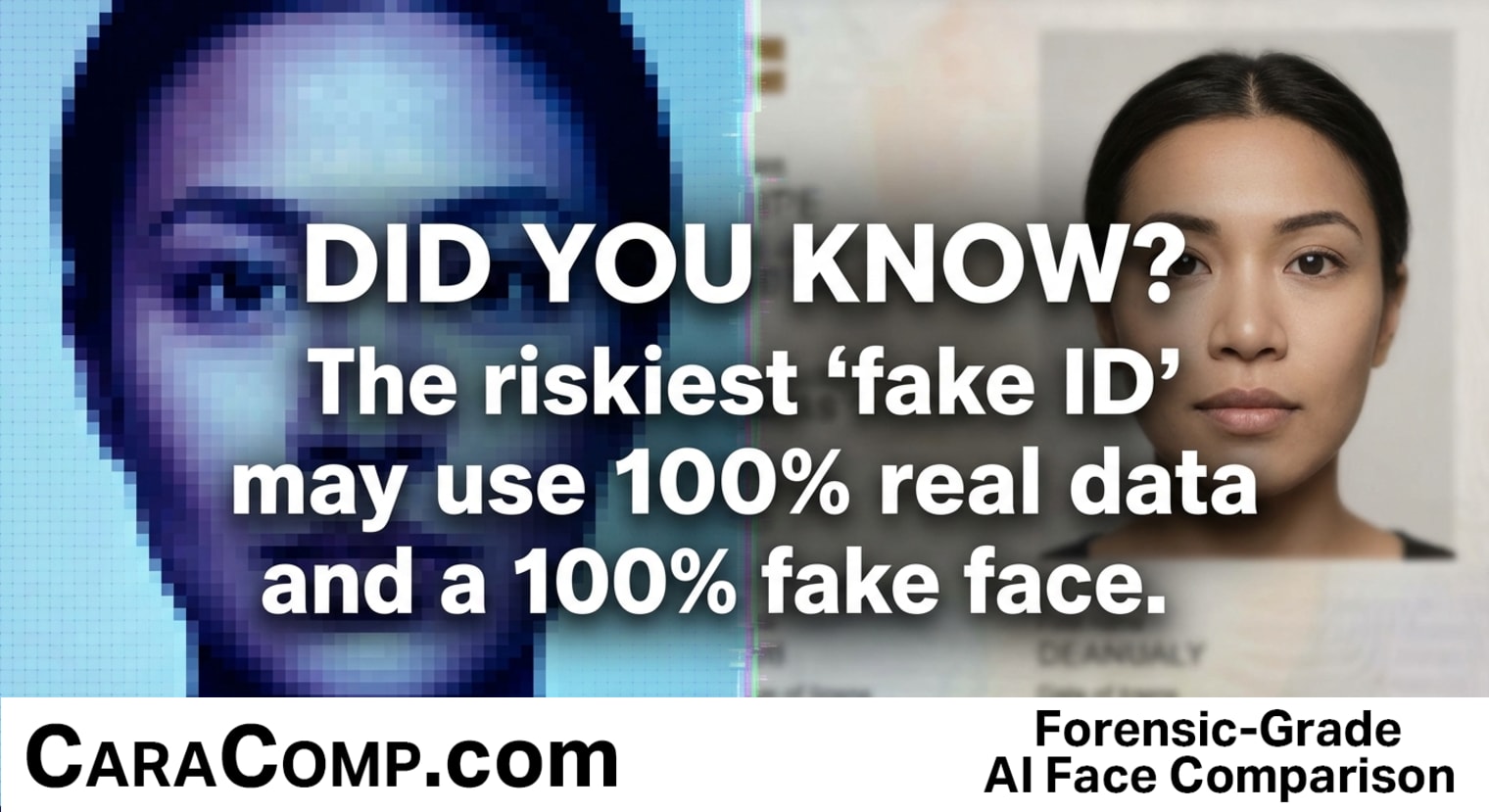
Stop looking for the "tell." If an investigator sees a 100% perfect match between a government ID and a liveness video, they shouldn't be closing the case—they should be sounding the alarm. We have officially entered a phase where internal consistency is the hallmark of a high-end forgery, not the proof of a legitimate person. When the face on the document and the face in the video are generated from the same synthetic source, the "match" isn't evidence; it's a closed-loop fabrication.
The latest industry data reveals a terrifying surge in deepfake-credential hybrid attacks. By pairing stolen data with AI-generated faces that have never existed, attackers are bypassing legacy verification systems with a 68% success rate. For the solo private investigator or OSINT researcher, this means the old manual "eye test" is effectively dead. If you are still spending three hours manually comparing faces across photos, you aren't just wasting time—you’re likely falling for a coordinated spoof that was engineered to fool the human eye.
At CaraComp, we recognize that the gap between federal-level tech and the solo investigator’s toolkit is a security vacuum. Fraudsters are using 2026-level AI, while many PIs are still priced out of enterprise tools, forced to rely on unreliable consumer apps. We believe that professional-grade Euclidean distance analysis shouldn't cost $2,400 a year. To catch a synthetic identity, you need more than a "pass/fail" check; you need precision analysis and court-ready reporting that treats the match as a data point, not a conclusion.
- The "Perfect Match" is the new red flag: Because AI generates both the ID photo and the liveness stream from a single file, a perfect match often proves the absence of a real human, not the presence of one.
- Internal consistency is no longer independent proof: Investigators must look outside the identity package—at behavioral signals and Euclidean distance anomalies—to break the loop of a synthetic forgery.
- Technology parity is a baseline requirement: Fraud losses are projected to hit $40 billion by 2027; solo investigators cannot defend clients against AI-driven fraud using manual methods or sub-par consumer tools.
The job is no longer just to see if two faces match. The job is to determine if they belong together. In a world of synthetic identities, the "perfect match" is the first thing you should distrust.
Read the full article on CaraComp: The Face Never Existed. The ID Is Stolen. The Match Is Perfect.


Comments
Post a Comment