The Face in That Video Is Flawless. That's Your First Red Flag.
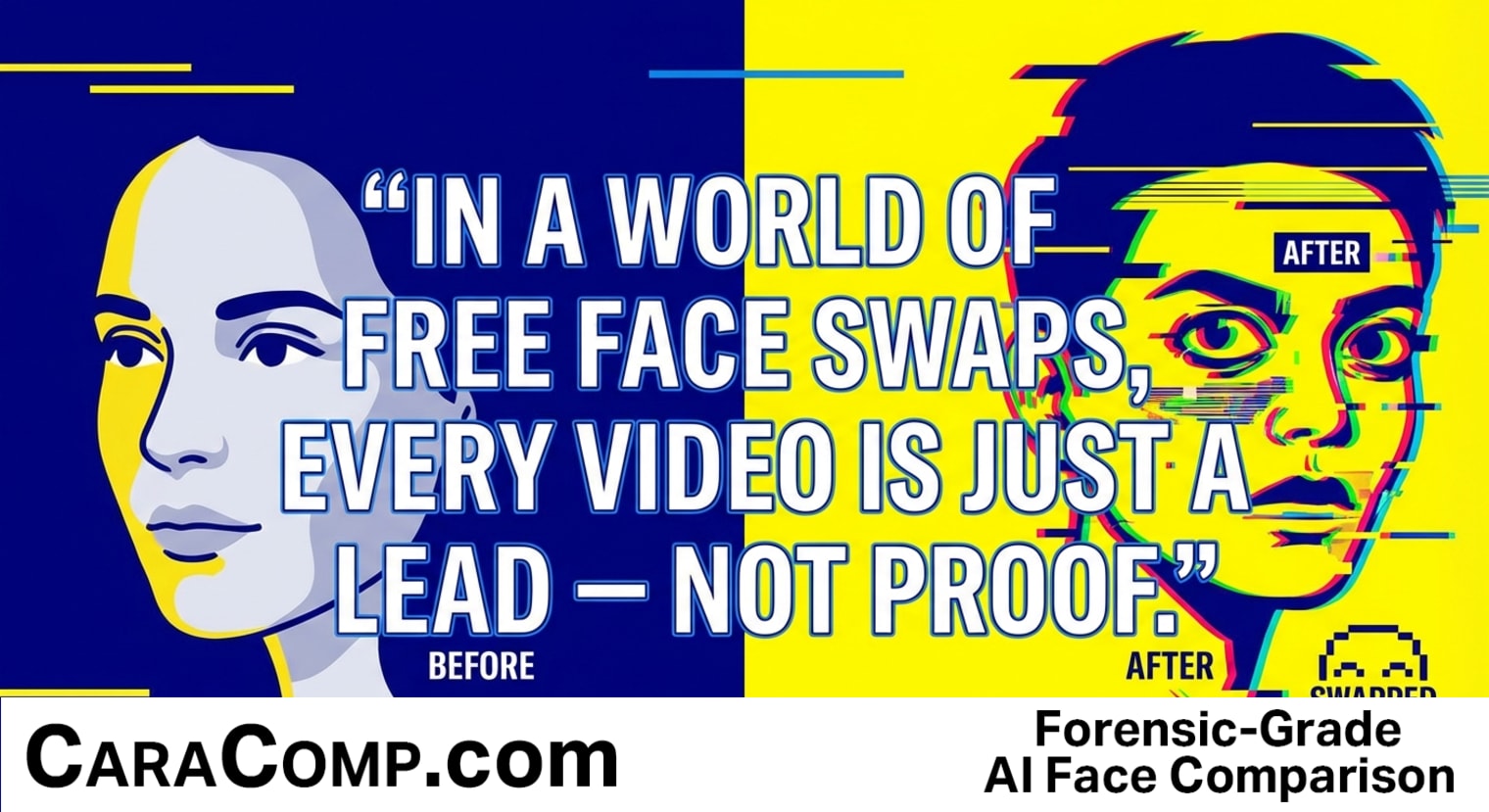
Your "gut feeling" is officially obsolete. When free, zero-skill tools can transpose a face onto moving video with frame-by-frame lighting adjustments and perfect landmark mapping, the era of visual trust is over. For the private investigator, OSINT researcher, or insurance adjuster, this isn't just a tech trend—it’s a professional liability. If 81% of AI fraud cases now involve deepfakes, then every video file landing in your inbox is a potential landmine for your reputation.
The real danger isn't that fakes exist; it's that investigators are still looking for 2018-era "glitches" like blurry hairlines or mismatched skin tones. Modern AI doesn't just paste a mask; it translates geometry. It maps landmarks—the specific Euclidean distances between eyes, nose, and jaw—and marries them to the original subject’s movement. This means the fake face laughs, blinks, and turns with authentic neuromotor patterns. You aren't looking for a "bad edit" anymore; you’re looking for a geometric mismatch that the human eye simply cannot calculate in real-time while juggling five other cases.
This is where professional facial comparison becomes the investigator's shield. We have to stop treating video as "proof" and start treating it as a high-stakes lead. Validation requires more than a casual glance; it requires a systematic analysis of the subject’s known biometric markers against the evidence provided. If you cannot explain the math behind why a face matches—or doesn't—you shouldn't be presenting it in a report. In the courtroom, "it looked real to me" is a losing strategy.
- The "Seam" is Dead: Modern fakes don't have visible edges; they have temporal inconsistencies. Investigators must shift focus from looking for static artifacts to performing rigorous geometric landmark analysis across multiple frames.
- Explainability is the New Gold Standard: A "match score" from a black-box consumer tool won't hold up in a deposition. Professionals need investigation technology that provides court-ready documentation of specific facial distances and structural features.
- Verification is Step One, Not the Final Check: In an environment where over half of identity verification attempts are now impacted by deepfake fraud, systematic facial comparison must be the first gate every piece of visual evidence passes through before it is entered into a case file.
The gap between enterprise-level forensic capability and the solo PI's toolkit is finally closing, but the stakes have never been higher. Don't be the investigator who gets burned by a "flawless" video that was actually generated for free on a fraudster's lunch break. Adapt your workflow, or risk being left behind by the tech you're supposed to be mastering.
Read the full article on CaraComp: The Face in That Video Is Flawless. That's Your First Red Flag.


Comments
Post a Comment