The Courtroom Question You're Not Ready For: 'Prove This Video Isn't a Deepfake'
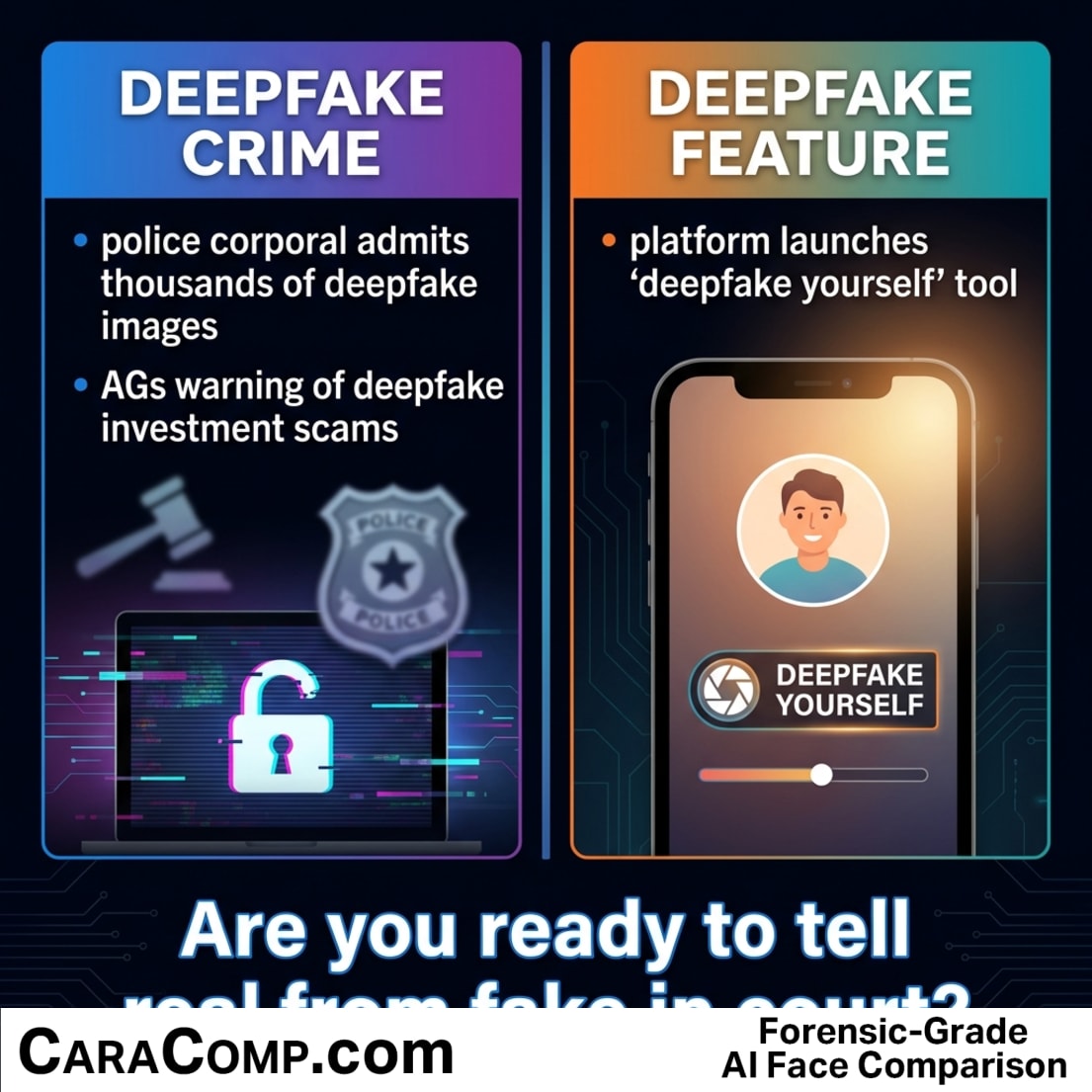
A Pennsylvania State Police corporal just pleaded guilty to creating 3,000 AI-generated deepfake images using privileged law enforcement databases. This isn't a speculative headline from a tech blog—it is a catastrophic breach of trust that fundamentally changes the rules for every private investigator and OSINT professional in the field. When the threat of fabrication comes from within the chain of custody, the "it looks real to me" standard of evidence is officially dead.
For years, investigators have viewed deepfakes as a "tomorrow problem" or something relegated to high-level political interference. The Kamnik case proves that synthetic media is already an active tool for fraud and harassment, and it’s being powered by the same source photos you use in your daily case files. As state attorneys general issue coordinated warnings about deepfake-powered investment scams, solo investigators are facing a new, brutal reality: defense counsel no longer needs to prove your evidence is fake; they only need to suggest that it could be.
The industry is shifting from a focus on detection to a desperate need for authentication. If you are a PI presenting surveillance footage or a facial match in 2026 without a technical methodology to back it up, you are walking into a trap. Using high-level facial comparison—specifically Euclidean distance analysis—is no longer just about identifying a subject; it is about providing a court-ready mathematical baseline that separates forensic reality from AI synthesis. You cannot fight an algorithm with an intuition.
- The "Reasonable Doubt" weaponization — Defense attorneys are already using the existence of deepfakes to undermine legitimate video evidence. Without professional-grade comparison reports, your primary evidence is vulnerable to being dismissed as "synthetic."
- Institutional access as a threat vector — The fact that 3,000 fakes were generated using police databases means that source material for deepfakes is closer to your case files than you think. Authentication protocols are now a professional liability requirement.
- Authentication vs. Detection — While platforms like YouTube scramble to detect fakes, investigators must focus on authenticating the real. Hard biometric data and comparison metrics are the only way to prove a match is undisputed in a courtroom setting.
The gap between the tech-savvy investigator and the manual researcher is no longer just about speed; it’s about professional survival. If you can't explain the mathematical distance between two faces, you shouldn't be in the courtroom.
Read the full article on CaraComp: The Courtroom Question You're Not Ready For: 'Prove This Video Isn't a Deepfake'


Comments
Post a Comment