Regulators Split Facial AI in Two. Investigators Need to Know Which Side They're On.
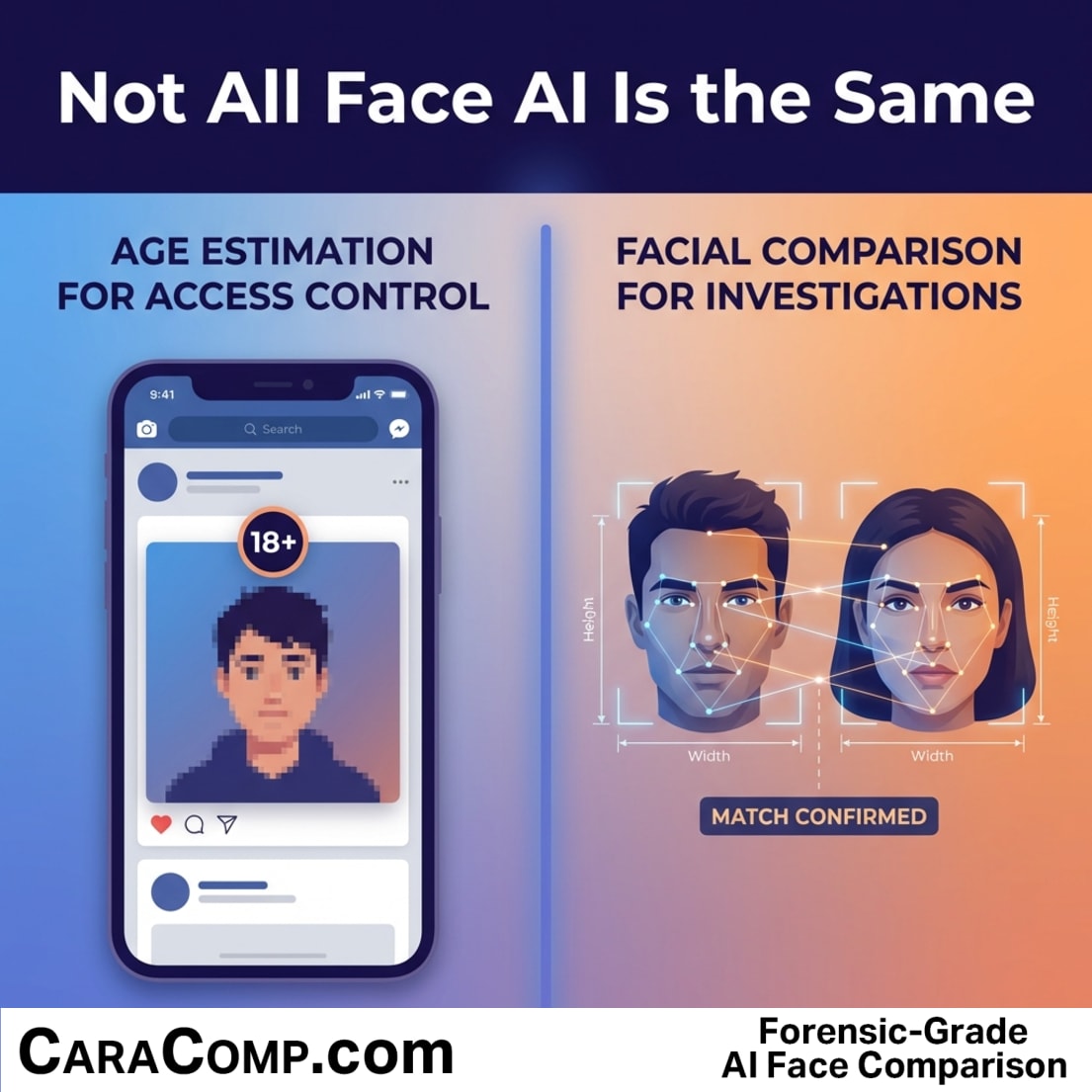
Regulators are inadvertently handing professional investigators a massive legal shield, provided you’re smart enough to know which side of the technical fence you're standing on. While the White House and international eSafety commissioners are busy scrutinizing "age estimation" and broad biometric surveillance, they are effectively carving out a protected class for forensic facial comparison. For the solo private investigator or OSINT researcher, this distinction isn’t just semantic—it’s the difference between evidence that holds up in court and a case that gets tossed for "algorithmic bias."
The industry is splitting in two. On one side, you have probabilistic "age gates" used by social media giants—tools that NIST has already flagged for high error rates and demographic "mean-reversion." On the other side, you have the work we actually do: controlled, identity-specific facial comparison. When you use Euclidean distance analysis to compare a subject’s DL photo against a known surveillance frame, you aren't "guessing" a stranger's age or scanning a crowd. You are performing a deterministic analysis of geometric points. This is standard investigative methodology, not a controversial AI "black box."
For too long, solo PIs have been priced out of this clarity. Enterprise-grade tools that offer this level of forensic precision often demand five-figure contracts, forcing small firms to rely on unreliable consumer "search engines" that regulators (and defense attorneys) are already beginning to target. At CaraComp, we’ve democratized that enterprise-level Euclidean analysis for $29 a month. We give you the court-ready reporting and batch processing required to show a jury that your results aren't "AI guesswork"—they are mathematical comparisons of specific, relevant evidence.
- Methodology is your best defense: As courts become more skeptical of "black box" AI, investigators must be able to articulate that they are using Euclidean distance comparison (side-by-side analysis) rather than probabilistic trait inference (scanning for characteristics).
- The regulatory "moat" is growing: New frameworks are targeting mass surveillance and age-guessing tools. By sticking to dedicated comparison software, investigators distance themselves from the legal and ethical "grey zones" of consumer search tools.
- Enterprise tech is no longer an elite gatekeeper: Solo investigators can now access the same high-caliber analysis used by federal agencies, allowing them to provide professional, court-admissible reports without the $1,800/year price tag.
The era of "guessing" is over. If you're still manually comparing photos or using unreliable consumer tools, you're leaving your reputation—and your clients' cases—exposed to the next wave of biometric regulation. It’s time to move toward professional comparison tools that are built for the courtroom, not the airport terminal.
Read the full article on CaraComp: Regulators Split Facial AI in Two. Investigators Need to Know Which Side They're On.


Comments
Post a Comment