Radiologists Miss 59% of Fake X-Rays on First Look — What That Proves About Your Case Photos
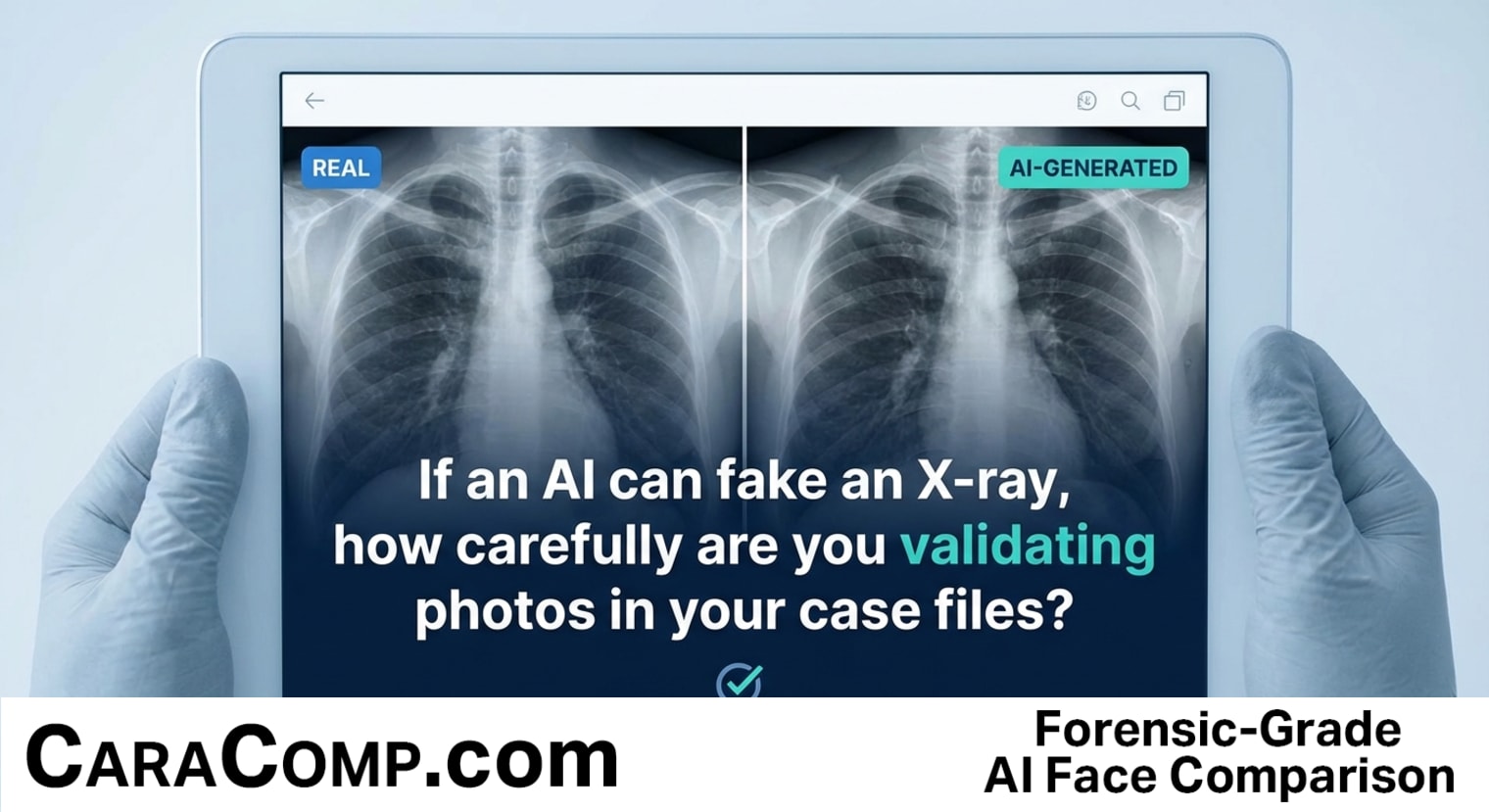
If a radiologist with fifteen years of clinical training can’t spot a fake image 59% of the time, your "experienced eye" is officially a liability in a modern investigation. A recent study from the Radiological Society of North America found that when experts weren't explicitly looking for AI-generated forgeries, they missed them more often than they caught them. For the private investigator or OSINT researcher relying on a "gut feeling" to verify a witness photo or a CCTV still, this is a massive wake-up call.
The study proves that professional experience offers zero protection against sophisticated synthetic media. In fact, thirty-year veterans performed no better than residents. The problem isn't a lack of expertise; it's that human visual processing is tuned to find what’s "right," not what’s mathematically "off." In the world of case analysis, this means the days of manually comparing faces across photos and calling it "due diligence" are over. If you aren't using systematic measurement, you are guessing.
At CaraComp, we see this transition from visual inspection to Euclidean distance analysis as the new baseline for professional standards. While enterprise-grade tools have historically cost investigators upwards of $2,000 a year, the need for that same level of mathematical certainty has never been higher. When a suspect’s jawline is subtly nudged or a landmark is shifted by two pixels, your eyes will tell you it’s authentic. The math, however, will tell a different story.
Investigators must move toward a model of facial comparison that relies on reproducible geometric data rather than subjective glances. This isn't about scanning crowds or mass data collection—it's about verifying the evidence already in your file. By using landmark-based analysis, solo investigators can finally bridge the gap between "looking" at a face and "analyzing" it for a court-ready report.
- Professional intuition is no longer a defense — The 41% detection rate among experts proves that "I’ve been doing this for 20 years" won't hold up when AI-generated evidence enters the mix.
- Measurement is the only safeguard — Moving from passive visual review to active Euclidean distance analysis is the only way to catch "too perfect" synthetic forgeries.
- The tech gap is closing for solo PIs — You don't need a federal budget to access the same geometric verification tools that protect your reputation and your cases.
Read the full article on CaraComp: Radiologists Miss 59% of Fake X-Rays on First Look — What That Proves About Your Case Photos


Comments
Post a Comment