Most Deepfake Attacks Don't Target Celebrities — They Target the Identity Check You Just Ran
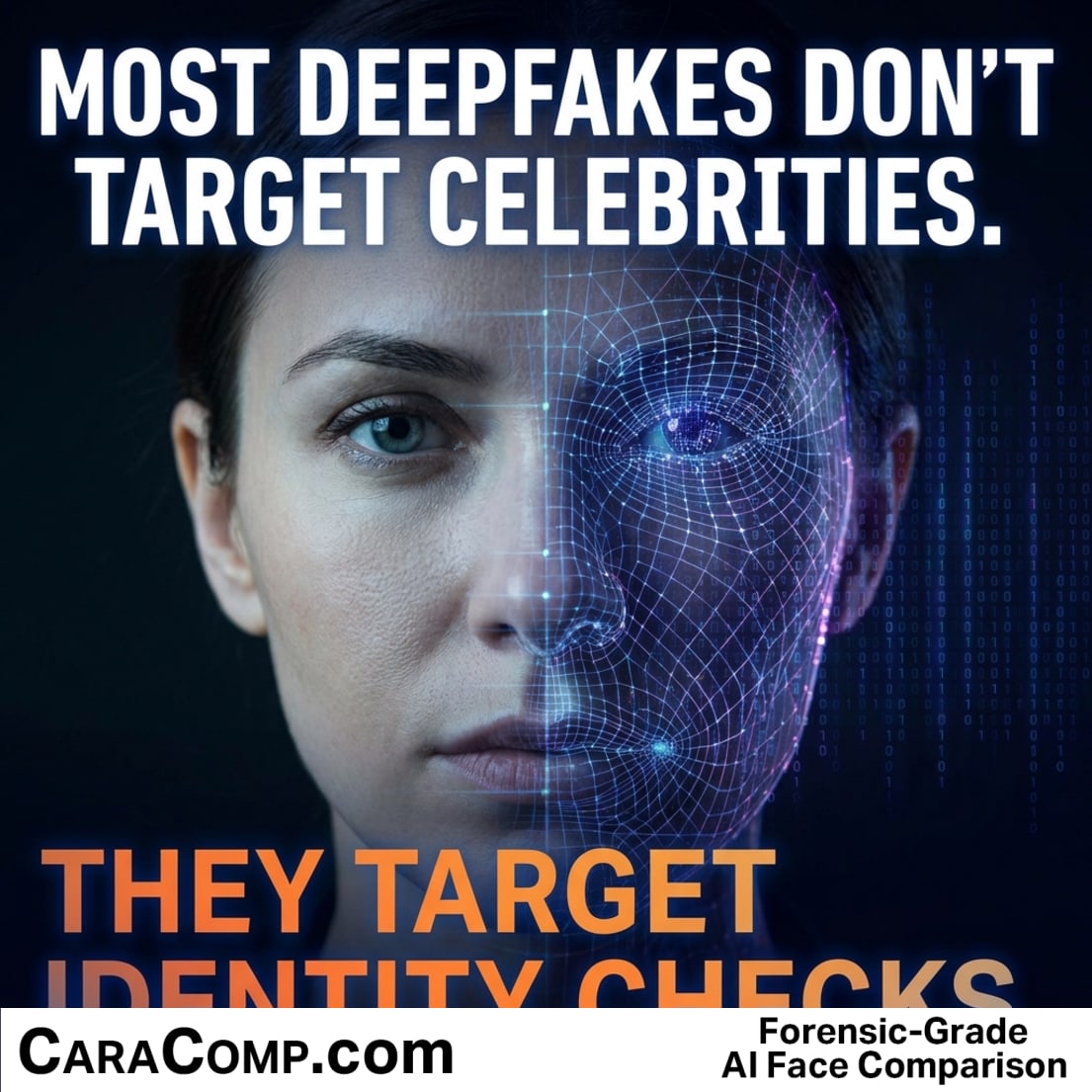
Stop looking for deepfakes on social media. The most dangerous synthetic faces aren't designed to go viral—they are designed to quietly clear the identity check currently sitting on your desk. While the public worries about political hoaxes, professional investigators are facing a silent epidemic of AI-generated personas infiltrating insurance claims, KYC checks, and legal filings. If you are still relying on a "gut feeling" or manual visual comparison to verify a subject's identity, you aren't just behind the curve; you're a liability to your clients.
The game has shifted from visual trickery to mathematical deception. Modern synthetic fraud doesn't need to fool a human eye; it only needs to land in the right neighborhood of a 128-dimensional mathematical space. When an AI analyzes a face, it calculates the Euclidean distance between facial landmarks. Fraudsters are now industrializing the creation of faces that match these specific mathematical coordinates. For the solo private investigator or the small SIU firm, this means the old way of "eyeballing it" is officially dead.
At CaraComp, we see this tech gap every day. Enterprise-level agencies have spent years using high-end facial comparison technology to bridge this gap, but they’ve kept the price tag at $1,800 a year or more, effectively locking out the independent investigator. This leaves the "little guy" stuck with unreliable consumer search tools that lack professional accuracy or, worse, nothing at all. To survive this surge in synthetic identity fraud, solo investigators need the same enterprise-grade Euclidean distance analysis—without the government-contract pricing.
- Mathematical benchmarks are the new standard of proof: Visual similarity is no longer enough for a court-ready report. Investigators must use Euclidean distance analysis to provide objective, quantifiable evidence that stands up to synthetic spoofs.
- The "Detection Gap" is your biggest risk: Synthetic identities don't complain to the police, meaning fraud can go undetected for years. Professional-grade facial comparison is the only way to flag these anomalies before a case is closed.
- Affordability is no longer an excuse for technical obsolescence: With the rise of 8 million deepfakes, having high-caliber investigation technology is a baseline requirement, not a luxury.
The investigators who thrive in this new landscape will be those who stop treatng AI as a threat and start using it as their primary filter. The math doesn't lie, even when the face does.
Read the full article on CaraComp: Most Deepfake Attacks Don't Target Celebrities — They Target the Identity Check You Just Ran


Comments
Post a Comment