Governments Lock Down Biometric IDs — Investigators Get Left Outside
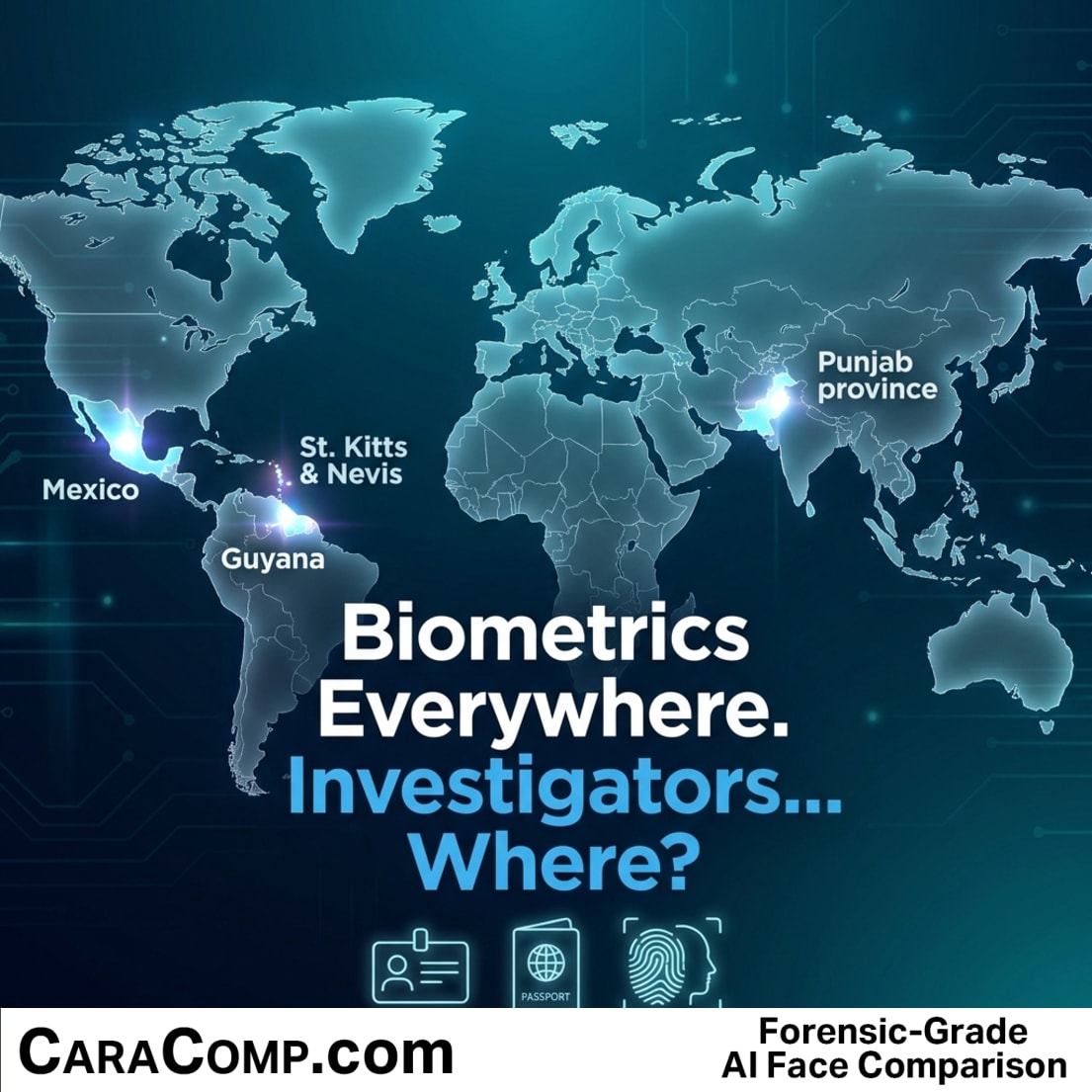
Governments are currently building biometric fortresses and leaving the keys under a mat that solo investigators aren't allowed to touch. Guyana’s recent activation of the Digital Identity Card Act isn’t just a win for state security; it’s a loud warning shot for every private investigator, OSINT researcher, and insurance fraud specialist. While nations from Singapore to South Africa race to centralize facial data, the independent investigative community is being structurally locked out of the very infrastructure they need to verify identities and close cases.
This isn't just about privacy—it's about a widening technology gap. Federal agencies and massive corporations have the budget to play in this new biometric sandbox, using enterprise-grade Euclidean distance analysis to match faces with mathematical certainty. Meanwhile, the average solo PI is still squinting at two monitors, manually comparing grainy surveillance footage against social media profiles. You are essentially bringing a knife to a drone fight. If you’re still relying on manual comparison or "free" consumer tools with abysmal reliability ratings, you aren't just working slower; you are courting a professional disaster. One missed match or one false positive in a court-ready report can end a career.
The irony is sharp: the people who need identity verification the most—the ones on the front lines of fraud and missing persons cases—are being forced into a corner. You either pay four-figure enterprise ransoms for software or settle for unreliable junk that makes your firm look amateur. At CaraComp, we see this lockout for what it is: a threat to the industry's relevance. Professional-grade facial comparison shouldn't be a state-guarded secret or a luxury for the 1%. It should be the standard methodology for every licensed professional who stakes their reputation on the truth.
- The Structural Lockout: State-controlled biometrics move identity verification behind high legal walls, rendering traditional public record searches obsolete and leaving manual investigators in the dark.
- The Credibility Chasm: As synthetic identities and deepfakes accelerate, investigators without access to scientific facial comparison tools will find it impossible to justify their findings to skeptical clients or judges.
- The Professional Displacement: Larger firms are already adopting advanced biometrics; solo PIs who fail to integrate affordable, enterprise-grade analysis will be priced out of the market by those who can close cases in seconds rather than hours.
The wall is getting higher. The question is whether you’re going to keep staring at it or start using the tools that let you see right through it.
Read the full article on CaraComp: Governments Lock Down Biometric IDs — Investigators Get Left Outside


Comments
Post a Comment