A Facial Recognition 'Match' Isn't Evidence Until It Survives These 4 Hidden Steps
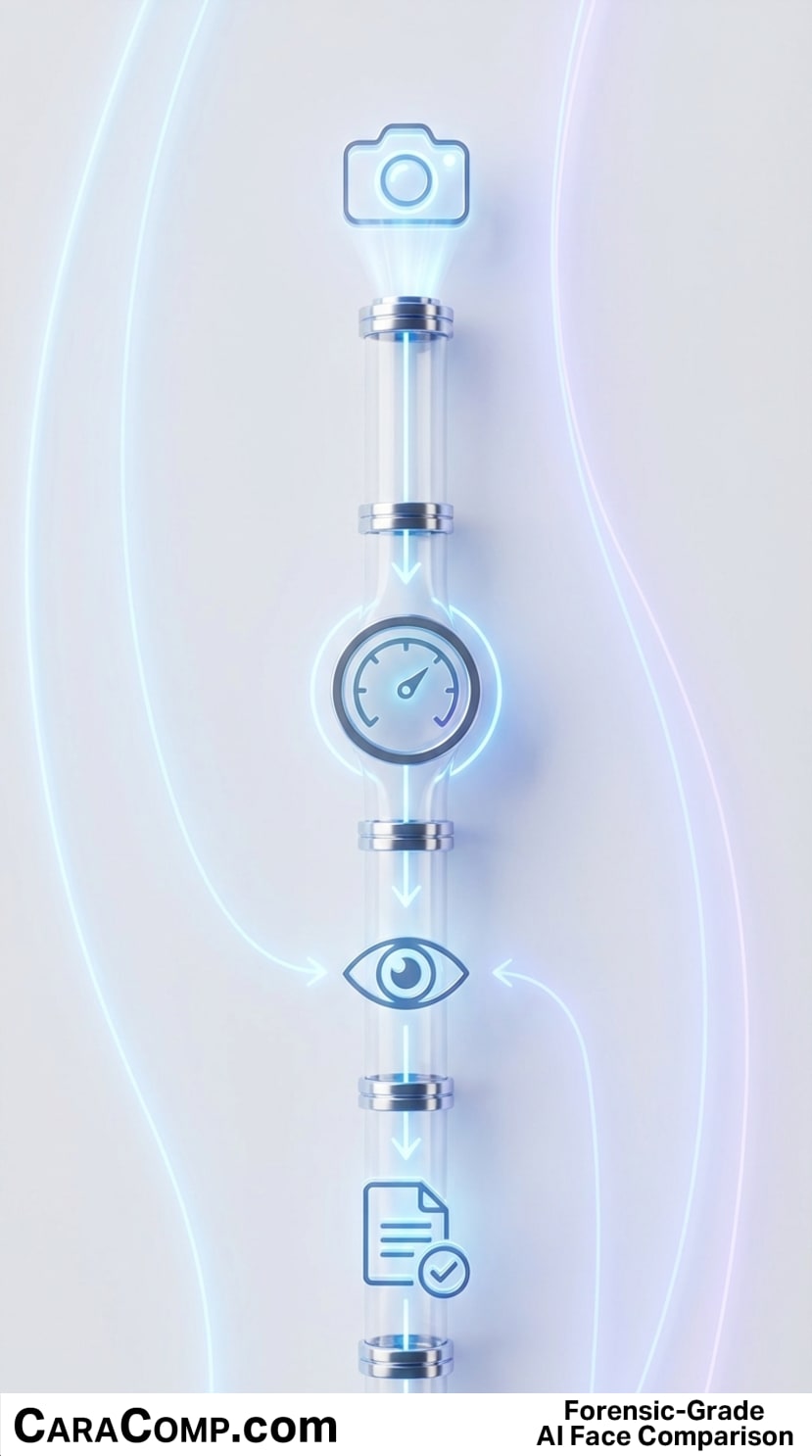
If your investigation relies on a facial recognition "match" pulled from grainy surveillance footage, you aren't just taking a risk—you are likely looking at a 50-point accuracy nosedive before the algorithm even finishes its work. For the solo private investigator or the small fraud unit, that raw "match" score isn't a conclusion; it’s a liability. When the inter-eye pixel distance drops below 24 pixels, the reliability of your evidence effectively vanishes, yet most tools will still spit out a high confidence score as if the data were pristine.
This is where the distinction between "surveillance" and professional facial comparison becomes critical. In the OSINT and private investigation world, we don't need tools that scan crowds; we need Euclidean distance analysis that holds up when a client asks how we verified a subject. The industry is currently flooded with consumer-grade search tools that offer high speed but zero forensic depth. If you cannot explain the "why" behind a match, you don't have evidence—you have a guess that will be torn apart in a deposition.
At CaraComp, we see this tech gap every day. Solo investigators have been forced to choose between enterprise-grade software costing $2,400 a year or unreliable free tools that lack professional reporting. That choice is a false one. Professional-grade investigation technology should prioritize the human-in-the-loop, allowing an investigator to verify quality factors—like pose angle and illumination—before staking their reputation on a result.
- Input Quality is the Real Gatekeeper: A high similarity score is meaningless if the probe image suffers from compression artifacts or poor lighting; true professionals verify the "workability" of an image before the comparison even runs.
- Thresholds are Risk Decisions, Not Defaults: Adjusting the sensitivity of a match isn't a technical setting—it’s an investigative strategy that determines whether you’re hunting for a needle in a haystack or avoiding a false accusation.
- Court-Ready Reporting is Non-Negotiable: A screenshot of a "match" isn't professional. Real case analysis requires a breakdown of the comparison methodology that can be presented to a client or a court with confidence.
The future of investigation isn't about letting AI make the final call. It’s about using enterprise-caliber Euclidean analysis to do the heavy lifting of batch processing, then applying human expertise to close the case. If you're still manually squinting at two photos for three hours, you're not just wasting time—you're falling behind the tech curve.
Read the full article on CaraComp: A Facial Recognition 'Match' Isn't Evidence Until It Survives These 4 Hidden Steps


Comments
Post a Comment