A 95% Match Score Sounds Solid. These 3 Reality Checks Show When It Isn’t.
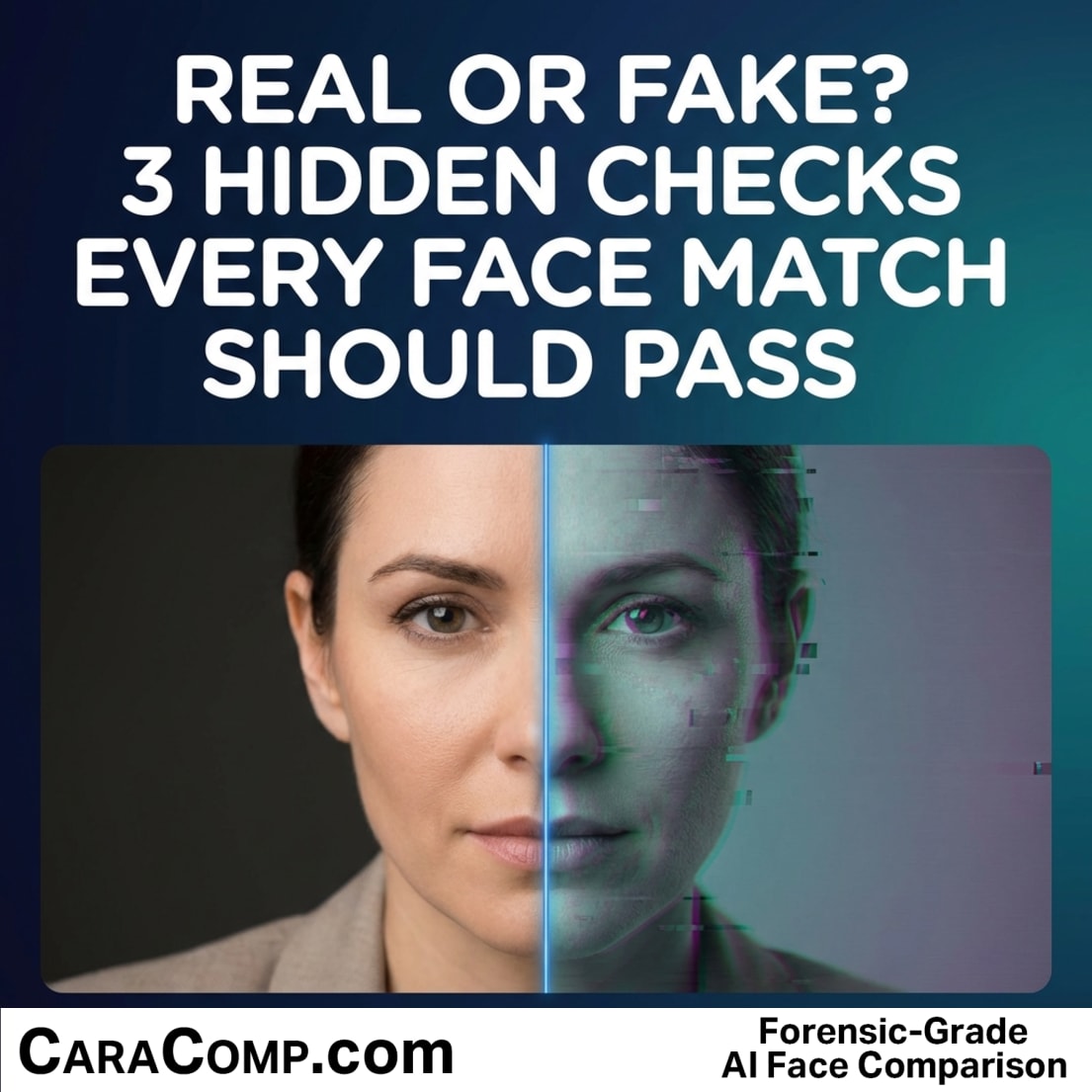
Most investigators think a 95% match score is a "case closed" moment. They are dangerously wrong. A high confidence score is not a certificate of truth; it is a mathematical calculation of Euclidean distance based strictly on the pixels provided. As cybersecurity experts recently demonstrated at RSAC 2026, even the most sophisticated systems can be defeated by injecting synthetic video directly into a camera feed. The algorithm sees a perfect match, but the person doesn't actually exist.
For solo private investigators and OSINT professionals, this is the new frontier of risk. You are no longer just looking for a face in a crowd; you are defending your reputation against synthetic data and "suboptimal" captures that give a false sense of security. If you are staking your professional credibility on a single percentage point, you’re doing it wrong. Professional facial comparison is a methodology, not just a software output.
At CaraComp, we provide the enterprise-grade Euclidean distance analysis that used to be locked behind $2,000/year government contracts. We’ve made this tech accessible for $29/mo because we believe solo PIs should have the best tools. However, having the tool is only half the battle. The modern investigator must apply "reality checks" to every match—interrogating the lighting, the head angle, and the biometric consistency across multiple frames. A 30-degree tilt in a surveillance shot can slash your effective accuracy by 40%, yet many tools will still spit out a high-confidence number without a single warning label.
- Automated match scores are vulnerable to injection attacks, meaning standard liveness checks like blinking are no longer enough to guarantee a face is real.
- Environmental variables are the silent killers of accuracy; lighting and angles can make an algorithm "hallucinate" a match that doesn't hold up under forensic scrutiny.
- Layered comparison is the only path to court-ready evidence, requiring investigators to analyze facial biometric consistency across an entire case set rather than relying on a single snapshot.
The goal isn't just to find a match; it’s to find a match that holds up when a client—or a judge—starts asking questions. Stop settling for consumer-grade tools that offer high "scores" with zero reliability. It's time to upgrade your tech and your tactics.
Read the full article on CaraComp: A 95% Match Score Sounds Solid. These 3 Reality Checks Show When It Isn’t.


Comments
Post a Comment