Why Super-Recognizers Still Fall for AI Fake IDs
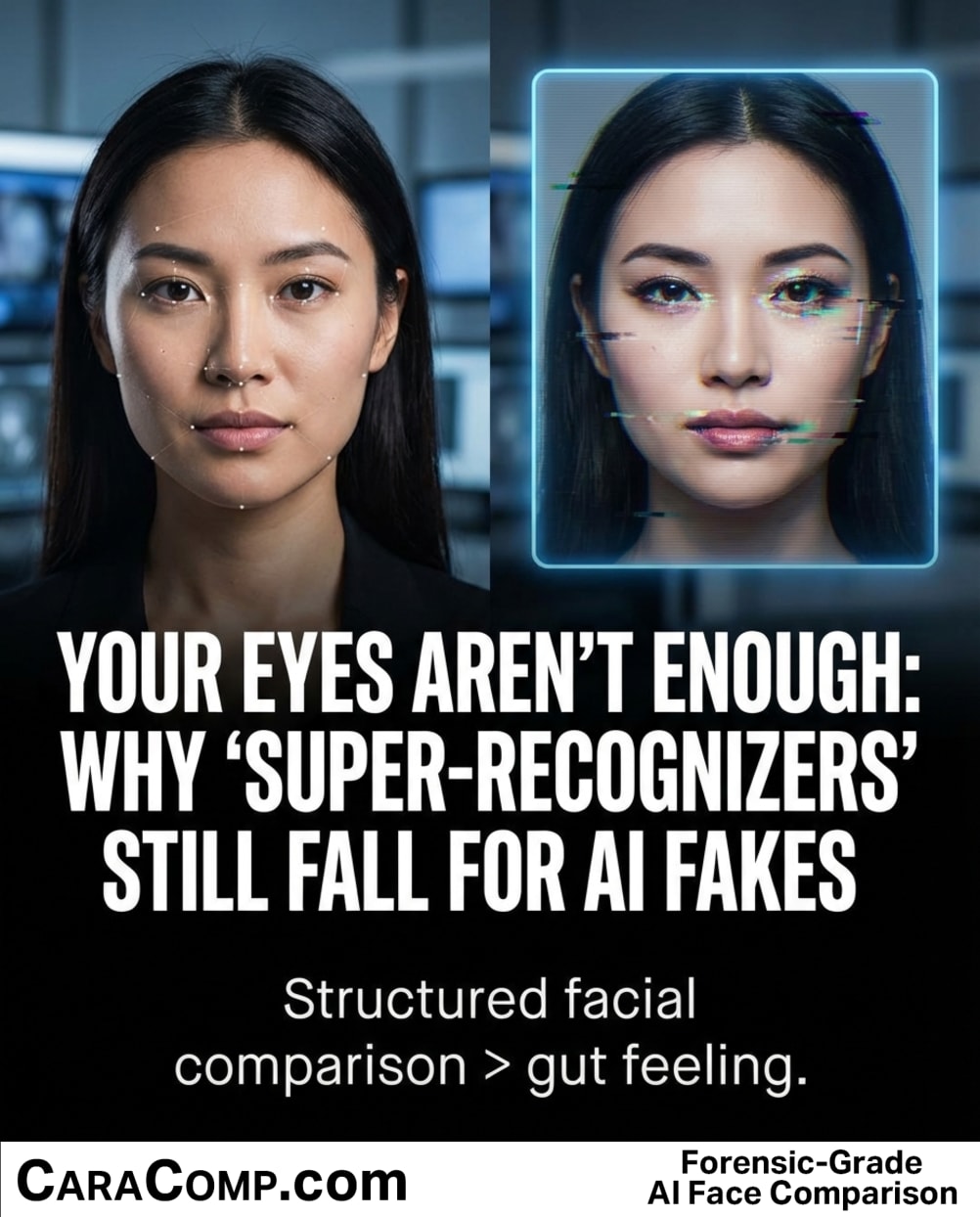
The top 1% of humans naturally gifted at face matching—known as super-recognizers—are statistically more likely to trust a high-quality AI-generated fake than a real human face. While these individuals possess an extraordinary biological ability to encode and retrieve facial data, research shows that synthetic images are specifically engineered to exploit the exact "trustworthiness" markers that human experts use to verify identity. For a private investigator or OSINT professional, relying on natural talent or a "gut feeling" is no longer a viable methodology in an era of sophisticated synthetic fraud.
The article explores why the most confident investigators are often the most vulnerable when they lack technical tools to verify their instincts. To maintain professional standards, the field must shift from subjective recognition to objective facial comparison.
- The Trustworthiness Trap: AI-generated faces are not random; they are mathematically optimized to sit at the center of human facial distributions. This makes them appear more symmetrical and "authentic" to the human eye than actual real-world photos, leading even experts to favor fakes over reality.
- Memory vs. Analysis: There is a critical distinction between facial memory (a biological talent) and facial comparison (a technical methodology). While super-recognizers excel in lab settings, their accuracy plummets when dealing with the degraded image quality, poor lighting, and odd angles common in real-world case analysis.
- The Confidence Calibration Problem: High confidence in a match does not equate to high accuracy. In forensic environments, an investigator’s unwavering "commitment" to a visual match can lead to significant errors if that match isn't backed by quantitative data like Euclidean distance analysis.
- Landmark-Based Verification: To produce court-ready results, investigators must move beyond holistic impressions and anchor their findings to fixed anatomical landmarks—such as canthal distance and nasal bridge width—that remain consistent across different images.
For the solo investigator, the takeaway is clear: your reputation depends on more than just a sharp eye. Professionalism in modern investigation technology requires a transition toward structured, landmark-based analysis. By using tools that provide quantitative similarity scores, you move from a "well-dressed guess" to a defensible, repeatable piece of evidence that can withstand the scrutiny of a courtroom or a skeptical client.
Read the full article on CaraComp: Why Super-Recognizers Still Fall for AI Fake IDs


Comments
Post a Comment