When 99% Accurate Still Means Thousands of Wrong Arrests
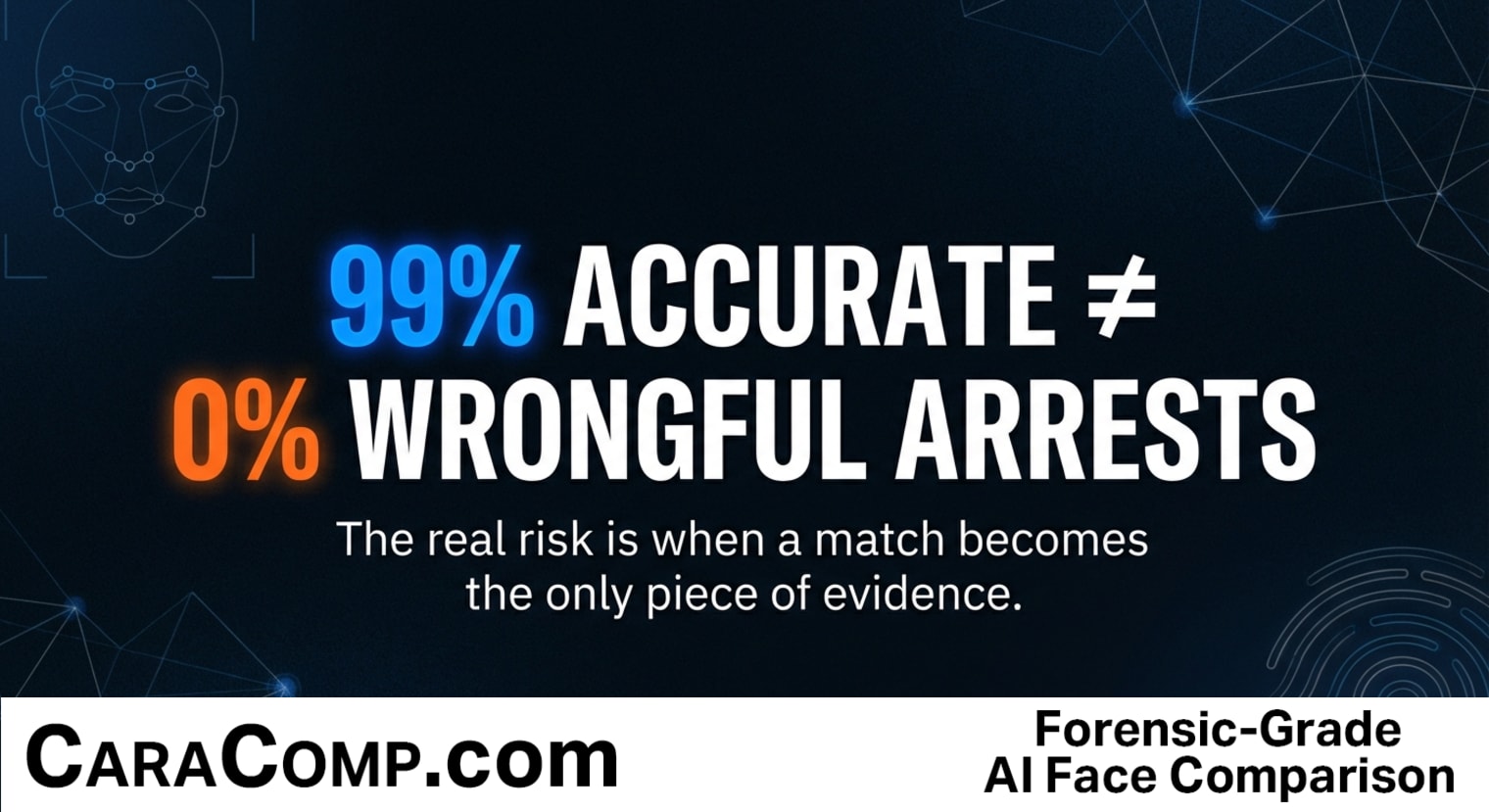
A 99% accuracy rate isn't a badge of honor—it’s a statistical death trap. For a solo investigator or a small PI firm, relying on a "match" from a high-volume surveillance database is the fastest way to lose a license and a reputation. When Brazil’s federal police celebrate a 99% biometric ID rate, they are quietly ignoring the 10,000 false positives that occur for every million comparisons. That 1% margin is where wrongful arrests live, and it’s where "black box" algorithms fail the professionals who use them.
The real crisis in the investigation field is the dangerous conflation of facial recognition and facial comparison. Recognition is what big-government surveillance does—scanning crowds and hoping for a hit. Comparison is what skilled investigators do: taking specific case photos and using Euclidean distance analysis to determine the mathematical probability that two images are the same person. One is a surveillance dragnet; the other is a standard investigative methodology. When investigators stop gathering corroborating evidence because an algorithm gave them a "high confidence" label, the technology hasn't failed—the methodology has.
Solo PIs and OSINT researchers cannot afford to stake their careers on tools that offer "trust me" results without the data to back them up in court. As cases in Delhi and New York prove, a simple match is not a conviction. Professionals need to move away from unreliable consumer apps and toward enterprise-grade Euclidean distance analysis that provides a transparent, defensible audit trail.
- The "Confidence" Fallacy: High-headline accuracy rates mask thousands of errors. Investigators must stop treating a software "match" as a destination and start treating it as a lead that requires quantified data and side-by-side case analysis to be court-ready.
- Comparison Over Surveillance: Professional investigation technology should focus on comparing YOUR photos for YOUR case. Scanning public databases for "recognition" creates liability; comparing evidence for "investigation" creates results.
- The Necessity of Euclidean Distance: To survive cross-examination, a "yes/no" output is useless. PIs need tools that provide a mathematical gradient of similarity, allowing them to present professional, objective reports to clients and counsel.
Don't let your methodology fall behind while the rest of the industry adopts "black box" tools. Real investigation requires professional-grade comparison that fits a solo firm's budget without sacrificing the technical caliber required for high-stakes cases.
Read the full article on CaraComp: When 99% Accurate Still Means Thousands of Wrong Arrests


Comments
Post a Comment