What "99% Accurate" Really Means in Facial Recognition
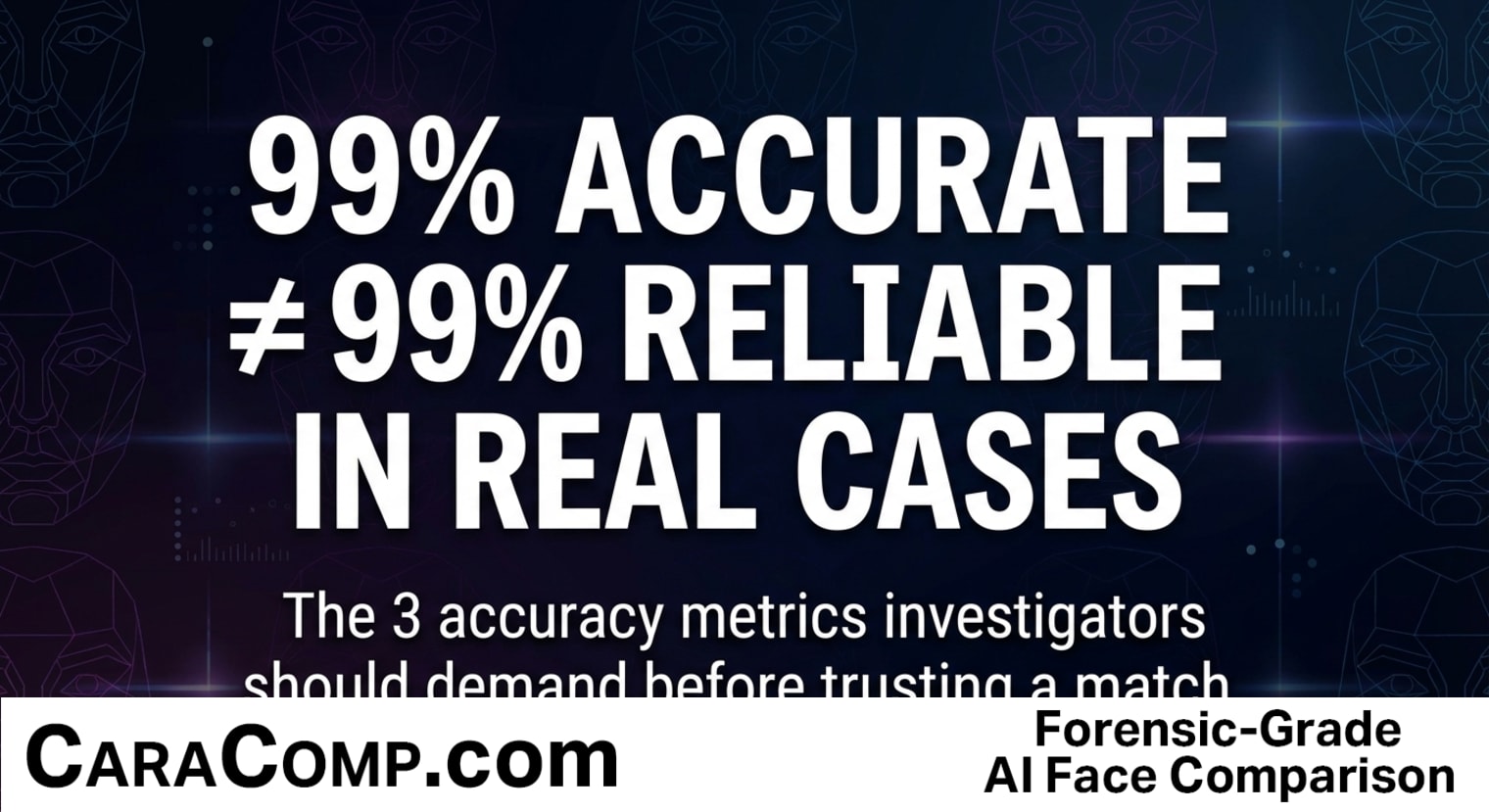
A facial comparison system can boast a 99% accuracy rating in a laboratory setting and still fail to identify one out of every ten genuine matches during a real-world investigation. This discrepancy exists because benchmark tests typically utilize "highway conditions"—perfectly lit, high-quality frontal imagery—that rarely exist in actual case analysis. For the solo private investigator or law enforcement detective, relying on a headline percentage without understanding the underlying metrics can lead to missed leads or, worse, unprofessional results that fail to hold up under scrutiny.
- The Benchmark Trap: Standardized tests often use controlled mugshots, whereas real investigations involve "city traffic" conditions. Factors like grainy CCTV footage, 30-degree head tilts, and environmental obstructions can cause a tool that scores 99% in the lab to drop into the 70% range during actual field deployment.
- The FAR vs. FRR Seesaw: Accuracy is an aggregate of the False Accept Rate (the risk of a wrongful identification) and the False Reject Rate (the risk of missing a suspect). These two are locked in a mathematical trade-off; tightening one automatically loosens the other, a policy decision often hidden from the investigator.
- Demographic Consistency: Aggregate scores frequently mask significant performance gaps across different age, gender, and ethnic groups. Some algorithms have shown false positive rates 100 times higher for specific demographics than for others, making demographic-specific data essential for generating court-ready reports.
- Euclidean Distance Analysis: Professional investigation technology moves beyond simple "matches" by providing mathematical distance scores. This allows investigators to justify their findings with forensic-grade technical precision rather than relying on a vague, black-box percentage.
Navigating these technical nuances is what separates a tech-savvy investigator from those still using manual methods or unreliable consumer tools. Most enterprise-grade facial comparison software is priced for government agencies with six-figure budgets, leaving solo PIs feeling behind the curve. However, the core technology—Euclidean distance analysis—is now accessible without the enterprise price tag or complex API requirements.
Understanding the "why" behind a match is the only way to ensure your evidence remains reliable. By demanding transparency regarding failure modes and demographic consistency, investigators can close cases faster while maintaining the high standards required for professional case analysis. Technology should empower the investigator, providing clear, mathematical evidence that can be presented with total confidence to clients and in court.
Read the full article on CaraComp: What "99% Accurate" Really Means in Facial Recognition


Comments
Post a Comment