What "99% Accurate" Facial Recognition Actually Means for Your Case
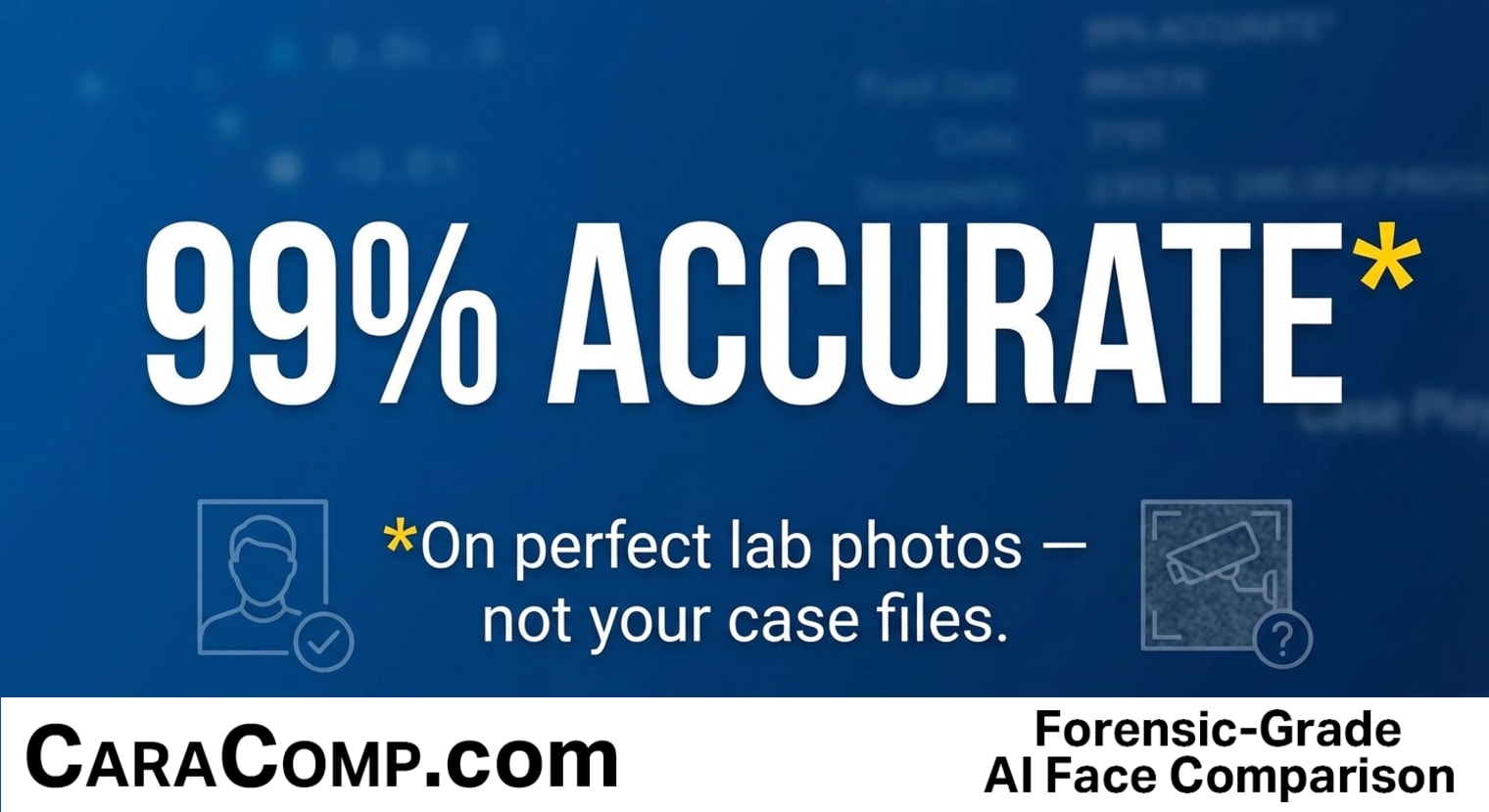
A facial recognition algorithm boasting a 99% accuracy rating can still fail to identify a suspect once in every hundred attempts under perfect, lab-controlled conditions. The moment that same technology is applied to a grainy parking garage CCTV feed or a low-resolution social media grab, that failure rate doesn't just tick upward—it can plummet by as much as 30%. For the private investigator or OSINT professional, relying on "headline" accuracy scores without understanding the underlying data is a recipe for a compromised reputation and a failed investigation.
To move beyond marketing brochures and into professional-grade analysis, investigators must understand these three critical insights from the field:
- The Disparity Between Lab Benchmarks and Field Reality: Most accuracy ratings are derived from tests using high-resolution, frontal "passport-style" photos with consistent lighting. In real-world investigative scenarios involving oblique angles, motion blur, or environmental shadows, even top-tier algorithms experience significant performance degradation. This "Passport Gap" means a lab score is rarely a field guarantee.
- The Tension Between FMR and FNMR: Accuracy is not a single metric; it is a delicate balance between False Match Rate (incorrectly identifying two different people as the same) and False Non-Match Rate (failing to identify the same person). Depending on the case—such as a missing person search versus a fraud verification—an investigator needs to know which failure mode the software is tuned to minimize.
- The "Compression Spiral" and Demographic Variables: Digital evidence often undergoes multiple rounds of compression before it reaches an investigator's desk, stripping away the spatial data required for a high-confidence match. When this data loss is combined with demographic performance gaps found in many standard algorithms, the resulting similarity score can be misleading if not interpreted through a professional facial comparison lens.
True investigative expertise lies in knowing when to trust the technology and when the evidence requires deeper manual scrutiny. By shifting the focus from mass surveillance to precise facial comparison—using Euclidean distance analysis on your own curated case photos—you can generate results that are both mathematically sound and court-ready. Understanding the asterisk next to "99% accurate" is what separates a tech-savvy professional from someone who simply hopes the software is right.
Read the full article on CaraComp: What "99% Accurate" Facial Recognition Actually Means for Your Case


Comments
Post a Comment