The Face Recognition Error That's Wrecking Investigations
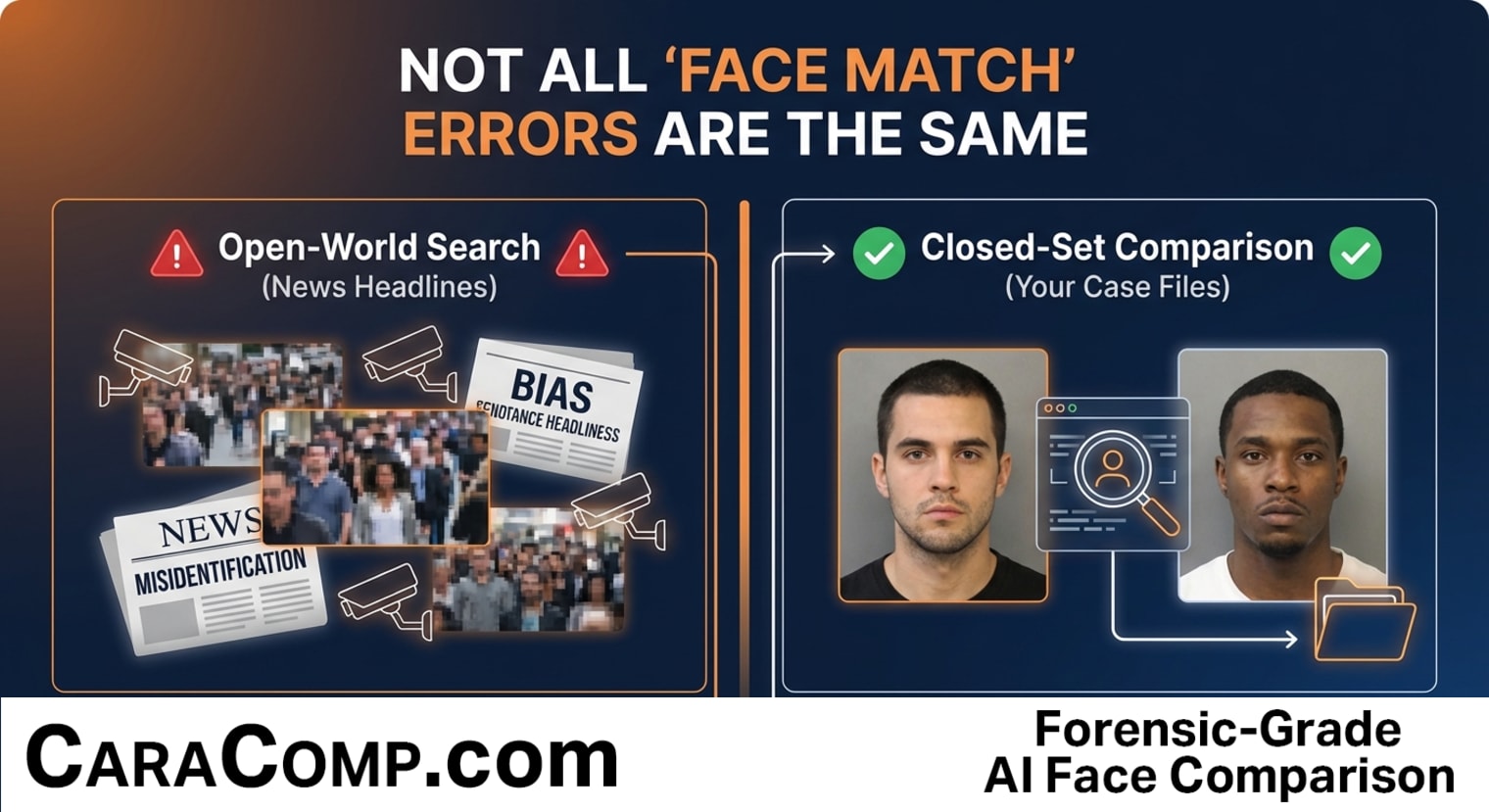
Most "facial recognition" failures reported in the headlines have absolutely nothing to do with the actual forensic work performed by private investigators. There is a massive technical gulf between scanning a stadium crowd to find a needle in a haystack and comparing two specific case photos side-by-side. Biometric science distinguishes between "open-world identification" and "closed-set verification," yet many investigators are losing cases or dismissing powerful tools because they don't understand that these are two fundamentally different mathematical problems. When a headline screams about high error rates, they are almost always discussing mass scanning—not the precise facial comparison utilized in modern case analysis.
Confusing these two categories is one of the most expensive methodological mistakes an investigator can make. While open-world scanning deals with millions of variables and compounding probabilities of error, closed-set verification focuses on a one-to-one similarity score. This process utilizes Euclidean distance analysis to measure the mathematical space between high-dimensional feature vectors. Because the system is only asked if two specific faces match, rather than searching a population of millions, the accuracy ceilings are categorically higher—often exceeding mass-search results by more than 20 percentage points.
- Mathematical Distinction Over Headlines: The errors plaguing large-scale "open-world" scanners (like those used in airports) do not apply to closed-set investigation technology. One-to-one comparison is a stable, scientifically sound methodology that provides a defensible similarity score for case files.
- Euclidean Distance Analysis is the Forensic Standard: Modern analysis relies on measuring facial geometry through high-dimensional vectors. This removes the "guesswork" from manual comparisons, allowing investigators to present findings based on calculated mathematical distances rather than subjective visual opinion.
- The Reality of Demographic Bias: Most documented bias research stems from low-quality imagery matched against massive databases. In a controlled investigative environment using high-resolution photos, the conditions that typically trigger these disparities are largely mitigated, making the results far more reliable for court-ready reporting.
- Professional Terminology Protection: Investigators should distinguish between "recognition" (often associated with controversial public scanning) and "comparison" (a standard forensic task). Using the correct terminology and understanding the problem class protects your reputation and ensures your evidence stands up to scrutiny.
For solo investigators and small firms, accessing this enterprise-grade Euclidean distance analysis was historically impossible due to six-figure government contracts. However, by focusing strictly on facial comparison for specific case photos rather than mass scanning, it is now possible to achieve federal-level accuracy at 1/23rd the cost of enterprise tools. This allows the modern investigator to move away from three-hour manual photo reviews toward automated, professional analysis that is both affordable and court-admissible.
Read the full article on CaraComp: The Face Recognition Error That's Wrecking Investigations


Comments
Post a Comment